
 Version imprimable
Since Babeuf’s Manifesto of the Equals (1796) and the Communist Manifesto (1848), many documents of this kind have emerged throughout the history of the workers’ movement. Some, like Marx and Engels’s in 1848, have influenced generations of readers. Others were quickly forgotten… Despite their differences, they share certain characteristics:
– the wish to bring a new proposal to everyone‘s attention;
– a summary of the main analyses, as well as the programme and strategy of a political movement;
– language accessible to the widest possible audience;
– the interaction between analyses of current economic conditions and the affirmation of some founding principles.
The Agony of Capitalism and the Tasks of the Fourth International, known as the “Transitional Programme”” (1938), can be considered to be a manifesto, even though this term does not appear in its title. The Fourth International designated several other documents as manifestos: for example, in 1948, the “Manifesto of the Second Congress of the Fourth International: Against Wall Street and the Kremlin. For the Programme of the Communist Manifesto. For the World Socialist Revolution” was published, which undoubtedly marks a turning point compared to what Leon Trotsky had envisioned in 1938 [1]. The same observation applies to “Socialism or Barbarism. On the Eve of the 21st Century. Programmatic Manifesto of the Fourth International” from 1992 [2], which acknowledges the demise of so-called “real socialism.”
A manifesto of our time
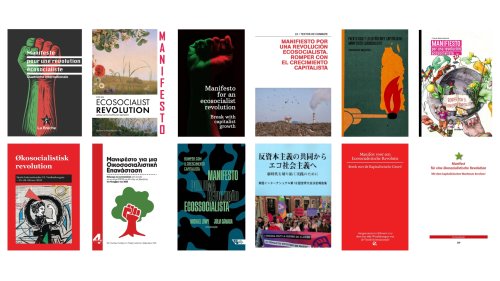
The new “Manifesto for the Ecosocialist Revolution” seeks to outline ways of understanding and acting in the face of the challenges of our time. It naturally shares much in common with those of 1938, 1948, and 1993: like them, it offers a Marxist analysis of the current situation—economic, social, and political—a “transitional programme” (according to the method defined by Trotsky ), a revolutionary strategy, and a socialist horizon. However, it also presents distinctive features that set it apart from the previous texts.
While the 1938 Transitional Programme was written by Leon Trotsky and the 1993 Manifesto, to a large extent, by Ernest Mandel, the new Manifesto of the International is the product of a collective effort, which lasted more than a year, and in which comrades from the Global North and South were involved, under the coordination of Daniel Tanuro.
The 1938 Manifesto asserted that “Mankind’s productive forces stagnate. Already new inventions and improvements fail to raise the level of material wealth.” This constituted, according to the document, an “economic prerequisite” of the proletarian revolution. Whatever one might think of the validity of this judgment in 1938, in the postwar period it could no longer be denied that the productive forces continued to grow and that, within the framework of capitalism, there was indeed a “rise in material wealth” —albeit usurped by a minority of exploiters [3].
However, in 2025, according to the new Manifesto, this “rise in material wealth”, this boundless and limitless capitalist growth, is precisely what must be fought: “break with capitalist growth!” It is also a break with a certain conception of progress, material wealth, and the “development of the productive forces”. This change is the expression of an obvious fact: the ecological crisis represents, in 2025, an existential threat to humanity, which was not at all the case in 1938.
The place of ecology
The Fourth International gradually became aware of the ecological challenge. Absent from the manifestos of 1938 and 1946, the issue is present in the 1992 manifesto, but in a limited way: it is one chapter among the document’s 22, and it focuses primarily on pollution and the depletion of natural resources. [4] The turning point came in 2003, at the 15th Congress, with the resolution “Ecology and Socialism”, the first in the International’s history to have the ecological crisis as its central theme. The term “ecosocialism” also appears here for the first time, to describe one of the currents of the ecological left, with which it identifies.
Breaking with the productivist ideology of progress – in its capitalist and/or bureaucratic form (known as “real socialism”) – and opposed to the endless expansion of a mode of production and consumption that destroys the environment, ecosocialism represents, within the workers’ movement and in ecology, the tendency most sensitive to the interests of workers and peoples of the Global South, the one that has understood the impossibility of “sustainable development” within the framework of the capitalist market economy [5].
The 2003 document also outlines a critical assessment of the Fourth International’s delay in understanding and addressing the ecological question. A section entitled “The Fourth international and the Ecological Crisis” is devoted to this “self-critical” assessment:
But, as was the case for most parties in the workers’ movement, our International failed to take it up in the first years of its existence. For example, it would be useless to look for it in the Transitional Programme, the basic programmatic document of the 1938 founding congress. In the period following the Second World War, revolutionary Marxists did not ignore environmental destruction or air and water pollution. However, these phenomena were seen as one of the negative consequences of an exploitative, inhuman system and not viewed as a global phenomenon threatening to destroy the very basis of all life. [...] Most of the sections only started pondering ecological questions when they made the headlines in the news following actions by other forces. As a result, the debate within the International has taken shape rather slowly. While other currents and individuals have been discussing the question of ecology and socialism for many decades, revolutionary Marxists have remained relatively silent.
Another important step forward was taken at the 17th Congress in 2018, when ecosocialism was adopted as the International’s guiding principle – it appears in the title of the resolution: “The Capitalist Destruction of the Environment and the Ecosocialist Alternative.” The document was dedicated “In memory of Berta Caceres, indigenous activist, ecologist and feminist from Honduras, assassinated on the 3rd of March 2016 by the henchmen of the multinationals and in memory of the martyrs in the struggles for environmental justice.”
The question of degrowth
This resolution already laid down the imperative of degrowth “a global reduction of material production is necessary” (point 3.2).
In the 2025 Manifesto, degrowth is an unavoidable necessity. It is affirmed from the very title of the document, which recalls the imperative to “break with capitalist growth”. Just, ecosocialist, degrowth, however, takes into account unequal and combined economic development: “Global final net energy consumption must decrease radically – which means producing less and transporting less globally – while increasing energy consumption in poorer countries to meet social needs.” [6]
That said, poor countries can also contribute to global ecosocialist degrowth by eliminating conspicuous consumption by the parasitic elite, by fighting against ecocidal megaprojects and the destruction of biomes by agribusiness and the mining industry.
The 2025 Manifesto builds on the achievements of the environmental resolutions of the previous two decades, but it differs in several aspects:
• acute awareness of the danger: ecosocialism is necessary if we want to “save humanity from an ecological catastrophe without precedent in human history”.
• the need to “update the analyses of revolutionary Marxism”.
• the recognition of the need for a “reformulation” of our programme and strategy, a true “refoundation” of the socialist project.
• henceforth, overcoming the “metabolic rift” (Marx) between human societies and nature, and respecting ecological balances, “are not just chapters in our programme and our strategy, but its common thread”.
• a more sustained reflection on our project for an alternative civilization, “the world we fight for” (Chapter 2).
The “Manifesto for the Ecosocialist Revolution” is the most systematic and in-depth document of the Fourth International in the twenty-first century. But it does not present itself as "the final word." It is intended as a contribution to the debate, open to discussion and criticism.
26 September 2025