
 Version imprimable
The Master-Vorcaro scandal [2] dominates the political and electoral landscape. On one hand, it exposes the state of decay into which the Brazilian political regime has sunk. On the other, it serves as the basis for a manoeuvre orchestrated by André Mendonça [3] —at the behest of the United States—to taint and confuse public opinion, shifting political momentum toward the Bolsonaro camp and even reviving the possibility of a Flávio [4] election victory. Uncertainty remains the prevailing feature of the electoral contest.
New developments reinforce this uncertainty: Fachin attempts to mediate the crisis, Dino reveals the secret surrounding Dark Horse, and accusations against Mendonça flood the news. [5] We must prepare for the current political crisis in order to grasp the profound significance of these events and regain the initiative ahead of the elections.
Sovereignty, Trump and Brazil
The Brazilian elections are among the most important in the realm of international geopolitical competition, surpassed only by the United States midterm elections, which will be held in November.
What is unfolding here is a specific manifestation of the international situation, marked by the geopolitical struggle of a hegemonic imperialism in crisis; the rearmament of core nations, which present war as a possible way out; the neocolonialist offensive of that same imperialism; climate chaos—the result of environmental destruction—and the use of AI to maximise the profits of billionaires and further control those who live by their labour.
All these factors are a direct consequence of the brutal and multifaceted crisis of capitalism. Trump needs to assert control over Latin America. This is a fundamental necessity, all the more so given the pressures he faces on three main fronts: the quagmire in the Middle East following the defeat regarding Iran; the looming electoral defeat that would isolate his administration within the United States; and the need to uphold the tenets and promises of the Monroe Doctrine in Latin America. These three factors—the crisis and defeat in Iran and the Middle East, the domestic electoral defeat, and the conflict in Latin America—are intrinsically related.
To this end, Trump is resorting to extreme measures born of desperation and interventionism. He even went so far as to promise US$5,000 —to every U.S. citizen in the event of his victory. Alternatively, to avert the collapse of the Milei project in Argentina—which is suffering a drop in popularity—he promised to reclaim the Malvinas Islands, a long-held aspiration of the average Argentine citizen. This unrestrained Trump seeks to defeat Lula in October, following the script of recent elections in Peru and Colombia.
In this way, the plebiscitary nature of the Brazilian elections is reinforced in almost every respect, but especially regarding sovereignty.
Threats to Pix (Brazil’s instant payment system), control over natural resources and rare-earth elements, and rising tariffs are the prelude to a strategy to turn Brazil into a protectorate—a process that would be facilitated by a new government led by the Bolsonaro clan, with an orientation directly subordinate to the neocolonialism of Trump and the billionaires backing him. The far right’s victory in the German regional election underscores this danger, as it demonstrates the level of international coordination possessed by neo-fascism—with Musk as one of its leading agitators, alongside figures such as Peter Thiel. [6]
Danel Vorcaro and electoral dynamics
Lula’s lacklustre re-election campaign took a significant turn a few months ago when a series of crises shifted the spotlight onto his main rival, Flávio Bolsonaro. Revelations stemming from Federal Police investigations regarding deep ties between Vorcaro and the Bolsonaro clan weakened the far-right candidate amidst the “Bolsón or Banco Master” scandal, which was linked to the financing of the film “Dark Horse”.
Isolated within his campaign circles and facing tensions even with Michelle Bolsonaro and other allies, Flávio began the campaign on the defensive, while Lula—albeit without much enthusiasm—was identified as the frontrunner by analysts across various electoral indices. The structural key to this progress was the agreement reached with Davi Alcolumbre of the conservative União Brasil, (Brazil Union or UNIÃO), which "pacified" relations in Congress.
The situation has shifted, turning unfavourable for Lula in recent weeks following André Mendonça’s decisive move to attack Alexandre de Moraes—a key figure providing stability to the reelection bid and the preservation of the "New Republic." Moraes had already been targeted by the far-right and anti-Supreme Court factions due to his principled stance against coup plotters and resistance to Trump’s blackmail; now, he has come under fire over his questionable ties to Vorcaro. Calls for his resignation have resurfaced, now backed by sectors of the liberal establishment itself, such as the newspapers Folha and Estadão.
The situation has worsened for Lula. Opinion polls show a decline in his approval ratings, electoral figures, and support from allies in certain states; this was compounded by a renewed initiative led by Flávio—joined by Tarcísio de Freitas, Michelle Bolsonaro, and Nikolas Ferreira, all standard bearers for the Brazilian right —who called for the September 7th rally during an election broadcast.
The event drew approximately 30,000 people to Avenida Paulista—a figure far lower than that which the Bolsonaro movement managed to gather at its peak—but it repositioned Bolsonaro’s political initiative, steering his thousands of activists across Brazil toward a firmer stance. The segment of the bourgeoisie that does not support Bolsonaro—with its various strains of conservatism—has failed to find an alternative: Ronaldo Caiado and Romeu Zema are drifting toward political oblivion due to a lack of votes; Renan Santos has yet to launch a project capable of challenging the far-right’s hegemony; and the newcomer, Augusto Cury, initially boosted by internet bots, appears to be stalling, having slipped in recent opinion polls.
The most recent Datafolha poll indicates that the gap between Lula and Flávio is narrowing (39% versus 35% for the first round—a statistical tie within the margin of error for the second round); it also points to a rise in governors aligned with Bolsonaro and growing opposition to Lula. Another, more recent Datafolha survey shows that 37% want Mendonça removed from office, while 34% want Alexandre de Moraes, Jtsice of the Supreme Federal Court, removed.
Amidst this uncertain landscape, the struggle to shape the liberal-right’s political agenda centres on controlling the next government—securing further commitments from the future coalition administration, the legislature, and the Supreme Federal Court in the event of a Lula victory. Their programme calls for severe fiscal austerity, a policy of equidistance in trade relations with the United States, China, and the EU, a freeze on the minimum wage and social benefits, and the opening of public services, state-owned enterprises, and natural resources to private capital.
What remains to be seen
The current situation, which has fuelled controversy, is not definitive. Bolsonaro’s undeniable offensive in recent weeks is not absolute. At least three important factors indicate that the outcome remains open—unlike in 2018, when the offensive that began with the September 7 stabbing [7] propelled Bolsonaro and the far right into action.
The most significant development so far is that the counter-offensive has been launched from within the Tribunal Supremo Federal (Supreme Federal Court or STF) itself, without waiting for the September 15 plenary session to debate Moraes’s role. The breach of confidentiality regarding the "Banco Master Case"—specifically concerning the use of the film “Dark Horse”, a key electoral asset—sparked a series of accusations. This provided potent ammunition for the campaign, clearly demonstrating André Mendonça’s selectivity and turning him into a target just as contentious as—if not more so than—Moraes.
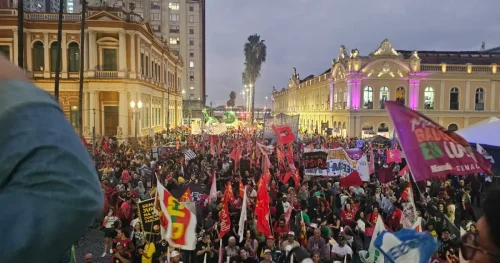
The second aspect—albeit a slow-moving one—was an increase in participation in anti-Bolsonaro activism, as evidenced by the Lula rallies that drew 10,000 people in Porto Alegre, 12,000 in Curitiba, and 2,000 to the weekend march in Brasília; but this was particularly apparent in the analysis of networks and interactions, which shifted the majority of references regarding the Master/STF case toward the Left and its key figures.
The third element is polling uncertainty, involving Centrão (center-right bloc) candidates in the states—or even those linked to Cury’s constituency—as well as undecided voters and those unwilling to vote; this helps explain the high disapproval rating for Flávio (who ties with Lula in this regard in the latest Datafolha poll, at 46%). How will the interplay between state-level scenarios and the national race unfold? This question is significant given the uncertainty surrounding the proportional and Senate elections—the latter being highly contested and unpredictable due to the two-vote system and the fact that current poll leaders still hold relatively low support, mostly in the 15% to 25% range.
For Bolsonaro, winning in as many states as possible in the first round is crucial. Lula needs to secure his vote in the Northeast and in the country’s major capital cities. For instance, ensuring strong results for his candidates in the North and Northeast—and forcing a runoff in strategic states like São Paulo, Minas Gerais, and the Federal District—will be key to shaping the dynamic. The most complex case is São Paulo, where Tarcísio has a real chance of winning in the first round, and where Fernando Haddad and the PT are struggling to mount an effective response.
What is certain is that polarisation will increase in the coming weeks, accompanied by a certain degree of aggression on the streets and at events, as well as heightened politicisation and the battle for votes. The far-right, led by Nikolas, mobilised thousands of people in Amapá to attack and humiliate Alcolumbre.
Lula’s victory is fundamental and will mark the start of the political battle over the next fifty days—alongside the votes we cast for proportional representation, where we will present our leaders and our platform. Lula needs an intense campaign, outperforming Flávio by at least eight or ten points in the first round, to be well-positioned for the runoff; the latter will undoubtedly be the most hotly contested and polarised in recent political history, thereby taking on crucial importance.
The campaign needs to mobilise activism now—reaching beyond spontaneous activists and paid campaign staff—to elevate the debate surrounding the plebiscite and engage undecided voters and those reluctant to vote across all regions of the country. This entails occupying every public space and increasing the visibility of activities—ranging from simple initiatives like information booths to joint city gatherings and events with candidates from major parties—as well as preparing a social media strategy to capture attention across all platforms.
Once again, the plebiscitary nature of the election is fundamental. What is crucial is to raise the tone and define the election as a plebiscite. There is no tied or middle ground: either Lula wins, or we will have the worst government in history, leading to a dangerous political situation.
In this instance, two campaign strategies clash: the one led by the PT (Workers’ Party) majority—spearheaded by Lula and his central campaign team—versus a strategy of heightened polarisation centered on mobilisation, which involves raising the tone and relentlessly attacking Flávio and his project. The government’s apologetic view, which focuses on its achievements and successes, presents an unrealistic picture of Brazil given the socioeconomic crisis. The resolution adopted by the PT’s Executive Committee—criticised even by the party’s left wing, such as Valter Pomar—proves insufficient because it relies solely on the Supreme Federal Court (STF) and the previous strategy, despite acknowledging the need to intensify mobilisation.
The PSOL is playing an important role, especially through its candidates. The party’s overall strategy should be to mobilise the population, raise the tone, attack Bolsonaro, turn the debate into a referendum, and present a vision for the future.
It is necessary to resume the political struggle and push the campaign forward with renewed vigour. The majority of the working class lives in precarious conditions—holding insecure jobs devoid of rights and facing high levels of debt amidst a rising cost of living. We must frame these hardships as demands and demonstrate that Flávio is not anti-establishment. Mendonça used the Supreme Court crisis to downplay the debate over the "6x1" work schedule [8], which is stalled in the Senate and barely mentioned in the media.
We need to frame this as a plebiscite on four issues, distilled into a single vote: Will Brazil become a U.S. colony? Will workers work one day less per week? Will the country minimise violence against women? Will climate change denial make us more vulnerable to El Niño?
And alongside that—as we have already begun to do—we keep emphasising who Flávio and his cronies really are: the dire economic hardship, the nearly one million pandemic deaths, the cost of food in supermarkets, the widespread corruption, the militarisation of the government, the fires in the Amazon and the Pantanal, the nefarious coup plotters of January 8th, the threat to Pix (Brazil’s instant payment system), and the humiliation before Trump. We emphasise the relationship with Vorcaro—the banker behind the bacchanals and the most expensive film in cinema history—as well as the connection to Eduardo Bolsonaro and the strategic selection of André Mendonça as his operative. We maintain that Flávio deserved to join his father in Papuda Prison rather than entering the Planalto Palace, the workplace of the Brazilian president through the front door. This could come about in various ways, such as PSOL’s Sâmia Bomfim’s request to the Federal Police to confiscate the genocidal son’s passport.
And gradually, raise the level of engagement. Call for the coordinated distribution of leaflets and for community cleanups in the city’s largest neighbourhoods and transit hubs; involve more people; and break the bureaucratic inertia that characterises some of the PT (Workers’ Party) campaigns. Our role as PSOL is to be at the forefront of this struggle and to elect strong, active representatives from PSOL and the federation.
PSOL’s place
PSOL is running major campaigns in the states where it holds parliamentary seats, with the federation [9] formed alongside Rede contesting Senate seats in Rio Grande do Sul, São Paulo, and Ceará, in addition to being well-positioned in Rio de Janeiro with Mónica Benício, where Benedita da Silva is leading the polls. PSOL is objectively gaining strength. PSOL should advocate for a shift in Lula’s campaign strategy; in addition to Lula’s correct stance of “investigating everyone, to the very end, regardless of whom it hurts,” the party should argue for raising the tone, organising mobilisation, proposing plebiscites, and launching a comprehensive offensive against Flávio.
On social media and in the streets, PSOL stands out as a key player in mobilising the left-wing electorate. It must engage with the youth and the working class to champion its platform. To win, it is essential to secure votes for the PSOL—votes for "number 50", the official electoral number used by the party on voting ballots, and for candidates with a real chance of being elected to the Federal Chamber and the legislative assemblies. Furthermore, it is crucial to strengthen the campaign in Sergipe, Santa Catarina, Espírito Santo, and Paraíba—states that have the potential to surpass the 1.5% vote threshold and thereby clear the electoral hurdle.
Our policies
Our struggle must combine broad-based demands—such as the "6×1" work schedule, sovereignty, the fight against violence towards women, and the climate emergency—with our own programmatic stance. This includes advocating for transitional measures such as free public transport; taxation of large fortunes; regulation of social media and the digital sphere; environmental protection through an eco-socialist programme; curbing the betting industry and financial capital; amnesty for indebted families; defense of the minimum wage, moving towards the "DIEESE wage" standard; rent controls (as we are demanding in the Federal District); defense of state-owned enterprises and the re-nationalisation of essential services like water and rail transport; national control over rare earth elements and critical minerals; and investment in and defense of the SUS (Brazil’s public health system).
Our strategy to drive street protests consists of cracking down hard on Flávio, exposing Bolsonaro’s disastrous administration, leveraging the tension surrounding the Supreme Court to channel energy into street protests (during both the first and second rounds), and supporting strikes by postal and Caixa Econômica Federal workers, alongside our own election campaign activities. In this context, we must address the fact that the Supreme Court crisis demands profound changes—something not to be confused with the fact that Moraes belongs to a class enjoying exorbitant salaries and powers; a class that played a progressive role in confronting the Bolsonaro clan and Trump, yet embodies the selective, elitist democracy of the wealthy.
We must advocate for profound changes, for a radical political reform. We advocate for a different institutional framework and a different judiciary—indeed, for a covert political revolution that establishes new criteria for the selection and oversight of judges, transparency in decisions and terms of office, an end to parliamentary amendments, and other concrete measures.
In this battle, we will work to engage and recruit activists, bringing them into PSOL and the MES by leveraging our presence and local cells in workplaces and schools. The new edition of “Retomada” magazine will be published soon, serving to rally a critical, radical, and anti-capitalist force. We recognise that this is part of an international political struggle—working to halt Trump’s offensive in Brazil and standing at the forefront of the fight against neo-fascism, just as we did at the First International Anti-Fascist Conference earlier this year.
We will take to the streets, to social media, and then to the polls to defeat the far right. This is the most important political battle between now and October 6.
15 September 2026
Translated and annotated by David Fagan for International Viewpoint from Punto de Vista Internacional.