
 Version imprimable
Antoine Larrache: What happened during the abduction of Maduro and his partner?
Franck Gaudichaud: Quite a few elements and details remain unknown, even more than a month later, but we are clearly facing a large-scale imperialist aggression and, quite literally, a coup d’état, which took place on the night of January 2–3. Venezuela was bombed with an unprecedented military deployment (with more than 150 aircraft and helicopters operating simultaneously). It is the first time that a South American country has been bombed in this way (let us recall the most recent interventions in the Caribbean and Central America, against General Noriega in Panama in 1989, or the invasion of Grenada in 1983, which was preceded by the arrest and execution of Prime Minister Maurice Bishop).
The U.S. had a massive military presence in the Caribbean for several months, including the deployment of the world’s largest aircraft carrier, the Gerald Ford, along with an entire armada, all under the pretext of fighting drug trafficking—an operation that resulted in several extrajudicial killings and the bombing of boats. The possibility of an intervention was ultimately confirmed. Special forces landed on the ground during the operation and destroyed several strategic and defensive points in Venezuela. The near-total absence of organized and centralized defense, particularly anti-aircraft defense, by the Bolivarian National Armed Forces (FANB) made it possible to capture and detain, in record time, the sitting president Nicolás Maduro and his partner, deputy Cilia Flores, who were then “extracted” and deported to the United States. They were presented before a judge in New York on fabricated charges, including accusations of leading a “narco-state.”
This military operation, which violates Venezuela’s sovereignty and—of course—all international law (which is the least of Trump’s concerns), marks the beginning of a brutal attempt to recolonize the country and perhaps even to establish a protectorate in the medium term, if we are to believe the first statements coming from the White House. Within the context of the prolonged crisis of capitalism, the decline of U.S. global hegemony, and the violent reorganization of the inter-imperialist system, Trump’s objective is to bring the entire hemisphere to heel, using or threatening to use the largest military-industrial arsenal humanity has ever built. It is also, more directly, about regaining control over Bolivarian Venezuela and preparing the colonial plundering of the country’s vast heavy oil reserves.
AL: According to your information, what has been the attitude of the state apparatus and the ruling layers in Venezuela following this operation?
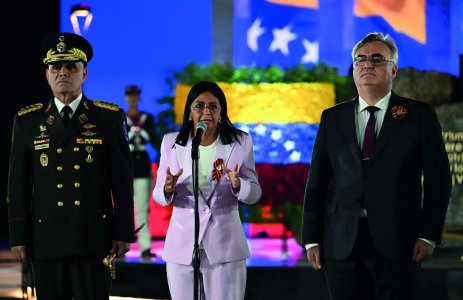
FG: It is still in the process of reorganization. What we can clearly observe — and what our contacts on the ground confirm — is that following the detention of the president and his partner, there has been continuity within the Madurista state apparatus, now embodied by the figure of interim president Delcy Rodríguez. Both military and civilian leaderships, the upper levels of the bureaucracy, leaders of the PSUV (United Socialist Party of Venezuela), and the various factions of the Bolivarian business bourgeoisie appear to be closing ranks… for now. Of course, what is decisive here — and will continue to be — is the attitude of the army, the pillar of Maduro’s political control, particularly since the crises of 2014 and 2017–2019.
For now, we see the main leaders of what had been Madurismo in power since the death of Hugo Chávez in 2013, on Delcy Rodríguez’s side. First and foremost is Diosdado Cabello, the regime’s strongman, who controls the police, maintains very strong ties with the army, and also with China. The Minister of Defense and Chief of Staff, the seemingly untouchable Vladimir Padrino López, has expressed his support (he was not dismissed despite the January debacle), as has the president’s brother, Jorge Rodríguez, one of the key figures of Chavismo and then Madurismo, now president of the National Assembly. There are nevertheless debates about the extent to which a sector of the regime may have dropped Maduro beforehand and struck a deal over the ongoing transition, in the face of maximum pressure from the United States and the repeated failures of negotiations with Trump.
A whole segment of the existing bureaucracy, particularly high-ranking military officials, has economic interests in oil and mining extraction to protect, as well as their own impunity to negotiate in the event of regime change… But how much room for maneuver do they have now (especially in the absence of a broad, autonomous national popular resistance movement)?
The fact remains that there was no immediate politico-military capacity to respond to what was, at the very least, an anticipated or possible aggression by the Pentagon — despite armed forces supposedly on permanent alert. Several billion dollars had been invested in Russian and Chinese equipment, particularly to protect Caracas and its airspace, with anti-aircraft defenses and sophisticated radar systems over recent years. Everything appears to have been neutralized beforehand. There are therefore many unknowns from this perspective, but there was no coordinated national defense movement. Does this indicate limited internal active or passive complicity, a breakdown in the chain of command, or a strategic passivity by the General Staff while awaiting a reorganization of power? Debates are raging at Miraflores Palace, and rumors and fake news are also being feverishly fueled by Washington’s services to maintain control. Those who paid the highest price for this debacle were more than 100 people (civilians and military personnel), including members of Maduro’s personal guard and particularly 32 Cuban agents killed in the confrontation.
As for Delcy Rodríguez’s position, she confirmed the establishment of a state of exception. We are therefore far from any perspective of opening or democratization, quite the opposite, even if several political prisoners have also been released, including the opposition figure Enrique Marquez. If approved by parliament, it would allow — under certain conditions — the release of several hundred political prisoners. The bill officially acknowledges the existence of prisoners of conscience in Venezuela (detained for political offenses or for “criticism of public officials”). Though it should be noted that the law does not cover murders or aggravated violence, particularly those committed by the far right, nor does it cover corruption (which is rather positive). This amnesty proposal is also the product of intense mobilization by several collectives of families of detainees.
More broadly, however, the Rodríguez siblings seem to be confirming what Trump and Marco Rubio proudly announced at their press conference immediately after the aggression: They would be willing to usher in a new era of “cooperation” with the United States, particularly to facilitate the “reconstruction” of the oil industry under imperial oversight. Their room for maneuver is admittedly limited. Internally, however, the president has repeated that the goal is to safeguard the country’s sovereignty; she is officially demanding the immediate release of Maduro and Flores and adopts anti-imperialist rhetoric in her televised speeches. Yet CIA director John Ratcliffe was received in Caracas and even awarded a medal! And Trump announced that he was canceling any further attack because “the United States and Venezuela are now working well together.”
AL: To what extent can a “Madurismo without Maduro” be organized, under pressure from imperialism and in collaboration with Trump? Why have there been no significant mobilizations of Chavistas and popular bases?
FG: It was believed that Trump’s main option was that of regime change, placing the ultra-conservative, neoliberal, pro-U.S. opposition embodied by Maria Corina Machado and the 2024 presidential candidate Edmundo Gonzalez, who was disqualified following electoral fraud, on the “throne.” But Machado has been publicly humiliated and sidelined by Trump, at least for now: and the gift of her Nobel Peace Prize medal to the autocrat of the United States will not change much! Trump’s gamble is therefore clearly to rely on the state apparatus and Madurismo, calculating that they control the country, noting that they retain the essential support of the army and also real (albeit diminished) social bases: popular Chavism, whose potential resistance must be channeled. This would be accompanied by considerable political, military, and economic threats and pressure. Washington’s calculation is that Corina Machado and Edmundo González would not be able to radically reorganize the country in the short term without direct support from imperialism, including ground troops. An Iraq-style scenario is unthinkable for Trump and would be too costly, including domestically, given that his MAGA base is highly critical of military invasions, that the situation in the United States is tense, with major struggles underway (against ICE in particular), and since the midterm elections are coming up in November.
AL: It is quite surprising that the state apparatus and the “bolibourgeoisie” are capable of navigating such an upheaval.
FG: Everyone is waiting to see what happens. The interim Venezuelan government, as I said, is blowing hot and cold, including in relation to its own population. But the collapse is shocking, especially for those who thought that massive national anti-imperialist resistance, fueled by years of the “Bolivarian Revolution,” was possible. Fear and uncertainty dominate at this stage, and while there have been demonstrations in support of Maduro’s release, they have remained relatively timid. This is not so surprising. On the one hand, there is the immense military asymmetry and maximum political pressure exerted by U.S. imperialism, in a regional context that is, moreover, hostile. On the other, for more than a decade, we have witnessed the authoritarian disintegration, political collapse, and economic destruction of Chávez’s country and of what the Bolivarian process and its progressive, national-popular, and anti-imperialist impulse had embodied in the 2000s.
Madurismo exacerbated the most problematic aspects of Chavismo and consolidated a Bolibourgeoisie caste in power, a new oligarchy that has accumulated foreign currency from oil and mining extraction and certain state assets through dispossession and corruption. After repressing (often violent) demonstrations and conservative pro-imperialist opposition sectors, temporarily closing the elected parliament, and concentrating power in the executive branch, Maduro did the same to the left-wing opposition, against former allies (notably the PCV, Venezuelan Communist Party), imprisoning trade unionists and former Chavista leaders and ministers. The internal situation, exacerbated and worsened by years of U.S. blockade and unjust sanctions, has led to the exile of 8 million Venezuelans (out of a population of 28 million!).
Despite this there has been a slow and steady macroeconomic recovery in recent years, embodied by the very pragmatic management of Delcy Rodríguez, who is responsible for oil extraction, among other things. However, as several Venezuelan trade unions have denounced, Maduro’s economic policy and labor rights resemble more a neoliberal dystopia, with the destruction of all fundamental rights and a headlong rush into extractivism with catastrophic ecological consequences, than “21st-Century Socialism.” A broad trade union front had even planned to hold strikes and demonstrations in mid-January, but this plan was thwarted by Trump and his warmongering.
Under these circumstances, the absence of conditions for a broad, multi-party anti-imperialist resistance, with a popular base mobilized behind a legitimate national government, is glaringly obvious. And the Trump administration is well aware of this. We are not at all in April 2002, when Hugo Chávez suffered a coup d’état, supported by the CIA and local business leaders, and was “saved” by a very strong popular mobilization, while the military showed its willingness to reject this pro-imperial coup.
Are there still sections of the civil-military apparatus that remain rooted in this nationalist-populist perspective and ready to resist the new colonial rule? Popular Chavismo, critical left-wing movements, trade unions, and social movements have been considerably weakened, with some demoralized and others co-opted. However, memories of early Chavismo remain, and here and there, collective community experiences are still alive. Nevertheless, it seems that a significant part of the population, with a great deal of resignation, believes that this new crisis could perhaps loosen the stranglehold on the country and that the arrival of U.S. capital could lead to an economic rebound, or even the return of millions of exiles.
Will we see the establishment of a kind of forced co-management and “pro-imperial” collaboration on the part of a section of the Bolibourgeois cast to to save its interests (which is in fact unlikely in the long term), while continuing to run the country in this quasi-protectorate context? There is no question of transition, or even elections, in the short term. But it is already being considered by everyone in the medium term. Is a nationalist response by the government conceivable? In any case, the new hydrocarbons law defended by Rodriguez as a step forward which has just been approved, greatly deepens the liberalization that Maduro had begun in recent months. It radically challenges the state’s sovereignty over the resource, as well as the orientations of the 1999 Bolivarian constitution, to the benefit of U.S. multinationals. This is a historic setback! The United States will decide on extraction. They have announced that they will start by confiscating 50 million barrels for their own benefit and that part of the future dividends from oil exploitation will be placed in Qatar and returned in dribs and drabs to run Venezuelan public services, at their discretion.
Under these circumstances, what will be the capacity of the working classes to reorganize autonomously in order to reject Trump’s control and demand real democratization of the country, in this new context of colonial oppression, after years of immense material precariousness and authoritarian abuses? This is a key question.
AL: Trump explained that he wanted to recover what had supposedly been stolen from the United States in terms of oil resources.
FG: Trump announced without mincing words the destruction he wanted to wreak and his intention to regain control of the country. Historically, since the discovery of oil and the first wells in 1914, and especially during the golden age of extraction in the 1960s under the control of Yankee multinationals, these companies have been able to reap the full benefits of oil extraction, with huge, excessive profit margins, much more than, for example, in Saudi Arabia or the Middle East.
This is in line with the thinking of the ruling oligarchy in the United States, and there is a desire to return to this type of “savage” accumulation through dispossession. When Trump says they were “sidelined,” one might think he is referring to the 1976 nationalization by Venezuelan social democracy (under Carlos Andrés Pérez), but in fact he is referring more directly to 2007 when Chávez reorganized joint ventures for the benefit of PDVSA, and nationalized much of the extraction in the Orinoco oil belt, where the main reserve is currently located, perhaps 300 billion barrels! This is the largest proven reserve in the world, but it is extra-heavy bitumen, which is very expensive to refine.
What billionaire Trump would like to see is for this reserve to fall back into the hands of Exxon, Chevron, and other major U.S. corporations, and also to be able to dictate the price of crude oil worldwide (Venezuela is a key player in OPEC). This is not so easy in reality, given that 80 percent of exports currently go to China and the infrastructure is in a state of advanced disrepair (with 800,000 barrels per day currently being produced). In any case, there are major investments to be made, with some talking about $60 billion or even $100 billion over several years to be injected by North American capital. Nothing is certain, however, as these capitalists would need long-term guarantees that the country’s social and political control will remain stable and that China will be effectively sidelined or at least marginalized. This is truly a prospect of recolonization that could take shape.
At the same time, while the energy and oil angle is obvious—in his speech, Trump says, “Money is coming out of the ground in Venezuela”—we need to analyze the geostrategic aspect, which, in my opinion, is essential and which, incidentally, is brutally expressed by Marco Rubio: to discipline the entire region and threaten South America. The target is Brazil, which still has a degree of geostrategic autonomy. At the same time, the aim is to realign the Caribbean region and, above all, to bring down Cuba (the obsession of Marco Rubio’s Miami clan) like “ripe fruit” rather than through intervention. Cuba is losing its essential ally in Caracas and its oil supply, while the island’s economy is in a situation even worse than during the “special period in peacetime” of the early 1990s. The island is clearly under threat today, which would be another major defeat for Latin American sovereignty. And in doing so, it would threaten Colombia and Mexico, both of which are still governed by progressive governments and enjoy a certain degree of relative autonomy in the regional arena (elections are coming up in Colombia and the pressure will be strong).
The White House’s new “National Security Strategy” (NSS), published last December, confirms a desire to disrupt international relations and even a growing “fascistization” of the world order. Éric Toussaint has just devoted a detailed study to this subject. We are once again entering an era of predatory states and imperialist gangsterism (which, admittedly, never disappeared), where only brute force counts: Latin America as the U.S. backyard, while Putin can more or less do what he wants on a European scale (the European bourgeoisie is despised for its weakness, timidity, and division), including in Ukraine, while China embodies the true “systemic” enemy: a Middle Kingdom to be weakened in Latin America and contained in Southeast Asia.
The Trump administration is redrawing the world map to cope with the decline of its once-hegemonic empire. This new phase of international relations in the era of the fourth age of capitalism and major climatic and ecological upheavals is more dangerous than ever, with the remilitarization of inter-state relations and continental-scale military conflicts. Gilbert Achcar describes a “new Cold War,” bloc against bloc, and indeed, this one is increasingly punctuated by open, “hot” conflicts and colonial violence, starting with the genocide in Gaza.
AL: How do you see this process of recolonization in Latin America, given that China is currently Latin America’s largest trading partner?
FG: We are seeing the consequences of what we have been calling, for some time now, the “polycrisis” of the capitalist and inter-imperialist system. The major powers have not really recovered from the crisis since 2008, and we are more broadly in a long wave of “secular stagnation,” with an ongoing reorganization of value chains and marked by the hyperconcentration of capital at the global level. In this phase, the current leading power—the United States of America—is in decline and wants to violently reclaim space, resources, markets, and capacity for geostrategic projection.
PULLL: We are seeing the consequences of what we have been calling, for some time now, the “polycrisis” of the capitalist and inter-imperialist system.END PULL
In this sense, it is very interesting to return to the writings of Lenin, Rosa Luxemburg, Ernest Mandel, and Samir Amin on imperialism, without reading them as “revealed truth,” of course. The same applies to the rich debates on center-periphery relations, the theory of uneven and combined development, and the theory of dependency in the 1970s. Authors who believed that the era of imperialism was more or less over, or that we would see the emergence of a “super-imperialism” of multinational, trans-state corporations that would rule the world, were sorely mistaken: what is emerging is a highly hierarchical and competitive inter-imperialist system, based above all on strong nation States and national military powers. Multinational corporations accompany them in this process, as does financial capital.
In this context, the idea of “hemispheric security” and the doctrine of national security, which is at the heart of U.S. strategic thinking for Latin America, is being reaffirmed in an ultra-violent manner. The Monroe Doctrine, Roosevelt Corollary, and gunboat diplomacy are being revisited by the Trump administration with renewed violence in the form of the “Donroe Doctrine.” According to this worldview, the problem now is competition from China on all fronts, particularly in technology, infrastructure (including Big Tech and monetary infrastructure), and geopolitical power (even if not yet on a military level). Benjamin Bürbaumer’s work is illuminating in this regard: China’s capitalist development since the 1990s directly threatens globalization under U.S. hegemony and that of the dollar, as it was built during the second half of the 20th century. China is in the process of displacing the U.S. commercially and economically in Latin America: it is the leading trading partner of Brazil, Peru, Chile, and South America as a whole. This trajectory seems almost impossible to alter. Even Mexico, which is fully integrated into the U.S. market and its supply chains (notably through a free trade agreement), has China as its second largest trading partner, with companies directly established by the Chinese on the border with the United States.
Trump has said it repeatedly: China could no longer be allowed to control the Pacific and Atlantic ports at the entrances to the Panama Canal, and he succeeded in changing the situation through political pressure and millions of dollars: Panama is once again a canal entirely under U.S. control. His tools are the multiple U.S. bases, the deployment of the Fourth Fleet, and very tight military, informational, and economic control, while China has no real military means in the region.
The relationship with Colombia is central in this regard, since until now, that country has been the key to military geostrategy for the South American region, via the “Plan Colombia” and under the pretext of fighting guerrillas and “narcos.” This is despite the fact that Central America and the Caribbean are considered easier to control (although Cuba continues to resist). This explains Trump’s rather harsh diplomatic conflicts with President Petro, even though negotiations are ongoing.
The outcome of this clash of titans is uncertain—even in Javier Milei’s Argentina, China remains central to trade. There are therefore geopolitical and ideological aspects: Trump wants to strengthen “his own,” in the regional far right, the Mileis, the Bolsonaros, the Kasts, and practices electoral interventionism, as he did in the midterm elections in Argentina. He has also recently succeeded in Honduras, and he will continue to rely on Kast, the newly elected Pinochetist in Chile, the conservative billionaire Noboa in Ecuador, and the conservative liberal right in Bolivia, and put pressure on even very moderate governments, such as Lula’s in Brazil, to say: “If you resist us, you will be considered enemies, and if you are enemies, we will impose completely unprecedented tariffs of 40 or 50 percent, or we will simply threaten you militarily, as we did in Venezuela.”
This show of force, which is also underway against Greenland, shows that the United States is less and less a “hegemon” capable of projecting force or soft power, support, and consensus: They now represent raw domination centered on political-military power relations and commercial ultimatums, against a backdrop of threats of economic or colonial destruction against the “non-aligned,” including Europe and NATO allies if necessary.
AL: It must be very complex to change supply chains and the international organization of labor, so it will require extremely repressive governments. Even in Venezuela, this could very quickly contradict what Trump or others might present as a supposed democratic opening.
FG: Exactly. It is interesting to note the recent statements by figures representing U.S. fossil capitalism and the major oil companies, who expressed their doubts and reservations about the considerable investment that would be required to “reconquer” oil in Venezuela for their own profit, and the lack of guarantees since political stabilization is hard to achieve without establishing a repressive and costly protectorate. Trump had to meet with them and reiterated his commitment to them. In return, Chinese leaders expressed their rejection of the aggression against their Venezuelan ally, but they will have to acknowledge that this is a serious blow, as their military equipment on the ground has proven ineffective.
Xi Jinping’s special envoy to Latin America had met at length with Maduro in Caracas just hours before Trump’s raid. Nevertheless, they issued new strategic documents renewing their rejection of U.S. imperialism and their willingness to engage in “friendly” cooperation and technology transfer with Latin American countries, in contrast to the belligerent attitude of the United States. China understands the threat and has an Achilles heel: its energy dependence (the country buys 70 percent of its oil needs from abroad). Chinese leaders will seek to consolidate their influence in Latin America in the name of mutual respect, despite the setback in Venezuela, without entering into direct confrontation with Trump in the hemisphere. They are promoting a “win-win” discourse, yet the relationship between China and Latin America remains completely asymmetrical: They always want more raw materials, minerals, arable land, and agribusiness. They have announced their intention to reach their goal of $700 billion in investment in the region by 2035. The recently inaugurated Chancay megaport is their flagship project in the region for the “New Silk Road.” Nevertheless, the economic slowdown is also affecting China.
Even though the Chinese Communist Party subscribes to the discourse on multilateralism, the construction of the BRICS and the “Global South,” many activists are well aware that the voracious capitalism of the Asian giant cannot embody a real alternative in terms of emancipation, development, and even diplomacy. This has been evident in their silence in the face of the massacres in Gaza, and even their direct or indirect support for Netanyahu. They advocate for a different global order, certainly, but one that will not necessarily bring liberation to the peoples of the South.
The Latin American region finds itself at the intersection of two conflicting tectonic plates: a dominant, violent imperialism in crisis and a global imperial hegemony that could potentially be emerging. At this stage, the United States spends more than 36 percent of the world’s total military expenditure. This is considerable. 250,000 U.S. military personnel are deployed around the world, compared to only a few hundred Chinese and perhaps 30,000 to 35,000 Russians. Trump wants to rely on this enormous military-industrial power to try to reestablish the United States as an untouchable global player.
AL: Do you have any information on resistance to this offensive in Latin America? What about the attitude of so-called “progressive” governments?
FG: Progressive or center-left governments are denouncing the aggression against Venezuela, the kidnapping of President Maduro, the breakdown of international order, and the violation of a neighboring country’s sovereignty. Lula, Claudia Sheinbaum in Mexico, Boric in Chile, and Gustavo Petro even more clearly in Colombia have all spoken out, which does not mean, however, that they support the Maduro regime.
Lula has intervened mainly on the diplomatic front and in a rather timid manner: He has called for an urgent UN meeting, as the legitimate forum for the settling international conflicts; he also tried to mobilize the Organization of American States, but at the same time he has shown a certain powerlessness. Whereas in the 2000s, national-populist governments had a strong capacity for cooperation and pooling resources, with UNASUR, CELAC, and even ALBA, in an attempt to exert influence on the international stage, we are now once again facing fragmentation.
There is no longer any talk of the Bank of the South project, or even of an alternative common currency. Today, the ideal of the Patria Grande (José Martí’s great Latin American homeland) is in decline, nationalism and the far right are on the rise, the collapse of the Bolivarian experiment is weighing heavily on the entire region, Cuba is suffocating and in danger, Bolivia’s Movement Toward Socialism (MAS) is tearing itself apart, the Boric experiment is giving way to Kast, etc. The progressive governments in power (Brazil, Colombia, Mexico, Uruguay) seem relatively isolated, even though Petro and, even more so, Claudia Sheinbaum have managed to consolidate a solid multi-class social and electoral base.
The decisive factor in such a context is and will continue to be grassroots resistance, class and popular struggles, feminists, peasants, indigenous peoples, regardless of the position of governments, for self-determination and national sovereignty. One way to gain more influence on the regional stage and in relation to Trump, including for left-wing governments, would be to rely on a mobilized population, invoking the historic anti-imperialist horizon that is still very much present in the collective imagination and values of some Latin Americans. However, in Brazil and under Boric in Chile, progressive politics has tended to deactivate struggles and mobilized actors. Not to mention Venezuela. The Maduro government has co-opted and/or repressed resistance, and what it has not done directly, economic collapse and sanctions have taken care of. There are still some “communes” and courageous experiments in self-organization that are worth supporting, but
This does not mean that there are not multiple mobilizations and resistance movements taking place right now. The continent of Sandino and the Zapatistas remains dotted with struggles. In Brazil, this is very clear, as we have seen the Landless Workers’ Movement (MST) remains powerful, despite internal debates about its relationship with Lula. In Ecuador too, in the face of Noboa, with the large mobilizations of CONAIE, the Confederation of Indigenous Nations of Ecuador, urban unions, and ecological collectives, which succeeded in inflicting a crushing political defeat on the government in the November 2025 referendum, rejecting the project for a new Yankee military base and the authoritarian reform of the Constitution. So in several countries, things are moving.
We could talk about the power of feminist, indigenous, and decolonial movements: For example, there is hope in Chile to confront Kast and his socially regressive, racist, and patriarchal measures. But there are currently no continent-wide mobilizations, as there have been in the past, for example to confront the Free Trade Agreement of the Americas (FTAA) project, which was defeated in 2005. One place of support that could be truly fundamental is the increasingly massive mobilizations underway in the heart of the United States, with the “No Kings” protests and the struggles against police violence and the fascist immigration police (ICE). Mamdani’s victory in New York, and the recomposition of the left against the Democratic Party establishment also come to mind.
Otherwise, we must recognize that there is a rising neo-conservative, even reactionary, tide in many areas in most countries, which weighs heavily. Violence also pervades everyday life and the media, whether it be from cartels and drug trafficking, the state or paramilitaries, or forced migration. This is the case in Chile, which I know well. It is imperative for us to understand what led this country from the great popular uprising of 2019 (which was heavily repressed) to the massive victory of José Antonio Kast’s neo-Pinochetismo in 2025: this is fundamental, in my opinion, because it is a major defeat for all social and political leftists in a country that is emblematic of global neoliberalism.
We are living in a time when neo-fascism and the conservative far right can appear to be an “alternative” in the eyes of a significant portion of the working classes. A time when the left has been discredited or has lost touch with the working classes to the benefit of conservative evangelical churches. A time when anti-capitalist left-wing movements remain weak, sectarian, or lacking in credibility. Of course, from our point of view, the far right is an ultra-regressive “alternative” that serves capital, the destruction of the environment, patriarchy, the brutal domination of oligarchies, etc. It also serves U.S. imperialism in the Americas. Thus, Kast loudly welcomed the kidnapping of Maduro and Cilia Flores. The same is true of Noboa, who posted tweets claiming that the attack was excellent news for Latin America. The Brazilian far right thinks the same. They are Trump’s “lackeys.” Elections are coming up in Brazil, Colombia, and Peru in a few months. In Colombia, there is a real risk of a return of the right. What will happen in Brazil, with an institutional left still dependent on the figure of an aging Lula, now in his 80s?
AL: What suggestions would you give for a transitional global anti-imperialist program?
FG: That’s very (too) ambitious! Because I can’t answer such a question on my own, which, moreover, would have to be adapted to local, national, and then global conditions based on the collective efforts of the populations concerned. What we can say with certainty is that the solution will certainly not be found in this context of militarization, imperial offensives, wars, genocide in Gaza, invasion of Venezuela, widespread submission of peoples to authoritarian governments, mass repression as in Iran, and fascism... So, as our friend Daniel Bensaïd said, we must start by saying “no!”
In the current Latin American context, what militant and radical leftists are seeking to build is already the broadest and most unified anti-imperialist resistance possible on a continental scale, in support of Venezuela and to defend against new interventions on the continent right now. At this stage, continental mobilization remains far below the urgency of the moment. They are already demanding the immediate withdrawal of the huge armada that the United States has been maintaining for months in the Caribbean and the immediate release of Nicolás Maduro and Cilia Flores, based on the clear principle that it is up to the Venezuelan people, and only them, to decide who governs them.
In the countries of the “South,” this requires the creation of broad united fronts to reject attacks on sovereignty and self-determination. But such open fronts of resistance should in no way sacrifice the construction of combative left-wing movements, independent of the national bourgeoisie, and of shaky governmental progressivism that has shown all its contradictions over the past 25 years.
This also means a clear debate with the many Latin American “campist” currents, as well as at the international level: “geopolitics” cannot lead to sweeping under the rug the struggle against authoritarianism (whatever form it takes) and the necessary unconditional defense of peoples fighting against imperialisms other than Trump’s (starting with Russia). In the countries of the “global North,” the urgent task is to build active and concrete internationalist solidarity. This is what we have begun, albeit timidly, to put in place in France around Venezuela. This internationalism will also have the task of denouncing the hypocrisy and responsibility of our own governments in the disorder of the world and their submission to Trump: Gaza has painfully reminded us of this, as has the scandalous position of the Macron government on Venezuela. In the short term, in March 2026, the anti-fascist conference in Porto Alegre could be a valuable opportunity. We hope that it will also be transformed into an international anti-imperialist conference to try to bring together, without sectarianism, political and social forces that do not agree on everything, such as the PT, the PSOL, the Brazilian CUT, and sectors of the radical left from across the continent, around common objectives. La Via Campesina, trade unions and feminist groups, social movements from all over the world.
In terms of concrete alternatives, we should try to promote the slogan “war on imperialist war” against the current insane militarization, while supporting those who are courageously wagingarmed resistance movements for liberation, particularly in Ukraine, Palestine, and Kurdistan. Beyond this “defensive” aspect, this means thinking collectively and “positively” about building democratic alternatives in a context of climate collapse, the collapse of the biosphere and biodiversity, and therefore thinking about a post-capitalist and post-productivist transition program, i.e., a perspective that is both eco-socialist and based on degrowth. Degrowth, of course, in rich countries, but “fair” degrowth, differentiated according to intersectional criteria (class, gender, race), and also degrowth for the oligarchies of the countries of the South. This would involve rebuilding public services, radically redistributing wealth, and implementing ecological planning on several scales (from local to global) based on deliberation, community organizing, self-organization, and democratic control. It is a perspective that raises the question of the exploitation and oppression that permeate our societies and affect us as individuals (racism, sexism, ableism, etc.).
All this cannot be “proclaimed” in an abstract way, like a mantra. How can we jointly develop very concrete transitional programs and measures that are part of a broader strategy based on wide-ranging deliberations? Which stories from the past can inspire us and teach us lessons? How can the left once again “enchant the world,” speak to the “affects” of millions of people, and forge a historic bloc that raises the question of power and its conquest, without denying itself or falling into dogmatism? Let’s start by avoiding ready-made answers. The 20th century and its horrors are still with us...
We know that there will be no emancipation without emancipation in the workplace. Rebuilding workers’ rights (both salaried and precarious) could be a first step in this direction. Let us also keep our ears open to utopian ideas and practical experiences. For example, Latin America is the birthplace of Zapatismo and several revolutionary processes, and for the past 20 years these movements have been debating ways to build a society based on “Buen Vivir,” which draws on a reinterpretation of certain demands and community practices of indigenous peoples. The same is true of women’s rights and all feminist demands against patriarchy. We have seen how the Chilean feminist movement has been able to take a cross-cutting and radical approach by responding to the “precarization of life,” confronting neoliberalism, promoting the dignified reception of migrants, and defending the rights of indigenous peoples. We must therefore start from there to think about transitions, applying them country by country, but also by rebuilding regional and international solidarity. In the face of globalized capital, it is essential to think at this level as well. This without giving in to the siren songs of “patriotism” from part of the left, including the decolonial left, assuming that we must indeed “dream” again, reinvent our collective powers, and help to co-construct popular sovereignties at several levels (including the national level, of course).
We believe that the situation is overdetermined by the catastrophe (already underway) of climate change and that we must rethink everything on this basis if we want to avoid a real cataclysm. The famous “transitional program” (proposed by Trotsky in 1938) must therefore be completely rethought. It is this perspective that the Fourth International has brought to the debate, in several languages, with the Manifesto for an Eco-Socialist Revolution – Breaking with Capitalist Growth, and is the result of several years of collective international work. The challenges are colossal: it is urgent to “pull the emergency brake,” to quote Walter Benjamin’s beautiful phrase. However, the scale of the challenges must not paralyze us. As Daniel Tanuro writes, “it is too late to be pessimistic.” Trump, Netanyahu, Macron, Putin, and their world are capable of the worst; let us feel capable of imagining the best!
9 January 2026