
 Version imprimable
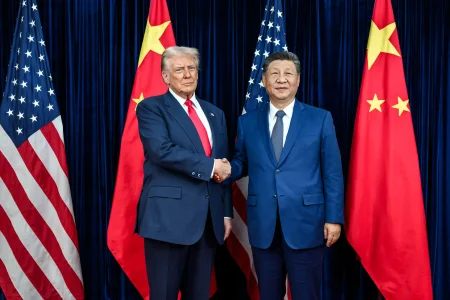
Donald Trump had postponed his visit to Beijing (to the great displeasure of Xi Jinping) to give him time, he hoped, to finish with Iran and arrive in a position of strength. The opposite happened. He has come to beg the Chinese, allies of the Iranians, to help him get out of a mess for which he alone is responsible.
In the current situation, Beijing and Washington share common goals, starting with the reopening of the Strait of Hormuz, through which a fifth of the world’s oil and gas transits. China currently imports about 40 percent of its oil from the Middle East, and many of its refineries are designed to process oil from Iran. Moreover, even if it supports Iran, the Chinese regime does not want to see a new country enter the very exclusive club of nuclear powers. This is a fact that Tehran does not seem to have understood. Possessing (or threatening to possess) the weapon certainly appears to be a guarantee of security and influence, but the great powers have tolerated the appearance of new applicants only if their own interests are at stake (for example, North Korea from Beijing’s point of view, a buffer state between South Korea and US bases and its border).
Xi Jinping knows, however, that Trump is under pressure for domestic political reasons (the midterm elections are taking place in November), and he has put the deal in his hands: he must make big concessions on support for Taiwan. For the time being, he does not seem to have made any commitment to intervene vis-à-vis Iran (assuming that he can indeed change Tehran’s policy).
Dangerous uncertainty for Taiwan
Xi elaborated on his warning on 14 May, the day after Trump’s arrival, saying at a press conference that the Taiwan issue was “the most important in Sino-American relations.” Well treated, “relations between the two countries can remain stable overall.” Otherwise, they will “clash, or even come into conflict.” Trump seems to have been taken aback, as this subject is not usually dealt with in the public sphere, and he dodged journalists’ questions.
Very concretely, Xi demands that the United States replace its official position, “the United States does not support Taiwan’s independence” with “opposes Taiwan’s independence” and that it stop supplying arms to the island state.
After announcing an agreement to deliver $11 billion worth of U.S. weapons by the end of 2025, the U.S. administration is considering a new program of some $14 billion, a record amount since the United States committed in 1979 in the Taiwan Relations Act to deliver sufficient military equipment to Taiwan to defend itself. This law was passed by the U.S. Congress in the wake of the establishment of diplomatic relations between Washington and Beijing the same year and the concomitant severing of U.S. diplomatic ties with Taipei. Since then, America has remained almost the only country to provide military aid to Taiwan. To meet Chinese demands, the US Congress would therefore have to abrogate this treaty.
The CCP would now prefer to impose a severe economic blockade of the island, rather than attempt a rather random military invasion. The invasion of Taiwan would not be an easy task. Xi Jinping promises great things to businessmen, mafiosi and politicians who would serve as his fifth column, to ensure Beijing’s stranglehold, but given the way he has been blithely purging his allies for a while, they should be wary. It also plays on soft power, with many fun shows being watched on both sides of the Strait.
Taiwan (the Republic of China) has a very special history. Beijing is playing on its internal contradictions. The Kuomintang, a counter-revolutionary party, invaded the island after its defeat on the mainland in 1949, imposing a dictatorial regime until the Sunflower Movement in 2014, which gradually led to the establishment of a democracy. The KMT nevertheless retains a social base and political weight, with the help of clientelism and corruption. Its leaders are now divided over relations with China.
However, it is difficult to see why the Taiwanese population, which enjoys a (bourgeois and imperfect) democracy, would freely opt to abandon it in favour of an opaque and super-authoritarian regime. It has the right to a self-determination exercised without external threats.
Taiwan is de facto independent, but does not officially proclaim it. The entire regional balance is due to this strategic ambiguity. Xi Jinping is once again questioning it, and Donald Trump seems to be taking his pressure into account. Just before leaving Beijing, he sent a form of warning through the Fox News channel to Taiwan against declaring independence at the cost of a distant war. “I want [Taiwan] to lower the temperature. I want China to lower the temperature.” If the statement is worrying, it is because the proclamation of independence was not on the agenda at all.
In doing this, Trump forced the Taiwanese authorities to react. The foreign minister said he took note of the remarks, noting that the arms sales were a U.S. commitment to the island’s security that was guaranteed by the Taiwan Relation Act and was a common form of deterrence in the region. The Taiwanese government, led by the Democratic Progressive Party (DPP), and President Lai Ching-te, declared on May 16 that “Taiwan is a democratic, sovereign and independent nation, which is not subordinate to the People’s Republic of China,” reaffirming the traditional position: de facto independence, although not proclaimed.
Strategic Balances in East Asia
Donald Trump is therefore now helping to reopen the Taiwan issue, a veritable Pandora’s box: geostrategic balances and control of the seas in East Asia are at stake. This state is located in the middle of the first chain of islands in the Pacific Ocean. Taking possession of it would give Beijing a key point of support for controlling this international seaway of primary importance from a commercial point of view (it is one of the busiest routes), very rich in resources (including in its seabed), whose sovereignty China claims, against international law, (at least in its southern part, which it has militarized to excess, without recognising the maritime borders of the other riparian countries).
The entire region is therefore concerned, from Japan and South Korea to Vietnam, including Singapore, Malaysia, Brunei, Indonesia and the Philippines. The conquest of Taiwan would be a real earthquake whose “aftershocks”, given the geopolitical centrality of Eurasia, could affect Central Asia, the Arctic, Russia and Europe.
Donald Trump’s erraticism and his lack of regard for the interests of his allies are already having consequences. Thus, Japanese Prime Minister Sanae Takaichi has initiated a real strategic turning point for Japan to assert itself as a great military power. The United States had imposed a pacifist constitution on the country in 1947 (with article 9), which the population had largely accepted. The counterpart to this renunciation of war was obviously the assurance of American protection in the event of a threat. This quid pro quo no longer seems obvious and allows Tokyo to justify the acceleration of its militarist program, while the so-called Japanese Self-Defense Forces are already at the top of the basket of conventional armies (without nuclear weapons), effectively emptying the constitution of its substance.
In 1976, under prime minister Takeo Miki, the sale of arms was banned. In 2014, prime minister Shinzo Abe opened a first breach in this embargo policy. On 21 April, all the previously stated principles of the country’s foreign policy were annulled. Japan can now export weapons, including “lethal” weapons, to the 17 countries with which it has a defence agreement. One of the largest military export contracts since 1945 was signed with Australia, for Mogami-class frigates produced by Mitsubishi Heavy Industries (these frigates have multiple functions and can operate with a short-crewed, high-quality frigate). Similarly, 1,400 soldiers are taking full part in the Balikatan (“shoulder to shoulder” in Tagalog) exercises in the Philippines, together with the United States and six other countries (China has invited itself into this area, also carrying out its own competing manoeuvres).
What does Donald Trump really want? If he allowed Beijing to conquer Taiwan in some form, the credibility of the United States in Asia would collapse, leaving the field open for China. He declared that he did not want to fight a war “9,500 miles away”. The problem is that the largest US military bases abroad are located precisely in this region: in South Korea and Japan (above all on the island of Okinawa). In the front row. Would he like to negotiate zones of influence: the south of the East Asian Seas to China, the north to the United States? It’s hard to believe. Perhaps he is simply trying to buy time given the mess he got himself into in Iran. He uses and abuses his military means and risks finding part of his armada out of service, while the refurbishment of an aircraft carrier, for example, requires a lot of time. Xi Jinping knows this perfectly well. However, the Chinese army is not operational today. Its staff has been the victim of successive purges, in all sectors. Xi’s paranoia is wreaking havoc. He also needs time. The icing on the cake is that we are dealing with two psychopaths, one cold and calculating, the other explosive, and this is not reassuring.
Speculation does not accomplish much, especially when one is not privy to the secrets of the Gods. However, we are living in a dangerous moment of uncertainty. In the face of militarism and great power rivalries, people-to-people solidarity remains our political compass, both in the region and internationally. For the right to self-determination (including for Taiwan), for demilitarization (especially of maritime spaces), for the seas and oceans to be freed from state borders in order to become once again common goods of humanity.
Towards a Sino-American duopoly?
What is confirmed, however, is that we are (temporarily?) moving towards a Sino-US global duopoly (necessarily very confrontational) and not towards a military confrontation between great powers in the short term. This was the hypothesis that seemed to me to have been favoured for a long time. Today, China is strengthening its hand in this duopoly in Asia, but we must not forget its impotence when Trump “co-opted” a wing of the Venezuelan regime and while he threatens Cuba, two countries that had or have Chinese support.
Beijing is certainly strengthening its global military presence thanks to its policy of purchasing ports with a dual function, economic and military. Considerable funds have been allocated for this purpose. Between 2000 and 2025, China acquired 168 ports in 90 countries, on all continents. Moreover, in Chinese companies established abroad, it is the army that ensures “security” (without displaying it). It is developing its naval base. The launch in November 2025 of its third aircraft carrier, the Fujian, represents a major step forward in modernization with its electromagnetic catapult system. However, its army has never been tested in a real contemporary military conflict (reliability of armaments, capacity of the chain of command, combined arms coordination and so on). Its deployment primarily concerns Asia-Pacific.
The Indo-Pacific has become a region of major strategic importance where global balances are (also) at stake. Joe Biden understood this and one of his main successes was to have prepared, at the time of the Afghan debacle that he had inherited from Donald Trump, a deployment of politico-military, economic and diplomatic means in this region. Back in power, Trump hastened to undo this Asian “pivot”. It was a bad thing for him. It has given China the opportunity to further weave its own cooperation in this part of the world (in rivalry with India). This strengthened its hand vis-à-vis Washington. From a geopolitical point of view, beyond the seas of East Asia, it is here that the Sino-American rivalry will be most alive.
More generally, the functionality of the Sino-US duopoly will be tested in the coming months, with Trump and Xi due to meet on multiple occasions, either face-to-face (Xi’s visit to Washington at the end of September, before the US mid-term elections), or during meetings: in November, the Asia-Pacific Economic Cooperation (APEC) summit in Shenzhen (China); in December, the G20 meeting in Miami (United States). If Beijing and Washington have common interests, they will rule the roost, as has been the case in the past. The areas of confrontation, on the other hand, should express themselves.
Despite Donald Trump’s cries of victory, no significant progress seems to have been made at the recent summit concerning the standards for the deployment of artificial intelligence and very high technology (superconductors), rare earths, trade deficits and so on. A truce in the tariff war had been decided until October (to the advantage of China). Its extension has not (yet) been announced. But the main if not the only tangible economic outcome of the summit may be the continuation of the fragile trade truce previously agreed in Busan, South Korea, when Trump suspended triple-digit tariffs on Chinese goods, while Xi Jinping gave up strangling U.S. supplies of critical rare earths.
Can a Sino-American duopoly last? Who lives will see. The United States is griped by a major regime crisis and this is probably also the case with China if we are to believe the extent of the purges, the disaffection of the population who no longer hope for an improvement in their standard of living, the ageing population, corruption, the environmental crisis, the growing dependence on exports and so on. In addition, the boomerang effects of the climate-ecological crisis are increasingly being felt. This increases the number of uncertainties.
An unimportant summit?
Many analysts seem to consider this summit to be of little importance. It is true that it will not have the same historical significance as the meeting in Beijing in 1972 between US President Richard Nixon and Mao Zedong, or that of Deng Xiaoping to the United States in 1979. However, this is the first visit to China by a US president since 2017, almost a decade ago – and that was during Trump’s previous term!
Xi Jinping probably aims to take advantage of the “Trump-Iran” moment to set a balance of power more to China’s advantage in view of the post-Trump era, as an established fact. This is a step in the rise of Chinese imperialism (except in the not insignificant field of finance, as Xi does not dare to make the Yuan a truly international currency) and in its desire to assert an alternative hegemony to that of the “West”.
The popular classes, inflation and ecological disaster
The inflation fuelled by the Iranian war is affecting the popular classes in Asia as elsewhere, with one particularity. In many Asian countries, the money sent by migrants allows families to survive. The Middle East is a major destination for this immigration, as far as Muslim countries are concerned. According to the International Labour Organization, the region is home to 24 million migrant workers. It is proving to be the world’s leading destination for foreign labour. Most of this comes from Asia: Bangladesh, India, Indonesia, Pakistan, Philippines (Mindanao), Sri Lanka. Many of these workers are in low-paying or precarious jobs and have little access to services such as health care.
The repatriation of emigrants is large scale. In the past two months, the Philippine government has secured the return of more than 9,500 of its nationals who were working in the Middle East. Many people remain blocked in unbearable conditions.
Finally, the wars in the Middle East are fuelling the climate and ecological crisis, the global crisis. A real disaster. This “polycrisis” is the greatest challenge we face. It is what makes the difference with all past periods. The number of “climate victims” is increasing exponentially in Asia, in particular.
In Asia, poverty and precariousness are spreading. However, once you have entered extreme poverty, you can no longer get out of it without long-term aid that states do not provide, but that movements try to ensure (with our help, sometimes).
The climate-ecological crisis
It’s the elephant in the china shop that no one (or almost) talks about. Debates follow one another on the economic consequences of the closure of the Strait of Hormuz, without saying a word about the climate crisis or the major attacks on biodiversity. Unfortunately, the international activist press does not always escape this syndrome. Articles appear that completely obscure the subject. Others mention it, but without concluding on the campaigns to be carried out in this area. A strange self-censorship.
While Europe is warming twice as fast as the global average, the health and social consequences are particularly severe in Asia, where societies are very vulnerable. Much of Bangladesh will disappear under water, but also densely populated areas in Indonesia. When the humidity level in the air becomes too high, even a “normal” temperature can become deadly, as the body can no longer cool itself by sweating. The violence of typhoons is increasing. Massive floods follow exceptional droughts...
19 May 2026
Translated by International Viewpoint from ESSF.