
 Version imprimable
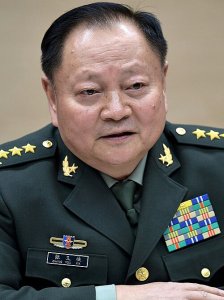
The only remaining member of the CMC, which Xi Jinping chairs, is Zhang Shengming, Secretary of the army’s CMC Commission for Discipline Inspection and Deputy Secretary of the party’s Central Commission for Discipline Inspection, responsible for carrying out dirty work [1].
The profound opacity of the regime makes it difficult, if not impossible, to know why a particular person is targeted by the successive purges within the party apparatus, the army, the Administration, civil society, or the economic world—even if the reason sometimes seems obvious: the victim had become too powerful, at the head of a conglomerate or a municipality, for example, or had been too vocal in its criticism and needed to be made an example of. But otherwise, how can we know why a particular figure no longer appears in public, as if they had fallen into a black hole, or why another is denounced for corruption or even treason? This would seem to be the case for the five disgraced members of the Central Military Commission.
Accusations of corruption are routinely used by Xi Jinping to justify the conviction of real or supposed opponents in order to hide other issues. Corruption is certainly a major problem. Because of it, defective weapons sometimes leave military production factories, which says a lot! Unfortunately, it is not just a matter of corrupt individuals; corruption is endemic. It is rooted in a system of autocratic power and privilege to which Xi Jinping, his family, and his close associates belong. Even if Xi is aware of its harmful consequences, this system is his own, and making it increasingly opaque and paranoid, and less and less collegial, will not put an end to it.
Zhang Youxia was the highest-ranking active military officer. He and Xi Jinping are known to have been very close for a long time, as “second-generation red princes”, a term referring to the descendants of CCP leaders from the revolutionary era. However, their family lineages differ. Xi Jinping’s father, Xi Zongxun, was a high-ranking official in the People’s Republic before being purged by Mao Zedong in 1962 and then rehabilitated by Deng Xiaoping. A civilian lineage, therefore, for a man of the apparatus. Zhang Zhongxun, Zhang Youxia’s father, on the other hand, was one of the generals of the People’s Army during the revolution. A prestigious ancestry if ever there was one, and perhaps that is the problem, as the military leadership has been bled dry by successive purges and Xi imposes his sole (and lifelong) leadership in the party and the government (which he marginalizes).
This is not the first time Xi Jinping has attacked members of his inner circle. It is quite logical in such a personalized regime. As the domestic situation deteriorates (and with it his authority), opposition to him may come from external centers of power, but also from members of the party’s central organs. After all, they are well placed to assess Xi’s missteps and to maneuver. In many monarchies, it is customary to assassinate “blue-blooded” relatives, members of the royal family, as a preventive measure. Within the North Korean dynastic regime, Kim Jong-un has not shied away from doing so. In China, being a “prince of red blood” is a precious privilege, but it can also be a risk...
Beijingologists wonder whether these purges are a sign of Xi Jinping’s strength or weakness. Why not both? He has the power to carry them out, but not to stabilize his grip on power or calm his paranoia. His ambition comes up against a reality: China is far too vast (1.4 billion inhabitants), the party far too large (more than 100 million declared members) and the army (more than two million active soldiers) far too alien to his own social milieu to impose the dictatorship of a single man (instead of the dictatorship of a single party) on the country. Yet Xi’s entire policy is based on exclusions. By decreeing the primacy of the “princes of red blood,” he excludes from power the majority of cadres and elites who are not the children or grandchildren of the recognized central leaders of the Chinese revolution. By amending the Constitution to grant himself the right to rule for life, he is no longer involving representatives of the political generation that should have succeeded him during his lifetime, as was traditional, in the party leadership. By making the CCP the sole and central pillar of his control over the country—from the capital “to the most remote village”—he is devitalizing the government structure. In doing so, he broke the balance that allowed the population to address two centers of authority, thus ensuring a certain flexibility in the system, but which could also provide support for competing factions within the party.
Mao, Xi, and the Cultural Revolution
The purges currently underway are said to be the most significant since those that China experienced under Mao during the ill-named Cultural Revolution. However, to understand the nature of the purges under Xi, the analogy is more valid in terms of the differences between the two eras than in terms of their similarities (an authoritarian single-party regime, etc.). While Mao was the leader of the party, the CCP’s Politburo was composed of strong personalities whose legitimacy was based on their role in the revolutionary struggles that led to the historic victory of 1949. Mao’s strength lay in his ability to form with them a new leadership team, but this unity eventually shattered under the pressure of economic crises and social tensions. Faction struggles led to calls for mass mobilizations to settle internal party scores, opening a veritable Pandora’s box. All the contradictions at work in Chinese society in the 1960s came to light.
The history of this “moment” of historical crisis is very complex, made up of murderous shadows (the summary condemnation of supposed bourgeois counter-revolutionaries, an unbridled cult of personality, etc.) and rays of light (the questioning by large sectors of society of a bureaucratized regime, the freedom of movement and initiative of a youth crisscrossing the country, etc.). The shock was such that the party disintegrated. Mao had played the sorcerer’s apprentice. He finally had to call in the army to restore order, including against his own Red Guards and his supporters in the working class, thereby signing the political death warrant of early Maoism. The Cultural Revolution was the ultimate expression of a crisis of the regime. The crushing of social movements marked the completion of a bureaucratic counter-revolution, embodied by the rise to power of the Gang of Four [2] From this point of view, it is very confusing to extend the period of the Cultural Revolution (1966-1969, a major and well-defined crisis) to 1976 (the fall of the Gang of Four). Unfortunately, this is commonly done.
Throughout its long history, the CCP has obviously experienced more or less opaque factional struggles, paranoid slips, and discreet purges, but can we imagine Xi Jinping calling on mass mobilization to resolve internal conflicts within the regime?
The analogy between the current purges and the factional conflicts of the 1960s is all the less valid given that they took place in radically different historical contexts. The victory of 1949 initiated a double break: with imperialist domination, ensuring the independence and unity of the country, and with the pre-existing social order (a break accelerated by the Korean War, which the Maoist regime did not want, but for which it paid a very heavy price). The old ruling classes, both urban and rural, were disintegrated. Today’s China is a major imperialist power deeply integrated into the global capitalist order, of which it is one of the major players. Obviously, the historical context is essential to understanding a regime crisis—yesterday’s Maoist regime, today’s regime established by Xi Jinping.
International Great Leap Forward
The traumas of the Cultural Revolution and the caricatural reign of the Gang of Four discredited “leftism,” creating the political preconditions for bourgeois counterrevolution. This process was largely initiated by Deng Xiaoping, culminating in the massive repression of 1989, which was not confined to Tiananmen Square and its surroundings (in Beijing) or to students alone. It spread to the provinces and to many social milieus, and broke the independent workers’ organizations for a long time. As for China’s reintegration into the international order, it was largely led by Xi Jinping’s predecessors, including Jiang Zemin and Hu Jintao.
The bulk of the transformation that enabled China’s Great Leap Forward on the world stage was accomplished by others than Xi Jinping. He was elected head of the party and the state in 2012 not because he was powerful, but because he represented an acceptable compromise between the main factions within the CCP leadership. He knew how to take advantage of his position. Thus, after his re-election in 2017, he was able to push through changes to the Constitution that allow him, among other things, to remain in power for as long as he wishes. This can be described as a genuine change of political regime. That said, although Xi has been able to acquire great powers, his legitimacy is weak. He is not a new Mao, despite the care he takes to cultivate his personality cult. Today, however, developments in China are not working in his favor, far from it.
Social Crisis, Regime Crisis
The profound effects of the real estate crisis that erupted five years ago are still being felt today – and go far beyond municipal debt and market sluggishness. It is traditional in China to invest a large portion of one’s savings in the purchase of a home to cover the costs of old age, as healthcare costs are prohibitively high. Many households have been ruined after investing in buildings under construction, buying plots of land in cities where construction has remained unfinished, or purchasing residences whose value has plummeted. Growth is sluggish. There are many signs of a regime crisis. China’s “Generation Z” refuses to obey Xi Jinping’s injunctions (work tirelessly, procreate without delay, etc.). Social struggles are regaining momentum.
What allows an authoritarian regime to gain support or neutrality among the population, beyond clientelism, is the belief that the economic situation of households will improve. However, parents no longer believe that their children will have a better life than they do. Social insecurity is growing, corruption is fuelling numerous scandals (building collapses, fires, defective medicines and baby milk, preventable deaths of children, etc.), and the ravages of the climate crisis are being felt ever more brutally. This explosive cocktail is not unique to China. On an international scale, it is fuelling a preventive and unilateral class war, from top to bottom, which aims to destroy long-standing popular solidarity and nip the formation of new solidarity in the bud at a time of “poly-crisis.” The so-called Western democracies are not kind today to their working and popular classes and resistance movements (see the criminalization of ecological struggles in France, even though they face the most urgent of the urgent emergencies)...
Xi Jinping calls for unity in the name of patriotism and the US threat, but this is great power nationalism, not anti-imperialism as in the days of the Chinese revolution. Could external war be the government’s response to the internal crisis? This seems unlikely at present. It would not be an easy undertaking. The military chain of command is disorganized by ongoing purges. It is riddled with corruption and has no significant military experience. The invasion of Taiwan is probably not on the agenda (with psychos like Trump and Xi, “probably” remains the order of the day), while remaining a totalitarian ambition.
A war in the Taiwan Strait would also jeopardize the political and diplomatic gains China is currently making on the international stage. Thanks to Washington’s blows to the Atlantic Alliance, China is in a pivotal position in representing a “front of refusal” that includes a country like India, with which it nevertheless has serious disputes. Leaders of “Western bloc” countries are visiting one after another, from Canada, Finland, France, Great Britain, Ireland, South Korea... and tomorrow from Germany. Xi Jinping must be enjoying this moment, but Beijing will not be giving any gifts. Faced with a cascade of overproduction crises, the Chinese economy is increasingly dependent on its foreign markets. This will be felt hard in Africa, of course, but not only there.
6 February 2026