
 Version imprimable
Since the beginning of 2026, discontent with socio-economic problems has increased. According to the Syria in Transition website, opinions of the current government had deteriorated as early as April 2026. The most notable deterioration was in the perception of the economy and the state’s ability to manage it: “In the face of rising costs and worsening economic pressures, confidence in the government’s response remains low. Only 13% of respondents believe that the government is doing enough to fight inflation, while 66% believe that the current efforts are insufficient.” [1]
The Damascus authorities have reinforced an economic orientation already in place under the Assad regime: instead of privileging the productive sectors of the economy, especially the industrial and agricultural sectors, they are prioritizing commercial and other low-productivity activities focused on short-term profit. The majority of investment opportunities offered to foreign investors since December 2024 are in tourism, real estate and financial services. Promises were also made on critical infrastructure, but they remained relatively few.
At the same time, there has been no protection for local production – including manufacturing and agriculture – against foreign competition. Quite the contrary: the government has pursued trade liberalization policies that threaten their very existence. In January 2025, Damascus reduced tariffs on more than 260 Turkish products, bringing Syria’s trade deficit with Turkey to a record US$3.26 billion by the end of the year, an increase of 87% compared to 2024 . [2]
The authorities have also advanced legislation that prioritizes investment by large foreign companies and high-net-worth individuals, while encouraging consumer dynamics within the economy, rather than strengthening the country’s productive capacities.
The proposed new tax system, which is expected to come into force in 2027, provides for a maximum tax rate of 15% for corporations, regardless of size. The new system risks weakening the state’s ability to broaden its tax base, in addition to being profoundly unequal.
Similarly, the new investment law, enacted last year, grants important concessions to investors, such as a permanent income tax exemption for agricultural and educational projects, income tax cuts of up to 80 percent in priority and export-oriented industrial sectors, and broad customs exemptions. In addition, state officials have made repeated statements regarding their intention to privatize state-owned businesses and assets, including essential social services in the areas of education and health.
In parallel with these policies favouring economic liberalisation and big capital, the authorities have taken a series of measures aimed at concentrating their power over the Syrian economy, and at the creation of new networks of businessmen linked to the new ruling class.
Strikes and popular demonstrations
The protests mobilized various segments of society, including transport workers, workers, farmers, teachers, students, lawyers, and bakers, reflecting growing discontent across the country over the continued erosion of purchasing power and the degradation of public services. They also targeted corruption, nepotism, and lack of transparency and participation in decision-making processes.
The protests erupted in mid-May, first in Raqqa, Deir ez-Zor and Daraa, and then spread to other parts of the country, after the Syrian Ministry of Economy and Industry set the price of a ton of wheat for the 2026 season at 4,600,000 Syrian pounds (about $333.30 at the unofficial exchange rate of May 27, 2026, or 13,800 Syrian pounds for $1). This decision has caused great discontent among a large part of farmers, as the cost of producing a tonne of wheat currently ranges from $340 to more than $530. Following the protests, Interim President Ahmed al-Sharaa issued Legislative Decree No. 120, granting a bonus of 900,000 Syrian pounds per tonne of wheat delivered by farmers to the Syrian Grain Company. Thanks to this increase, the price of a ton of wheat has reached about 5,500,000 Syrian pounds (about $398.60), a price still lower than the protesters’ demands.
Other protests took place during the same period, including in Hasakah governorate against the reduction of diesel allocations for agricultural projects, and in the Tarhin region, in a rural area near Aleppo, where owners and employees of oil refineries protested against the decision to close them permanently. The protesters also demanded fair compensation to ensure a minimum standard of living, pointing out that thousands of families depend on this sector.
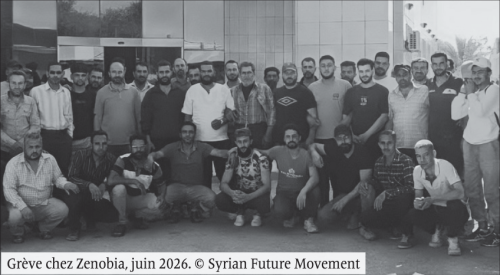
In June, strikes broke out at the private company Zenobia ceramic and at the factories of Madar Detergent in the Al-Kisweh area near Damascus, employing 4,000 and 4,500 people respectively. The protesters were demanding higher wages and better working conditions. After a week-long strike, Zenobia workers have won several of their main demands, including an increase in their wages (which includes a 500,000 Syrian pound increase, in addition to 200,000 Syrian pounds in cost-of-living allowances, for a total of 700,000 Syrian pounds (equivalent to $51.2 at the end of June) and health coverage guarantees, including health insurance, the presence of a doctor in the factory, the provision of an ambulance and safety equipment at work. [3]
Workers at the Bab al-Hawa border crossing north of Idlib protested in late June against the administration’s imposition of a 24-hour shift system and unfair working conditions. Despite threats of mass layoffs and replacements by the administration to break the strike, the workers – some of whom have 14 years of seniority – have maintained their demands for an adjustment of working time. According to the al-Hal Net website, “the administration has already recruited new employees, but about 90% of them resigned immediately, unable to continue due to the harsh working conditions and long hours.” [4]
The city of Qamishli also witnessed several days of protests at the end of June denouncing rising prices and poor living conditions, as well as power cuts due to fuel shortages. For example, the demonstrators staged a sit-in to protest against the increase in the price of diesel, demanding the reversal of this decision and an improvement in their living conditions, while the region is experiencing a surge in the prices of goods and services, as well as an increase in transport and production costs. Dozens of pensioners staged a sit-in in front of the city’s Social Security office, at the invitation of the Pensioners’ Solidarity Group, to demand an acceleration of the payment of their monthly pensions and an end to the delays and procrastination that affect their rights. After these protests by retirees, the Retirees’ Rally was officially created at the end of June, with the aim of defending the rights of retirees to a decent life, in particular by resolving problems related to their salaries and delays in disbursement.
The sit-ins and protests come amid soaring inflation in Syria’s northeastern Jazira region, with rising transport costs, agricultural production and commodity prices, as well as persistent complaints of deteriorating services and frequent power cuts. For example, in mid-June, social movements erupted in Raqqa governorate due to salary delays and the blocking of the regularization of the status of thousands of service workers. These protests have led to new strikes that have affected the sanitation sector in several areas of the governorate.
Unfair dismissals and persistent austerity measures
At the same time, layoffs continued in several ministries throughout 2026, provoking new protests. In mid-June, dismissed workers at the Compagnie Générale du Fil de Coton in Idlib staged a sit-in to demand justice and reinstatement.
The Syrian government has yet to establish clear, legal and precise standards and procedures for dismissals or suspensions, fuelling accusations of arbitrary dismissals. The human rights organization Syrians for Truth and Justice is deeply concerned about the compliance of these procedures with the legal guarantees provided for in the Unified Basic Law for Workers No. 50 of 2004 (Articles 132 to 139 ). In addition, the organization published a report in June 2026 describing cases of arbitrary dismissals and forced transfers based on “sectarian, political or gender criteria, or on criteria related to position on the 2011 Syrian uprising or regional and social belonging”, raising serious concerns about the use of the state restructuring process as a tool for excluding and reshaping the public sector on non-professional bases. [5]
At the same time, the government has recently increased salaries for some jobs, usually at the top of management or in positions considered more “skilled” or “functional elite”, while the vast majority of employees have not benefited from similar measures. In addition, wage disparities persist within the same ministries for similar jobs, with employees appointed by the new authorities receiving higher salaries (often in US dollars).
The Damascus authorities have continued to reduce the number of loaves of bread distributed from ten to eight, while maintaining the price at 4,000 Syrian pounds. The ministry has set the weight of a packet of bread at 1,000 g, compared to 1,050 g previously. As a reminder, in December 2024, the price of subsidized bread was 400 Syrian pounds (for 1,100 grams). These measures have worsened food insecurity among the most vulnerable populations.
.
Opposition to luxury projects and population displacement
At the same time, several protests have erupted against housing projects that have led to the displacement of local populations and the loss or erosion of their property rights. In Homs, residents of the al-Qarabis neighbourhood managed to pressure the Kuwaiti real estate development company Al-Omran to cancel part of the “al-Nasr Street” project that allegedly impacted the neighbourhood, threatening their property and forcing them to leave their homes. In early May 2026, a protest took place in Damascus, organised by residents of the al-Mazzeh, Kafr Souseh and Basatin al-Razi neighbourhoods, which were affected by Decree No. 66 of 2012, and two of the organisers were arrested a few days later. This is a testament to the ongoing social and legal tensions related to major urban development projects, including the Marota City project. At the same time, in the countryside of Aleppo, the residents of Jabal Aqil demonstrated against the seizure of their land by the Turkish military base.
In the same month, a demonstration took place in northern Raqqa to protest against the local authorities’ plan to demolish homes north of the railway tracks, under the pretext of “reconstruction and investment”. This situation is all the more worrying as rumours are circulating about a Saudi investment and the construction of housing by a Chinese company on this land. Official statements claim that the land is "state property", which residents dispute, claiming to have official transfer documents and legal supporting documents. At the demonstration, protesters chanted slogans demanding the resignation of the governor, who refused to cancel the reconstruction plan affecting about 3,000 families, most of them low-income and living in poverty. They reaffirmed their determination to find a just solution that guarantees their rights to housing and puts an end to evictions and demolitions.
In general, these real estate projects are often aimed at an elite capable of affording new luxury housing and accumulating capital, rather than developing housing and infrastructure projects that meet the needs of a large part of the population faced with deteriorating living conditions and declining purchasing power. in a context of soaring rents and property prices. For example, one of the most emblematic real estate projects is Yaafour 963, launched by Overseas Investment Group, owned by Syrian-Emirati businessman Muwaffaq al-Qaddah, where apartments are offered from $300,000. Similarly, the Abyat Hills project, launched by the Saudi Abyat Real Estate Investment and Development Company in the suburbs of Qudsi and al-Bajaa in Damascus, is estimated to cost more than $2 billion and provides for the construction of 22,000 housing units in secure residences equipped with modern equipment.
In addition, the country continues to suffer from a severe and worsening shortage of housing and infrastructure, threatening stabilization and recovery efforts, as well as the aspirations of displaced persons and refugees for safe and dignified living conditions and prospects for return. According to the 2025 Humanitarian Response Plan, a third of the country’s housing stock has been damaged or destroyed, while critical infrastructure, including roads, water, electricity and sanitation networks, remains largely out of service. [6]
Cost of living continues to rise
The growing anger of the population testifies to the disastrous socio-economic situation of the country. The poverty rate in Syria hovers between 80 and 90 percent, and 16 million people need emergency assistance to survive. More than 7 million people face severe food insecurity. In addition, following a significant funding gap, the United Nations World Food Programme announced in mid-May 2026 that it would reduce its operations in Syria by halving its emergency food aid from 1.3 million to 650,000 people, and ending its national bread subsidy program which supported millions of people on a daily basis.
The labour market remains unstable and the unemployment rate is rising, especially among young people. Due to the lack of accurate statistics on unemployment in Syria, due to the lack of regular and systematic labour force surveys, estimates for 2025 range between 14% and 60% for youth unemployment. In addition, reports indicate that 83% of Syria’s labour market is informal, lacking social and legal protections, leaving millions of workers vulnerable to exploitation or sudden loss of income. [7]
The cessation or reduction of subsidies has led to a spike in the prices of basic goods and services, contributing to increased inflation and a rise in the cost of living for Syrians. Although the government increased public sector salaries and pensions by 200% in July 2025 and a further 50% in March 2026, bringing the minimum wage to 1,256,000 Syrian pounds per month (about $114), this amount remains insufficient to ensure a decent standard of living. According to the Syrian Center for Policy Research, the extreme poverty line for a family was 3.34 million Syrian pounds per month in April 2026 (about $252 according to the exchange rate at the end of April), while the lower poverty line was 5.26 million Syrian pounds ($397) and the upper poverty line was 7.26 million Syrian pounds ($548). [8] From this point of view, what the Syrian people lack are not only job opportunities, but jobs that allow them to live with dignity and meet their daily needs. In this context, the reduction of subsidies and the increase in the prices of basic necessities will only aggravate the situation and cancel out the effect of wage increases.
Limits of protest movements
Protest movements and attempts at self-organisation by workers are positive developments, especially after years of war and dictatorship. For example, workers at the Zenobia company have set up a strike committee, made up of four members elected by the strikers to negotiate on their behalf.
Despite the positive aspects of these events, their impact remains limited. First, these protests remain geographically circumscribed, with no coordination between regions, with the partial exception of demonstrations related to the price of wheat. There is no close cooperation between workers in the same sector, for example between public sector teachers protesting in different governorates. This allows the Damascus authorities to manage each movement separately and limit its influence on the political landscape.
Second, protest movements lack political channels and means of expression, mainly due to the absence of political parties or mass political networks capable of relaying their demands and calls to action. Moreover, with the exception of a few left-wing parties that observe these protests without playing an influential role, political actors and civil society do not give them the attention they deserve.
In this context, it is important to emphasize that workers’ self-organization and the struggle for democratic, independent and mass trade unions – in order to foster coordination between workers and autonomous unions of power – are essential to improving the living and working conditions of the population and, more broadly, to the defence of democratic rights.
In addition, it is essential to build and rebuild people’s organizations, from trade unions to feminist and women’s rights organizations, local associations, progressive political parties and national structures, in order to unify them.
The collective and democratic organization of the popular and working classes is also the best way to face and oppose the religious and ethnic tensions that continue to impact society. These tensions are often encouraged or inflamed – or at least not radically combated – by the central government and/or its political allies to divert attention from the social, economic and political problems affecting the population. For example, recently, protests that “demanded justice for the crimes of the Assad era in Syria” coincided with an escalation of attacks by civilian groups and incitement to hatred based on sectarian identity between 13-17 June 2026. The Syrian authorities have so far failed to establish a mechanism to promote a comprehensive transitional justice process to bring to justice all individuals and groups implicated in war crimes. Such an approach could have played a crucial role in curbing reprisals and mitigating the escalation of sectarian and ethnic tensions.
Conclusion
Any political force that came to power after the fall of Assad would have inherited a multitude of political, social, and economic challenges. However, the policies of the Syrian authorities in place have exacerbated these difficulties instead of solving them. On the economic level, the approach of the new ruling classes has not improved the living conditions of a large part of the population and has had a negative impact on the recovery of the productive sectors of the economy.
The increase in protests since the beginning of the year, fuelled by deteriorating living and working conditions as well as socio-economic problems, testifies to the shortcomings of current economic policies and could serve as a warning to Damascus.
Any successful economic recovery and reconstruction process must be based on a democratic and comprehensive political transition that gives the different sectors of society – political parties, social actors such as trade unions, professional associations, the Farmers’ Union, human rights and feminist organizations, local associations, etc. – the means to participate in decision-making processes, including in the economic field. This would create the necessary conditions for the integration of their collective interests and the establishment of the political stability essential for the sustainability of these policies. Therefore, free and transparent elections must be held within trade unions, professional associations and agricultural federations so that these sectors can choose their representatives and defend the interests of their members.
Finally, the processes of capital accumulation and distribution, as well as economic policies, should be the subject of collective debate within society, not be the preserve of a small ruling elite.