
 Version imprimable
Marouane
1. The main manifestations of the new wave of repression
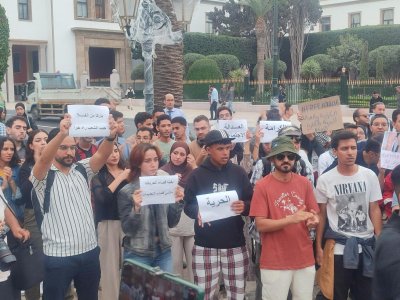
The main target of this offensive are the young people mobilised within the GenZ movement: there have been more than 5,000 arrests since the end of September 2025 and around 2,000 people were still detained at the beginning of April 2026. Prison sentences of up to fifteen years have been handed down, including against minors. In addition, three young people were killed with live ammunition by the Royal Gendarmerie in the Lakliaa region, near Agadir. The repression also affects the diaspora, with arrests at the airport for simple publications.
Several rappers have been prosecuted or convicted because of their songs or their critical positions on social networks. Jawad Asradi (“Pause Flow”) was sentenced in November 2025 to three months in prison, suspended, Hamza Raid to six months in prison, suspended. In Fez, 20-year-old Souhaib Qabli (“L7ASSAL”) was sentenced in March 2026 to eight months in prison. In July 2026, rapper and director El Mahdi Lyoubi (“Mehdi Black Wind”"), known for his support of the GenZ movement, was arrested and placed in pre-trial detention. The crackdown is also targeting content creators and influencers, aiming to create a climate of surveillance and self-censorship on social media.
Attacks on freedom of expression
The independent press remains one of the government’s permanent targets. Ali Lmrabet, a 66-year-old French-Moroccan journalist, is a historical figure in the independent press who was already imprisoned in 2003 and then banned from working for ten years. Arrested on 12 July 2026 at Tangier airport on his return from Spain, he was placed in police custody and then referred to the prosecutor’s office for “alleged dissemination of false information undermining constitutional institutions”, on the basis of several wanted notices. He was released on 15 July as the defamation investigation continues. According to his own testimony, more than thirty arrest warrants have been issued against him by the public prosecutor’s office.
Omar Radi is also one of the leading figures of the independent investigative press in Morocco, embodying the excesses of state repression against dissenting voices. After spending four years behind bars, he was released on 29 July 2024, but he continues to face systemic surveillance and pressure as well as a smear campaign on media outlets close to the Moroccan secret services that severely limit his freedoms.
The hardening of authoritarianism is accompanied by a growing repression of the media sector. The concentration of media ownership in the hands of capitalist groups linked to the government, the capture of public aid for their benefit and the resumption of control of the institutions responsible for supervising the profession reinforce political control over the media landscape. This offensive has resulted in the establishment of a provisional commission to manage the National Press Council, the revision of its legal framework and revelations of manipulation in the allocation of press cards, in disregard of professional criteria, all of which are intended to reduce the independence of the profession and the spaces for critical expression.
Critical artists are also targeted. In February 2026, cinema distributor Zineb Kharroubi was given a six-month suspended prison sentence. The young cartoonist Yasser (22) was arrested in Morocco in mid-June 2026 because of his critical cartoons.
The right of association systematically flouted
The right of association is systematically flouted by the authorities. In addition to illegal administrative obstructions – refusal to issue deposit receipts, blocking the registration procedures of associations, their sections or the renewal of their bodies – there is also a ban on meetings, training, conferences and other associative activities aimed at reducing civic space and weakening independent organisations. These practices target a wide range of political, trade union, community and human rights organizations. Among the many cases identified are the National Association of Unemployed Graduates of Morocco (ANDCM), active since 1991, ATTAC CADTM Morocco, deprived of the renewal of its legal receipt despite its existence since 2000, as well as the Moroccan Association for Human Rights (AMDH), dozens of whose sections remain without a deposit receipt.
This policy also extends to international human rights organizations, whose activities are routinely banned or prevented in Morocco. Organisations such as Amnesty International, Human Rights Watch and Transparency Morocco have been repeatedly restricted, while international observers and lawyers have been expelled on several occasions.
This situation led to the creation, in 2015, of the Network of Associations Victims of Prohibition (RAVI), which brings together organizations confronted with refusal of receipts, bans on activities and other forms of administrative repression. Its reactivation in 2026 testifies to the persistence, even the aggravation, of these attacks on associative freedoms. In this context, the RAVI organized a national demonstration in front of Parliament on 15 July 2026 to denounce these practices and demand the effective respect of freedom of association and assembly.
Despite the diversity of the profiles targeted, these cases have the same feature: the use of deliberately vague criminal qualifications, such as “attacks on institutions” or “dissemination of false information”, making it possible to prosecute people with very different profiles.
Social movements in the face of increased repression
The repression of student mobilizations at the Ibn Tofaïl University in Kenitra since the beginning of 2026 has explicitly targeted the movement’s trade union organization: ten students have been sentenced to two months in prison and 18 excluded. The latter staged an open sit-in in front of the Ministry of Higher Education in Rabat, which was harshly dispersed by police on 25 June 2026.
The struggle of workers at the Sicomec textile factory is systematically confronted with brutal repression every time they toughen their forms of struggle, whether in Meknes or Rabat, in front of the ministries concerned by their case. More than 500 workers were dismissed without compensation. For more than three years, they have been conducting a sit-in to demand respect for their rights and a just end to their struggle. The authorities responded to their demands with repeated police interventions aimed at breaking their mobilization and discouraging the continuation of their struggle.
The Hirak in Figuig is a popular mobilization carried out without interruption by the inhabitants of this oasis since 26 October 2023 against the transfer of the distribution of drinking water and electricity to a Regional Multiservice Company (SRM), which they consider a step towards the privatization of their water, a resource historically managed collectively. This movement was marked by a judicial repression targeting several of its figures. Mohamed Brahmi, known as “MoVo”, was sentenced on appeal to eight months in prison on charges related to his involvement in the Hirak, while Halima Zaid was given a six-month suspended prison sentence and a fine for speaking at a demonstration. In May 2025, Mohamed Brahmi and Redouane Marzouki were arrested again following a protest before being acquitted. Despite this repression, the Hirak continues its mobilization through sit-ins and weekly marches organized every Friday.
For nearly two years, the inhabitants of the Oulad Rami village, in the rural commune of Sidi Aïssa Ben Slimane (El Kelâa des Sraghna province, Marrakesh region), have been leading a mobilization against the operation of a stone crushing quarry, which they consider a threat to their health, their environment and their livelihoods. After several sit-ins remained unanswered, the courts authorized the resumption of the operation. On 24 March 2026, the execution of this decision led to a violent intervention by the repressive forces, resulting in numerous injuries and several arrests among the demonstrators.
The diversity of the sectors targeted reveals a coherent strategy aimed at reducing all the spaces for social, political and cultural contestation. This new escalation of repression does not, however, constitute a rupture. It extends a long tradition of authoritarian management of social conflicts in Morocco.
2. A repression inscribed in a historical continuity
This sequence is part of a longer history of territorial mobilizations in Morocco. Among the most emblematic are Imider’s fight against the exploitation of the country’s largest silver mine, where residents have occupied the facilities supplying the mine with water since 2011; the Rif Hirak (2016-2018), triggered after the tragic death of Mouhcine Fikri and followed by a massive crackdown that led to hundreds of arrests and heavy sentences, including twenty years in prison for several of its main leaders, including Nasser Zefzafi and Nabil Ahamjik; as well as the Jerada Hirak (2017-2018), which arose after the deaths of miners in clandestine coal pits and was also marked by a major wave of arrests and convictions.
The movement of unemployed graduates is also one of the most enduring examples of this repressive policy. Organized since 1991 within the National Association of Unemployed Graduates of Morocco (ANDCM), it remains active in several regions and continues to face an essentially authoritarian management of its demands, marked by police interventions, arrests and prosecutions against its activists. The persistence of this mobilization testifies to the extent of unemployment that affects a significant part of the young graduates in Morocco. Morocco’s dependent economy remains unable to provide opportunities for an ever-growing number of skilled workers. This impasse has fuelled the mobilizations of unemployed graduates around the right to work for more than three decades. It also contributes to making these young graduates one of the main breeding grounds for emigration. For many graduates, emigration appears to be the only prospect in the face of long-term unemployment, precariousness and an attack on dignity.
While popular movements remain the main targets of this authoritarian management of social conflicts, tensions are now spreading to other categories of actors. The reforms undertaken by the government are also sparking mobilizations within organized professions, as evidenced by the tug-of-war that has been taking place since the beginning of 2026 between the legal profession and the Ministry of Justice.
The unprecedented mobilization of lawyers
Since June 2026, the legal profession has been engaged in an unprecedented conflict with the Ministry of Justice over Bill No. 66.23, which undermines the independence of lawyers, their organizational autonomy, their immunity as well as the constitutional guarantees of the exercise of the right of defence. After a first week of national strike (15-21 June), the movement was renewed in the form of an unlimited general strike, accompanied by the suspension of legal aid. Entering its sixth week at the end of July 2026, it has caused an almost total paralysis of the courts. At the same time, the profession has multiplied its protest actions, including a national sit-in in front of Parliament on 29 June, before announcing an escalation through regional mobilisations, an appeal to the Constitutional Court and an international advocacy campaign to bring the issue of the independence of the profession before the world congress of the International Union of Lawyers (UIA). scheduled to take place in Marrakesh in October 2026.
3. The political drivers of the authoritarian crackdown
Morocco is preparing to co-host the 2030 World Cup with Spain and Portugal. It also hosted the 2025 African Cup of Nations. These events are part of a broader strategy aimed at strengthening the country’s attractiveness for foreign investment and tourism. In this perspective, the authorities seek to project the image of a stable, secure country with full control of its public order, which contributes to a toughening of the management of social protests and critical expressions. The generalization of control mechanisms and the strengthening of police powers are explicitly part of this logic of securing major events and flows, but also, more broadly, of guaranteeing a business climate considered favourable to investors, for whom security predictability and the absence of visible social protest are as important as macroeconomic indicators.
Security modernization accelerated by normalization with Israel
Since the December 2020 agreements, security and military cooperation between Rabat and the Zionist entity has moved to a global integration: transit of equipment for the occupying army through Moroccan ports, sale of intelligence technologies, cyber defence and surveillance drones. In addition, there is a rapid spread of so-called “smart” video surveillance in public spaces: several thousand fixed and mobile cameras were deployed in Rabat, Casablanca and other major cities for the 2025 African Cup of Nations. Presented as a tool for managing flows and “security”, this infrastructure remains just as capable of being mobilised for social control and the recording of gatherings. This normalization extends to many other sectors — economic, cultural, sports and so on. However, it continues to face massive popular rejection, initiated in particular by the Moroccan Front for the Support of Palestine and Against Normalization, which is leading to continuous demonstrations in the majority of Moroccan cities. Several sit-ins in solidarity with the Palestinian people have been violently repressed, including the most recent one held on Saturday, 18 July 2026 in Tangier. Meanwhile, several activists opposed to normalizing relations with Israel have been imprisoned or are facing legal proceedings.
The consolidation of authoritarian bourgeois power
The government coalition that emerged from the September 2021 elections brings together three parties — the National Rally of Independents (RNI), the Authenticity and Modernity Party (PAM) and the Istiqlal Party — liberal, monarchical bourgeois and closely rooted in business circles and the workings of the political system. Their coalition pact is based on a voting agreement in the legislature guaranteeing systematic support for executive bills and extended coordination to local authorities, ensuring homogeneous management at all levels of the country.
This political architecture extends a structural characteristic of the Moroccan bourgeoisie, which traditionally prospers thanks to the support of the state, through rent and clientelism. The racketeering born of the accumulation of political and economic mandates encourages nepotism in the awarding of public contracts, licenses and access to land to family networks historically close to power. This distribution is carried out under political protection, with the approval of a regime that also keeps the economic weight of this same social base under control. The head of government Aziz Akhannouch has an estimated fortune of $1.6 billion, or about 3.5% of the country’s public external debt at the end of 2024. He is among the very biggest Moroccan fortunes (according to the Forbes ranking of billionaires) — having held the top spot several times. It is a family wealth that he has strengthened since his appointment as head of government in September 2021.
4. A social offensive against the working classes
Beyond the attacks on public freedoms, the repression of the mobilizations is part of a more global offensive. It accompanies a neoliberal restructuring aimed at weakening social rights, making work more flexible and transferring the cost of crises to the popular classes.
Restriction of the right to strike
The organic law (No. 97.15) on the right to strike, adopted on 3 February 2025 after more than two decades of deadlock and published in the Official Bulletin on 24 March 2025, appears more as the result of pressure from employers than as the outcome of trade union demands. The leaderships of the main trade union federations, increasingly locked into the mechanisms of “social dialogue” and “social peace”, are also largely discredited in terms of their ability to defend workers’ rights or to obtain new gains. The General Confederation of Moroccan Enterprises (CGEM) has hailed this law as a step forward that has been awaited “for more than 60 years”, which says a lot about the interests it serves. Indeed, the text severely restricts the exercise of the right to strike by imposing a notice period, the holding of a general meeting with a quorum, by prohibiting the occupation of workplaces and by providing for heavy financial penalties. It is also accompanied by the maintenance of the possibility of criminal proceedings against the strikers, in particular on the basis of article 288 of the Criminal Code relating to “obstruction of the freedom to work”.
In addition, the CGEM is continuing its pressure in favour of extending the flexibility already introduced by the 2004 Employment Code. This orientation is reflected in particular in the generalisation of temporary work and the extension of contractualisation, including in the civil service, as well as a relaxation of the rules governing dismissals.
A regressive pension reform
A neoliberal-inspired reform project was presented by the National Commission in July 2025. This provides for the gradual increase of the legal retirement age to 65 for all schemes (compared to 60 in the private sector and 63 in the public sector today), the extension of the contribution period, the increase in contributions and the restructuring of funds around two poles. True to neoliberal recipes, this reform places the brunt of the adjustment on workers.
Public debt and structural austerity
The share of overall public debt in GDP rose from 56% in 2008, to 76% in the period 2012-2019 in the wake of the structural crisis of capitalism in 2008-2009, and then to 87% in the period 2020-2024 following the health crisis of the Covid pandemic. This increase is accompanied by a much more marked alignment of Morocco with the austerity policies advocated by the IMF and the World Bank, especially since the Covid crisis. It is reflected in increasingly restrictive debt service repayments, to the detriment of social spending — health, education, commodity subsidies — while subsidies and tax benefits granted to private capital continue, and in increased pressure for structural reforms (pensions, civil service reform, clearing, taxation, exchange rate liberalization) dictated by these two institutions.
This is happening at the same time as the infrastructure linked to major sporting events (stadiums, high-speed lines, airports) is mobilizing hundreds of billions of dirhams of public investment: hospitals and public schools are in chronic disrepair — this is precisely what the GenZ youth movement is denouncing. As a structurally dependent country, Morocco is suffering the repercussions of international crises. The Russian war against Ukraine, the wars in the Middle East and the tensions on the global energy and food markets have accentuated inflationary and budgetary pressures, used by the government to make the working classes bear the cost of these crises.
5. Conclusion
This repressive offensive reflects less the strength of the regime than its desire to prevent a worsening of social protests in a context marked by the rise in the cost of living, the deepening of neoliberal policies and the accumulation of inequalities. The criminalisation of dissent thus accompanies a wider attack on social and democratic rights.
Despite the scale of this offensive, the mobilizations are not disappearing. Territorial movements such as that of Figuig, workers’ struggles, student mobilizations, youth protests and demonstrations of solidarity with Palestine testify to a persistent social mobilization that continues to find new forms of expression.
However, this dynamic is developing in a context marked by the deep discrediting of the leaderships of the main trade union federations, which are largely integrated into the mechanisms of “social dialogue” and “social peace”, as well as by the organisational weakness of the radical left and its still limited presence in the main sectors of struggle. This double weakness today complicates the convergence of resistance and the construction of a balance of power on a national scale. However, the multiplication of mobilizations shows that authoritarian and neoliberal policies are not succeeding in sustainably containing popular aspirations for social justice and democratic freedoms, nor in preventing the emergence of new generations of activists and new forms of resistance.
28 July 2026
Translated by International Viewpoint from Inprecor.