
 Version imprimable
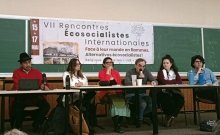
In the buildings of the Université libre de Bruxelles (Free University of Brussels), more than two hundred and fifty people from some forty countries gathered in mid-May for the seventh International Ecosocialist Encounters. For three days, discussions ranged across trade union struggle and degrowth, care work and the defence of indigenous land, debt, artificial intelligence, Ukraine, and Palestine. A glance at the programme might give the impression of a loosely assembled sequence of disconnected themes. The opposite proved true. It was precisely the breadth that made visible what the organisers were after: demonstrating that all these apparently separate fronts flow from the same crisis, and that this crisis can only be reversed collectively, across borders.
The International Ecosocialist Encounters have been held since 2014 — the initiative arose around a German-language book on an ecosocialist international — and have grown into a recurring gathering of activists, trade unionists, academics, and social movements from several continents. [1] Ecosocialism holds that the ecological crisis cannot be separated from capitalism. An economy driven by profit maximisation and unceasing growth inevitably collides with planetary limits; only a society that produces to meet human needs rather than to generate profit can sustain a good life within those limits. That premise was the common denominator running beneath all the conversations in Brussels.
A sombre backdrop
The gathering took place against a sombre backdrop, and participants made no secret of it. Climate disruption is accelerating, while the European Green Deal — once heralded as the definitive response to warming — is being systematically hollowed out in Berlin, Paris, and Brussels. At the same time, wars, rearmament, and the far-right bloc are all growing. An opening debate on geopolitics drew the connection sharply: the Green Deal had been left largely to capital and had offered working people, and the poorest layers in particular, very little. It is precisely into that gap that the far right thrusts. It frames environmental policy as an assault on ordinary people and wins terrain the left has long vacated.
The labour movement at the centre
That is also the first reason why the labour movement occupied such a central place in Brussels. Trade union engagement has been part of these encounters from the start, and the opening session made clear why. A trade union member from the Democratic Republic of Congo, Hervé Kambiniam of the CDT (Confédération Démocratique du Travail — Democratic Confederation of Labour), [2] described how the war in the east of his country has produced a war economy in which money flows to weapons rather than education or healthcare, while foreign companies and armed groups plunder raw materials and drive the population from its land. From Colombia came the account of trade unionists who, against opposition from part of their own base, have turned against fracking and allied themselves with environmental and rural movements.
From the Basque Country, Ainhara Plazaola of the ELA (Euskal Langileen Alkartasuna — Basque Workers’ Solidarity) confederation showed how things can be done differently: she described how her confederation has brought demands on emissions, energy and water use, and sustainable business plans directly into collective bargaining, and how it secures commitments that workers affected by the closure or downsizing of polluting enterprises can move into other employment or receive a decent income and retraining. [3] The thread running through these discussions was that the opposition between labour and the environment — on which the far right plays so deftly — is not a law of nature but a political choice. Winning the trust of workers requires connecting the ecological transition to the fight for their jobs and income.
Degrowth and ecosocialism
A second thread ran through the debate on degrowth. Ten years ago, that concept would scarcely have been placed alongside socialism; degrowth and socialism were treated as alternatives between which one had to choose. Increasingly, degrowth is now seen as a component of the socialist programme. Daniel Tanuro, one of the driving forces behind the Ecosocialist Manifesto of the Fourth International (IVe Internationale — Fourth International), set out the necessity soberly. [4] Of the nine planetary boundaries identified by science, seven have already been breached. A reduction in energy and raw material consumption is therefore no longer a choice but a given; the only question is whether that reduction happens in a planned and humane way, or as a catastrophic collapse.
In this understanding, degrowth does not mean poverty or austerity, but the abolition of useless production and the restoration of what genuinely matters: time, care, and community. It was telling that a representative of the academic degrowth current and the Marxist ecosocialists explicitly sought each other out in Brussels. There are multiple paths to the same destination, and the willingness to bring those paths together was one of the gains of the conference.
Not without feminism
That degrowth cannot proceed without feminism was a third insight that recurred throughout. Reducing production alone, without redistributing care work, simply shifts the bill on to women, who already perform the largest share of that unpaid labour. Speakers from the ecofeminist tradition argued that care — for people, but also for land, water, and communities — belongs at the heart of an ecosocialist project, not at its margins. In Brazil, as several interventions noted, landless and indigenous women have long put this principle into practice, in their resistance to agribusiness, mining, and dam construction. The idea of radical abundance that emerges from the degrowth movement breaks both with the artificial scarcity of capitalism and with the capitalist image of abundance as endless possession.
Latin America at the front line
Nowhere did the coherence of all these struggles come together as concretely as in Latin America, which commanded a large share of the attention. Michael Löwy, the French-Brazilian Marxist sociologist who was present at all previous encounters and received a personal tribute in Brussels, identified indigenous peoples and peasant movements there as the vanguard of the ecological struggle: they are in the front line of the defence of nature and life, and at the same time the first victims of capitalism. [5] From Ecuador, Leonidas Iza, president of Ecuarunari (Confederación Kichwa del Ecuador — Kichwa Confederation of Ecuador), described how his communities have lived with the land for thousands of years and are now resisting oil extraction in the Amazon region. [6]
From Brazil came a victory from which to draw courage: following a 33-day occupation of the terminals of the US multinational Cargill and a series of actions during the COP30 climate summit, a largely indigenous movement forced the Lula government to reverse the privatisation of three Amazonian rivers — the Madeira, Tocantins, and Tapajós. [7] Mariana Riscalli, a member of the national executive of Brazil’s PSOL (Partido Socialismo e Liberdade — Socialism and Freedom Party), held up that struggle as evidence that social movements must remain independent from the government, even from a progressive government. At the same time, a warning was sounded against what participants called green colonialism: an energy transition that replaces fossil fuels but perpetuates the same plunder of raw materials, the same dispossession and repression, now in the name of clean energy.
Internationalism, not campism
The wars also received their place, and it was precisely here that the political maturity of the gathering asserted itself. Over Russia’s invasion of Ukraine and over European rearmament, a deep dividing line runs through the left, and the Ecosocialist Encounters did not avoid it. Ukrainian ecosocialists from Sotsialnyi Rukh (Соціальний рух — Social Movement), [8] including the trade unionist Artem Tidva and the degrowth specialist Vitaliia Kilinkarova, described the enormous ecological devastation that Putin’s war has wreaked on the country and called for international solidarity from below, on the model of Swedish dock workers who refused to unload Russian ships.
The Syrian researcher Joseph Daher extended the analysis to Gaza and southern Lebanon. What connected the speakers was their rejection of campism — the tendency to stand uncritically behind every adversary of the West, out of opposition to Western imperialism. Solidarity, as the repeated formulation had it, is owed to the attacked peoples and to working people, not to the repressive regimes that oppress their own populations. Rearmament itself was assessed not only as a war threat but as a massive shift of resources away from the ecological transition and social services.
The danger of the far right
What ultimately connects all these fronts is the rise of the far right. Löwy preferred the term neo-fascism: it shares much with classical fascism but is radically neoliberal rather than corporatist, and it uses religion without itself being religious. At the conference the phenomenon was also given a new name: fossil fascism. The far right is less and less openly denying climate change; instead it turns against climate policy, as an ally of the fossil industry, and sometimes even presents immigration as an ecological threat. A workshop on artificial intelligence gave this reaction a further technological face. The power of a handful of tech companies over information, communication, and surveillance, and the quasi-religious visions of the future held by figures such as Elon Musk, constitute a distinct front in the same struggle — one on which resistance, from tech workers to people living near data centres, is only just beginning.
A convergence of movements
Here lies the core of what the encounters sought to convey. The women’s movement, the indigenous struggle, the struggle of working people, the fight against debt and extractivism, resistance to war and to the far right: these are not separate campaigns but expressions of a single crisis of capitalism. Tanuro named this a convergence of movements — of women, indigenous peoples, LGBTQI+ people, peasants, and workers — and Löwy described ecology not as a chapter but as a red thread. Breaking with productivism does not mean abandoning the class struggle; it means broadening it. The gathering itself, with its forty countries and its difficult but real conversations between academics and activists, between North and South, was an exercise in precisely that broadening.
That raises the question of what ultimately matters: how to give that convergence a form capable of compelling concrete change. The answer that was most concretely formulated in Brussels was organisational. Alongside the encounters themselves, the Global Ecosocialist Network presented itself — a worldwide collaboration with a small secretariat, a low threshold for participation, and online debates in which organisations from several continents exchange experiences and strategies. The network and the encounters are complementary and will seek closer collaboration in future.
From the Netherlands, activists from LinksBoven (the ecosocialist member movement within PRO — Progressief Nederland, the recently formed merger of GroenLinks and PvdA) and from the new initiative Democratisch Ecosocialisten (Democratic Ecosocialists) [9] were present. The next edition of the Encounters, the 3rd Latin American and Caribbean Ecosocialist Encounter, will take place next year in Colombia, possibly followed a year later by the 8th International Ecosocialist Encounters in Ecuador — a telling shift towards the continent where the struggle is waged most fiercely and most boldly.
Whether that will be enough, no one knows. An Argentine speaker reminded the gathering that debates must remain rooted in concrete struggle and independent of governments, including supposedly progressive ones. Löwy cited Brecht: those who fight can lose, but those who do not fight have already lost. That is not reassurance, and it was not intended as such. What the 7th Ecosocialist Encounters showed is that the individual movements are each too weak for the task on their own, and that coordination among them — across sectors, movements, and borders — is no longer a luxury but the precondition for achieving anything. The building blocks are there. They only need to be stacked.
3 July 2026
Translated and annotated by Adam Novak for ESSF from Grenzeloos.