
 Version imprimable
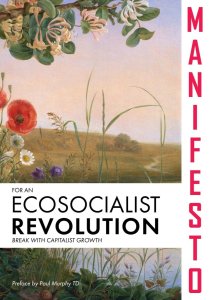
We are reproducing the Preface to an edition of the Fourth International’s “Manifesto for an Ecosocialist Revolution - Break with Capitalist Growth” by the Irish socialist organization RISE, a Permanent Observer within the Fourth International.
It was 1917, six months post the February Revolution, and famine was on the horizon in post-Czarist Russia. In “The Impending Catastrophe and How to Combat It”, Lenin wrote that “…the slightest attention and thought will suffice to satisfy anyone that the ways of combating catastrophe and famine are available, that the measures required to combat them are quite clear, simple, perfectly feasible, and fully within reach of the people’s forces, and that these measures are not being adopted only because, exclusively because, their realisation would affect the fabulous profits of a handful of landowners and capitalists.” He could have easily been writing about the climate and biodiversity catastrophes facing us today.
2024 was the hottest year on record globally, 1.6ºC above the pre-industrial level. Some of this is attributable to the effects of El Niño, but the underlying trend to breaching 1.5ºC, heading to 2ºC and then going much beyond is clear.
Let’s not forget that positive feedback loops have the potential to rapidly worsen the situation beyond the conservative predictions in the Intergovernmental Panel on Climate Change (IPCC) reports. For example, the IPCC predicted that the AMOC (Atlantic Meridional Overturning Circulation), which includes the Gulf Stream, could shut down, but not until after 2100. However, over the last few years, there have been significant warning signs that this current system is slowing down now and could collapse much earlier.
The entire Earth is warming, except in the North Atlantic, where a “cold blob” has formed as a consequence of less heat being transported by the AMOC. The AMOC is like a central heating system for much of the Earth. If it collapses, it would have devastating and irreversible impacts. The last time it happened was about 12,000 years and temperatures plummeted by 10 degrees!
That’s just climate change. Another five of the nine global planetary boundaries have been crossed: biodiversity loss, freshwater change, land system change, biogeochemical flows and novel entities. These mostly emanate from the intensification and unceasing growth in extraction, pollution, and industrial farming.
Massive algal blooms are choking the life out of Lough Neagh, the largest freshwater lake in Ireland. The blooms are a direct consequence of nitrogen and phosphorus leaking into the water from intensive farming and sewage. It’s devastating for wildlife and impacting the water people drink. The same is happening at Lough Hyne in Cork. Almost half of all Irish rivers and lakes are below good ecological health standards.
The impact is also in the fact that 98% of Europeans are breathing polluted air, causing 400,000 deaths a year. The scariest figures relate to the very rapid loss of biodiversity - whereby wildlife populations have collapsed by 70% in the last 50 years. This loss of animal populations and species extinction is undermining the resilience of our ecosystems and will threaten food production.
Capitalist inaction
The alarm bells are ringing. All the newspapers are reporting the coming catastrophe. And yet, almost nothing is being done. The main impression one has of the capitalist class’s attitude to ecological crises is that they have effectively given up. Instead, all the eggs are placed in the basket of future technological developments, which allows them to avoid disrupting the flow of profits or contemplating the kind of radical system change demanded by the science.
Climate sceptics are increasingly represented in government, most notably with Trump in the US, but also with the Healy-Raes much closer to home. Trump, with his links to Big Oil, has vowed to ‘Drill, Baby, Drill’. He quit the Paris Agreement immediately and rolled back environmental protections in the US. This has prompted other world leaders to follow suit.
Within weeks, it was reported that “Brussels under pressure to curb green agenda in response to Trump.” [2] The European Round Table for Industry (IBEC’s EU equivalent) is leading the charge to abandon sustainability regulations under the guise of cutting red tape. A major part of the EU’s response to Trump’s tariffs is to offer to buy more weapons and more Liquified Natural Gas from America.
In Ireland, the government has an inadequate legal commitment of a 51% reduction in greenhouse gas emissions by 2030. The last government was on track to maybe hit half of that. The new government is even worse, abandoning any restrictions whatsoever on data centres, announcing more investment in roads and is pushing for fracked gas infrastructure.
Despite all the grand declarations at the annual Conference of Parties (COP), the policy commitments amount to just a fraction of what is necessary to avoid catastrophe, and the actual implementation is even less. The current level of promises from governments worldwide would result in at least a 2-degree rise, if you accept their technological fantasies. But in terms of what is actually being done, we are heading for at least 3 to 4 degrees increase in average global temperature. In other words, disaster and possible civilisation collapse.
COP28 couldn’t even agree to a phase-out of coal, the dirtiest of all fossil fuels. Instead, they settled for the “phase-down of unabated coal power”. The “unabated”, matched by a positive reference to “abatement and removal technologies” elsewhere, is a reference to carbon capture and storage technology that does not exist anywhere close to the scale necessary. It is an illustration of the reliance on future techno-fixes to allow business as usual to simply continue business-as-usual.
Despite all the talk about increasing investment in renewable energy, fossil fuels still dominate the global energy mix (84% in 2020). The total production of fossil fuels has increased by 62%, going from 83 TWh in 1992 to 136 TWh in 2021. This is because energy demand continues to expand quicker than renewable energies are added.
Catastrophe
We are now witnessing what Rosa Luxemburg called “the chain of incessant social catastrophes.” [3] Imperialism, war, the rise of the far-right, climate and biodiversity crisis are all interconnected. The climate crisis accelerates the rising inter-imperialist tensions, and they, in turn, add to the climate crisis through the expansion of imperialist militaries.
Climate denialism is also a core part of the appeal of the far-right. In power, they intensify the ecological crises - with Bolsonaro, for example, encouraging the burning down of the Amazon rainforest and Trump removing any limits on fossil fuel production. And of course, the migration of people forced to leave their homes because of climate catastrophe is already being weaponised by the far-right.
So how can we break out of these catastrophes? How do we avoid sinking deeper and deeper into barbarism?
The capitalist system cannot get us out. It is an ecocidal system incapable of solving these crises because it is based on national capitalist competition rather than the international co-operation that is necessary to deal with a global problem like this. Each capitalist firm is focused on increasing private profit. Increasing profits (or even just maintaining them) requires exponential growth: growth in stuff, in production, materials extracted from the Earth, the energy to power it, and all the accompanying waste, dumped in the air, seas, land and us.
Capitalism, therefore, means barbarism. Only a revolution can stop the destruction and clear the way for a new world to be built within the planetary boundaries, ensuring a good life for all.
A ‘pessimism of the intellect’ [4] would be quite justified at this moment - you could be forgiven for thinking that perhaps barbarism is more likely than ecosocialism. Yet, it was precisely out of a catastrophe - the first world war - that the successful Russian Revolution was forged. [5] It’s a reminder that we don’t have to passively accept our fate. We can act today, with an ‘optimism of the will.’
Lenin & World War I
It’s hard to overstate the catastrophe of World War One. Out of 65 million soldiers, nine million perished, with an additional five million reported missing and seven million suffered permanent disabilities. Civilian deaths were even higher.
It also devastated the powerful socialist movement. The big majority of the mass parties of the working class, supposedly Marxist parties, went over to support the war aims of their own ruling classes.
But three years later, revolution in Russia (beginning in February 1917 and coming to a denouement October 1917) put workers in power and began to bring an end to the war. Revolutionary movements broke out across much of the world, including in Ireland.
How did that happen in the face of such catastrophe and barbarism, and what can we learn from it?
Lenin was aghast that the socialist movement failed to act to stop the war. Instead of despair, he responded to this catastrophe by going to the library. He spent weeks reading and digesting the works of the 19th century German philosopher Georg Wilhelm Friedrich Hegel. [6] He broke with the objectivism and mechanical materialism which characterised the Second International - that assumed a much more evolutionary-like process of capitalist crisis leading to socialist revolution.
Lenin’s new dialectical understanding of Marxism placed more emphasis on human agency and revolutionary leaps. This helped him to see the revolutionary potential in the struggles against imperialism like the Easter Rising and develop his ideas on the state post-revolution, elaborated in ‘State and Revolution’. Most importantly, he began to see the potential of the Russian Revolution was beyond what the Bolshevik Party had previously thought was possible.
Strategically, epitomised by the April Theses, Lenin broke with what had been the Bolshevik doctrine that the Russian Revolution would be a bourgeois or capitalist revolution. When he arrived at Finland Station in April 1917, he called for a socialist revolution. This was matched with a programmatic shift to calling for ‘All power to the Soviets’, the democratic workers’ Councils thrown up by the revolution.
Similar shifts are necessary and underway for the Marxist movement confronted by ecological catastrophe. They inform this ecosocialist manifesto. Really embracing the centrality of the ecological crisis and the necessity of ecosocialism means philosophical, strategic and programmatic shifts for the revolutionary left.
Philosophically, it means a further break along the lines that Lenin took, away from mechanical materialism and productivism. It means rejecting the notion that “the history of mankind is determined, not by ideas, but by an economic development which progresses irresistibly…” [7]
It is people, not abstract ‘productive forces’, who make history. Yes, as Marx outlined, we do not make it in circumstances chosen by ourselves, but “under circumstances directly encountered, given and transmitted from the past.” Our possible futures are undoubtedly constrained by circumstances beyond our individual wishes. But it is class struggle that is the motor force of history.
Strategically, we need to place an understanding of the ecological crisis at the centre of what we are doing. We are not just ecosocialists when we are campaigning about the environment and socialists the rest of the time. We are ecosocialists when we are trade unionists, cost of living protesters and housing activists. Within the trade union movement we are the people saying that the ecological crisis is a workers’ issue. Within the environmental movement, we are the ones pointing to the strategic power of the working class and the need for the system change to be ecosocialist change.
Programmatically, we need to reject any promotion of growth as the answer to the crises that the majority of people on this earth face. We need to reject the goal of material superabundance - an impossibility on a finite planet. Instead we have to recognise that in order to sustain a liveable future for humanity, and for a just transition for all - the workers, small farmers and indigenous peoples in the Global South as well as in the advanced capitalist countries - it is necessary to reduce total energy consumption and material throughput.
That is necessary for two reasons. Firstly, to hasten the transition to 100% renewable energy. Secondly, to avoid further breaches of the other planetary boundaries through the impact of extraction of rare earths and minerals overwhelmingly from the Global South, destroying local environments and communities.
Programme
This [Manifesto for an Ecosocialist Revolution-https://fourth.international/en/world-congresses/18th-world-congress-2025]> sets out a vision of why this is necessary and what it could look like. It places emphasis on the possibility of a good life for all. The Manifesto, which was agreed by the 18th World Congress of the Fourth International (FI), is the product of years of work and discussion within the FI and is the culmination of a process of practical and theoretical engagement with the ecological crisis and the social movements around it.
For us in RISE, it is a crucial area of agreement with the FI. When we began as a group that left the Socialist Party in 2019, we launched as a clearly ecosocialist organisation ( with our logo and name, the ‘E’ in RISE stands for ‘environmental’). We engaged actively in Extinction Rebellion [8], together with members of People Before Profit, which we joined in 2021. We also engaged with ecosocialist writers and debated the ideas of degrowth and anti-productivist Marxism.
In a sense we were on a parallel journey to the FI and were able to accelerate our journey through engagement with the FI debates, including in relation to this manifesto. Hopefully, we were also able to contribute to it, in a small way. This agreement on a framework of ecosocialist degrowth was a crucial reason for our becoming Permanent Observers in the Fourth International.
We now participate actively in the debates and structures of the FI. We do have important ongoing differences with the FI majority, particularly in relation to the characterisation of the war in Ukraine. […]
Nonetheless, we are proud to publish this manifesto from the Fourth International. It represents a significant contribution to developing the necessary programme to avoid the catastrophe we are heading towards. To paraphrase Walter Benjamin, it is a tool to help the working class pull the emergency brake.
Building a force that can pull the brakes
"... the proletariat requires a high degree of political education, of class-consciousness and organisation. All these conditions cannot be fulfilled by pamphlets and leaflets, but only by the living political school, by the fight and in the fight, in the continuous course of the revolution."
Rosa Luxemburg, The Mass Strike (1906)
Without building a revolutionary force to help lead a mass working class movement capable of overthrowing capitalism, the ideas set out in this manifesto will never come to life nor be realised.
The only force that can do that is a conscious and organised working class, together with the oppressed peoples of the world. These are the people who make society and our economy work. When mobilised, we have the power to overthrow dictatorships, defeat imperialism and end capitalism.
Our job as ecosocialists is to be actively involved in the day to day struggles of working class people and connect them to the need for ecosocialist change. A crucial part of that is working to redevelop a mass environmental movement - committed to stopping the development of LNG infrastructure and any more data centres. Within that movement, we should be clearly raising the banner for ecosocialist revolution and urging activists to join.
Within and through this fight we want to build People Before Profit as a mass ecosocialist party and encourage people to join us in doing so. We also want to develop RISE as a consciously revolutionary Marxist and ecosocialist force.
Without the Bolsheviks, revolution would not have come out of catastrophe in Russia, and the word for fascism may well have been Russian instead of Italian. The same sort of force - made up of principled, sacrificing, independent thinking working class and social movement leaders - is desperately needed to avoid the horrors facing civilisation.
Forging a revolution out of ecological catastrophe is the urgent task in front of us. If we’re successful, we will be inheriting disaster, ruin, and ongoing climate disruption — all of the mess that capitalism has created for humanity. But by putting the working class and oppressed peoples in power, making decisions for themselves, we will have at our disposal all of the capacity, creativity, and will required to do it.
May 2025