
 Version imprimable
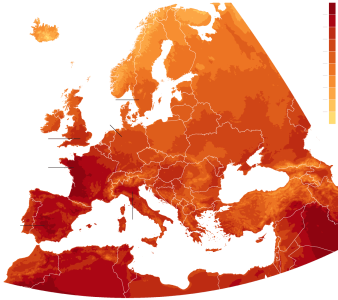
As Europe experiences its second spring heatwave of the year.
As the health, agricultural, and ecological consequences promise to be severe.
As this extreme weather event — like the heatwaves in India and in Antarctica — is a sign that global warming, driven principally by fossil fuel combustion, is tipping the Earth into an irreversible catastrophe.
As what is needed — as with COVID, but structurally — is a public emergency plan to 1) protect the most vulnerable populations and care for living beings; and 2) drastically and immediately reduce CO₂, CH₄ and other emissions, in the greatest possible social justice, beginning with the prohibition of deforestation and of unnecessary production, transport, and services (private jets, yachts, and so on).
As the ongoing deterioration of the situation makes it abundantly clear that finance, energy, and agricultural production must be wrested from the grip of big capital in order to develop a comprehensive policy oriented towards a different society — good, truly human, ecosocialist.
As all of this is obvious, in fact:
– Financial investment in fossil fuels surged again in 2025 — and not only in the United States: in Europe and China too — and in Russia, of course.
– The G7 members deferentially assembled (in air-conditioned rooms) around the most criminal, the most fanatical, the most foolish of pro-fossil climate denialists, without uttering a word about the climate. The crowning absurdity: they went so far as to congratulate him for having restored peace (!) in Iran, and rejoiced alongside him that precious oil would once again flow through Hormuz. Woodlice. [1]
– All are competing to develop artificial intelligence, whose data centres are on course to have as great a climate impact as the entire transport sector — and will soon surpass it.
– The European Commission, in agreement with governments and under pressure from industry, continues as if nothing were wrong to unravel the wholly inadequate emissions-regulation measures taken under its own Green Deal (internal combustion engines, methane leaks, the emissions trading market: everything passes through the omnibus grinder of "simplification"). [2]
– A significant number of media outlets continue to put it into people’s heads that the weather is "fine" — this absurdity is even repeated by people on the left, who rejoice at the sunshine for their end-of-year barbecue.
An anecdotal result — though not entirely so: under a blazing sun worthy of the Peloponnese in August, Ryanair planes continue their infernal to-and-fro above my garden, as if nothing were happening, and the entire political class rejoices, because "it creates economic activity." A perfect illustration of the death-dealing automaton — capitalist profit — that devours society down to its very soul and substitutes itself for intelligence.
But the wind will eventually turn (to use a climate metaphor). Inevitably, the catastrophe... will place the catastrophe back on the social and political agenda. The first signs of growing anxiety are already showing up in polls, in the United States. Even at the risk of adopting a messianic stance, we must hold firm, grounded in science. Refuse "realism." Open up breaches in productivism wherever possible. Shake up the major organisations — trade unions above all — to couple the social, the ecological, and the democratic in our struggles. [3]]
We will not return to the world before — no. The Holocene — which enabled the flowering of civilisation — is over, whatever geologists may officially say. The rise in ocean levels (which will continue for a very, very long time, even if emissions were halted immediately) is irreversible. So are the losses of biodiversity (coral reefs, for instance) and of ecosystem functions (at least on the human timescale). But we still have the possibility of living, and of living well — all of us — in a manageable Anthropocene in which the mean surface temperature will remain "well below +2°C" (Paris Agreement) and will eventually — in 2,000 years — stabilise at approximately 1°C above Holocene levels. [4] [5]
This is the only conclusion one can draw from all of this: the degree of “manageability” of this Anthropocene, the Earth we will leave to our children and our children’s children, “for ever and ever,” depends on our struggles NOW against the capitalist Moloch. [6] Together, let us be courageous, determined, inventive, and joyful where we can. "Brothers, humans who will live after us, do not harden your hearts against us." [7]
20 June 2026
Source: Translated for ESSF by Adam Novak