
 Version imprimable
It is true the Constitution does not mention “race.” Given that the white men who wrote the Constitution believed the new country was based on white settlers, in the early years only white male landowners voted. (A few white women voted too, until state laws got rid of that anomaly.)
With slavery’s defeat, the passage of the 13th, 14th and 15th amendments to the Constitution assured ex-slaves and freed Black people their right. Later court decisions, expanded their meaning to non-white racial minorities. But the white counterattack prevented the vast majority from exercising their voting rights. It was the mechanism embodied in the 1965 Civil Rights Act which enabled those rights to be enforced. Section 2 demanded that congressional districts be proportional to the percentage of Black residents in the state.
Ruling Reverses 60 Years of Multiracial Progress
The Court’s ruling in the Louisiana v. Callais examined how Louisiana applied Section 2 of the Civil Rights Act. With six congressional districts, the state had drawn a map in which African Americans, who are more than a third of the state’s population, were the majority in only one district. A lower court rejected that map and approved a new one with two majority minority districts.
A group of “non-African American” voters sued, saying that they were the victims of racial discrimination. The federal district court sided with them, ruling the maps could not be used in 2024 or in future elections. In May 2024, the Supreme Court temporarily paused the decision, and with this ruling undermines the Voting Rights Act itself.
Justice Samuel Alioto (who also wrote the decision overturning abortion rights) said, “Because the 1965 Voting Rights Act did not require Louisiana to create an additional majority-minority district, no compelling interest justified the state’s use of race in creating SB8.” Referring to the map, Alioto wrote: “That map is an unconstitutional gerrymander, and its use would violate the plaintiffs’ constitutional rights.”
Alioto justified the decision, writing that “the Constitution almost never permits the Federal Government or a State to discriminate on the basis of race.” In his assessment, the question of the case was “whether compliance with the Voting Rights Act should be added to our very short list of compelling interests that can justify racial discrimination.”
Although not outlawing Section 2 of the Act, the Court added criteria for overcoming inequality by demanding it is necessary to prove racist intentionality.
The lie about race (skin color not science) is the root of the myth of “American Exceptionalism.” U.S. laws and practices have always assumed white supremacy. The United States has never been a “colorblind” or “nonracial” country.
The Court majority, including Clarence Thomas, who is a Black ultra right, says the country using a criterion based on race to end discrimination is a form of reverse disclination against whites. (Thomas has always viewed special protections for discriminated groups as condescending, which is why he has opposed affirmative action programs.)
The Minority Opinion
The minority of three justices rejected the majority’s gas lighting of history and the reality of discrimination.
Justice Elena Kagan, joined by Justices Sonia Sotomayor and Ketanji Brown Jackson, wrote in her dissent that the majority “eviscerates” Section 2. She warned that because of the Supreme Court’s decision, the law is “all but dead letter.”
“Under the Court’s new view of Section 2, a State can, without legal consequence, systematically dilute minority citizens’ voting power,” she wrote. To emphasize the severity of the majority decision, Kagan read the summary of her dissent from the bench.
She emphasized that under the conservative majority’s test, plaintiffs challenging a redistricting plan must show that legislators acted with a racially discriminatory motive, which she said is “well-nigh impossible” to prove. She warned that minority voters in Louisiana and other states will lose the equal opportunity to elect their preferred candidates, leading to a sharp decline in minority representation.
“I dissent because the Court betrays its duty to faithfully implement the great statute Congress wrote,” she stated. “I dissent because the Court’s decision will set back the foundational right Congress granted of racial equality in electoral opportunity.”
Roberts’ Role
Chief Justice John Roberts has long opposed the Voting Rights Act. He served in the Reagan White House and soon after his appointment as chief justice in 2013 overturned the key provision of “preclearance” (Section 4b) that prevented states from redrawing electoral maps to exclude racial monitories from representation.
For Roberts and other conservatives, history had been overcome. It was no longer necessary to provide oversight in order to right historical wrongs, and their continued presence.
History paints a different picture. Blacks, not only those who were slaves, were never considered citizens until after the Civil War of 1861-65 under the 13th and 14th Amendments, and other non-European settlers. Native People faced genocide from settlers and, along with women, were not granted citizenship until the 20th century.
Chinese immigrants who built the railroad system in the 1800s also were not citizens. It took a Supreme Court ruling to apply the 14th Amendment to apply to them.
In siding with the “non-African American” group that brought the case, the conservative justices have sent the country back into a pre-Civil Rights Movement, back to the assumption that white settlers are the “real” citizens.
Reply by Southern Civil Rights Groups
Alanah Odoms, executive director of the ACLU of Louisiana, which was a party in the case, told Salon that “Today, we lost one of the last seatbelts of our democracy.”
“The Supreme Court has gutted the last pillar of the Voting Rights Act. This decision doesn’t just weaken voting rights, it obliterates them,” Alanah Odoms said. “Black Louisianans fought, bled, and died for generations to gain fair representation. Today, the court stripped it away. But Louisiana’s Black and brown communities will not be silenced. We will not accept this quietly. The fight for representation continues in the legislature, and in the streets, and in every election where our voices refuse to be silenced.”
Hilary Harris Klein, senior counsel for the Southern Coalition for Social Justice, told Salon in an interview that the Supreme Court has effectively gutted the act that was the “crown jewel” of the Civil Rights Movement.
“It was foundational and had such a wonderful impact in creating a more multiracial democracy where our representatives look more like the general population,” Klein said. “And I think today’s decision, in a few ways, takes us back to pre-1965 and tears that down.”
Klein added that in requiring a showing of the discriminatory intent of those drawing the map as the new standard for establishing a Section 2 violation — as opposed to the impact of the actual districts created by the maps — the Supreme Court has opened the doors for legislators to whitewash their attempts at racial gerrymandering.
Civil rights activists in the South had a withering appraisal of the decision. Charles Taylor, a state organizer for the Mississippi NAACP, told Salon that he believes the court may be ushering in “Jim Crow 2.0.”
“If you ‘don’t consider race,’ you could gerrymander racially, and we could lose a great deal of the Black seats that we have in Mississippi,” Taylor said, adding that he’s expecting the government of Mississippi to not just target congressional seats, but to “do everything in their power to dilute Black voting power.”
That may include state legislative districts and state supreme court districts, which would further dilute the representation and power of Black voters in the state. While the case focused on the voting power of Black Americans, Taylor noted that the decision impacts all minorities as well.
Rhyane Wagner, the senior policy manager at the Black Voters Matter Fund, also told Salon in an interview that she wasn’t surprised by this decision given Chief Justice John Robert’s career-long effort to dismantle the Voting Rights Act.
“Justice Roberts has been after the Voting Rights Act for at least 40 years — as long as I’ve been alive. He believes the Voting Rights Act to be a mistake, if you will, and that’s putting it lightly,” Wagner said. “The decision shifts the legal focus away from racially discriminatory outcomes and discounts the ongoing effects of historical societal discrimination.”
The reality is that it took a Civil War to add civil rights to the Constitution. In 1868 a Black radical Republican was elected to Congress. By the end of Reconstruction (1877), there had been eight Blacks in Congress. Then Jim Crow called a halt to the gains of that era. It took until 1970, five years after the passage of the Civil Rights Act, to equal that number. The Congressional Black Caucus was created the following year and now stands at 62 members.
Currently there are 66 Blacks members of Congress, including 31 Black women. Many of these representatives represent multiracial districts, not just majority Black ones. But the Court’s ruling will accelerate racist campaigns and gerrymandering to lower that number drastically. It will also have a negative impact on minority representation just as civil rights laws spurred the Latinx, Asian and Native American struggle.
This number is expected to drastically drop as the former slave-holding states redraw districts to exclude Black representation.
Other Trump Administration Actions
The Department of Justice has transformed the Civil Rights Division into a white supremacist arm of the state. It has filed suits against cities, companies, and universities with policies or legal Consent Decrees because of anti-discrimination and inclusion policies.
It used a grand jury to indict the Southern Poverty Law Center for fraud for its decades long work against racist hate groups. The DOJ charges the Center with raising funds to send operatives into groups causing racist violence. In fact, the organization openly carries out its antiracist activity and has reported its findings to the FBI. This has led to many convictions of white supremacists. Typical of Trump agencies. The DOJ charges are turning reality upside-down.
Growing Response
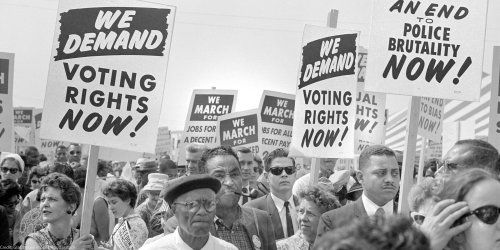
Civil rights leaders are planning rallies and protests. They reject a return to Jim Crown and second-class status. On April 30, the No Kings coalition organized protests. It was also seen at hundreds of protests on May Day.
Many also raised the issue of DEI (Diversity, Equality and Inclusion) that has come into prominence now that the Supreme Court has outlawed affirmative action.
The African American working class plays an important role in unions and union leaders have denounced this decision. This includes SEIU and teachers’ unions as well as nurses and airport workers.
The Democratic Party of course sees the ruling as a way of diluting its power. That transactional view of the Black community remains a problem.
The bottom line is that the white supremacist ideology assumes that the country is a white-ruled country with the oppressed and discriminated minorities forced to accept our place. We are definitely not viewed as equals. The aim of Trump and his regime: Jim Crow 2.0.
Source: Against the Current.