
 Version imprimable
The teachers’ strike: a people in motion
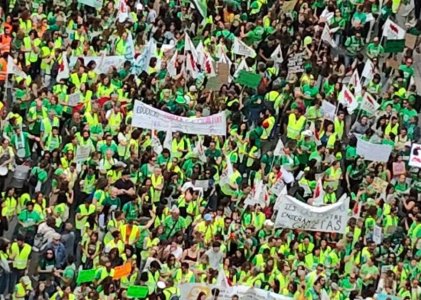
Powerful also because of the process itself. It had been decades since the Valencian Country had seen such a large workforce challenge the Valencian government with an indefinite strike. This strike is not defensive—aimed at preventing a company closure or the loss of rights—but offensive—demanding improvements. Furthermore, it is not merely a union-driven strike; in addition to salary increases and better working conditions, the teachers are fighting for a better, higher-quality education for everyone, taught in Valencian. This is why they have received widespread public support.
But let’s leave this part aside, already explained in a previous editorial, and focus on another element. One of the most fundamental aspects of the teachers’ strike is the energetic grassroots organisation, in unitary central assemblies, which have played a key role, both in pushing the undecided to join the strike and in explaining to the educational communities the reasons for this struggle and the reasons why it is so important for teachers, non-teaching staff, students and families, in short, for the whole of society.
An organisation that—despite all the differences—is reminiscent of the wave of solidarity and self-management that followed the disaster of the DANA storm in October 2024. [1] Then, as now, it was the people who mobilised autonomously, without waiting for instructions or slogans, to demand that the rulers do their job. Then as now, these events have been a source of empowerment and awareness on an industrial scale. They are—like the 15M or Indignados movement, the Catalan independence process, the housing unions, and so many others—the kind of processes that can topple governments and change a country’s political culture.
As Manel Pitarch says in his article: “The indefinite strike is the result of political confusion and a disregard for thoughtful, respectful dialogue.” Or, as Vicent Maurí argues in his, translated below: “The indefinite strike is already a moral and political victory against an arrogant, authoritarian government completely out of touch with the reality of educational institutions.”
They have good reason to be nervous at the Palau de la Generalitat [2] about the teachers’ revolt and the entire educational community - a nervousness betrayed by the terrible letter that Councillor Carmen Ortí sent to families last Thursday [3] - because every day that this conflict grows and becomes entrenched is one less day they have left in government.
11 May 2026
We will win: unity is our strength
May 11th will be etched in the collective memory of the Valencian people. The teachers, the grassroots and union movement, and the entire educational community will make history for the dignity, determination, and strength they demonstrated during weeks of mobilisation and organisation. The indefinite strike is already a moral and political victory against an arrogant, authoritarian government that is completely out of touch with the reality of educational institutions.
The Minister of Education, Mari Carmen Ortí, has gone from being the political head of Valencian public education to becoming the symbol of imposition, repression and contempt towards teachers. Her administration has brought nothing but chaos, hidden cuts, excessive workloads, union persecution, and a complete inability to listen to the educational community. She has preferred to govern from her office, surrounded by propaganda and subservience to private interests, rather than go to the schools and listen to the outcry of those who sustain public education every day. `
And at the top of this offensive against social and labour rights is the president of the Generalitat, Juanfran Pérez Llorca. His government represents the worst side of politics: authoritarianism, empty propaganda, and confrontation with public services. They have tried to subdue the teachers with fear, threats, and abusive and unjustifiable minimum services, turning a fundamental right like the right to strike into an anti-democratic obstacle course. The imposed minimum services are not intended to guarantee any citizens’ rights; they are intended to break the strike and intimidate the workers. This is a practice unworthy of a government that claims to be democratic.
But they have failed. And they will fail. Because this strike is not just a union response. It is a collective, grassroots, deeply democratic movement born from below. This is the response of thousands of teachers tired of precarious working conditions, institutional neglect, and the progressive destruction of Valencian public education. It is also the response of families, students, and staff at educational centers who know that defending public schools is defending the future of our people.
And if this strike is making history, it is above all for one fundamental reason: union unity. Unity built from the ground up, from local unions, from assemblies, and from a shared will to stand up for what is right. An essential unity that has set aside party labels and individual personalities to put workers’ rights and the defense of public services at the forefront. This is the movement’s greatest strength: trade union and popular unity.
We must strongly advocate for this unity because it is the key to any future victory. When unions coordinate, when assemblies speak out, when the educational community moves forward together, governments tremble. And this is exactly what is happening. The Valencian government is nervous because it knows that this strike could open a new cycle of social struggle in the Valencian Country.
It is also important to highlight that this struggle has transcended borders. The solidarity shown by unions and organisations in the Spanish state and around the world demonstrates that what is happening in the Valencian country is part of a global conflict between the interests of the elites and the rights of the majority of society. The support of the Confederación de Educadores Americanos (Confederation of American Educators), Federación de Sindicatos de Docentes Universitarios de América del Sur (FESIDUAS or Federation of South American Teachers’ Unions), the Forum for Education in Ibero-America, Education International, the French union Solidaires, and the International Network of Solidarity and Struggles is a demonstration that the struggle of Valencian workers is also the struggle of millions of people around the world against precariousness and authoritarianism.
Tomorrow nothing ends — a new stage begins. This strike must serve to extend the conflict and the mobilisation to other sectors of public administration and the world of work. The situation in education mirrors that of healthcare, social services, public transportation, and so many other sectors hit by cuts, privatisation, and the erosion of rights. A comprehensive response from the entire working class is essential.
For this reason the message is clear and resounding: we will win. We will win because we have the strength of reason and the strength of unity. We will win because no government can defeat an organised people. We will win because the teachers and other education workers have decided to rise up and never kneel again.
10 May 2026
Translated and annotated by David Fagan International Viewpoint from Vientosur 15 May 2026.