
 Version imprimable
History has no philosophical meaning. But it is politically intelligible and strategically thinkable, because, in real history, the vanquished are not necessarily wrong, and the victor is not necessarily right.
Daniel Bensaïd
The post-election scenario of the 17 May 2026 Andalusian regional elections has put the Partido Popular’s (People’s Party or PP, the major conservative party) absolute majority model in crisis, as it falls back to 53 seats, losing its parliamentary dominance. The social-democratic Partido Socialista Obrero Español - Andalucía (Spanish Socialist Workers Party-Andalusia or PSOE-A) of María Jesús Montero, although it gained 60,000 votes, obtained the worst result in its history with 28 seats.
Meanwhile, the sovereignist left of Adelante Andalucía (Forward Andalusia), led by José Ignacio García, rose to 8 deputies (400,000 votes), surpassing in relevance the project of Por Andalucía (For Andalusia, an alliance of Podemos Andalusia, the Communist Party and several other groups) headed by Antonio Maíllo, which while losing some 20,000 voters has maintained its 5 seats.
Initially, it seems clear that the 8.71% increase in voter turnout to 64.84% (recovering levels not seen since 2015) did not benefit the PP of Moreno Bonilla. While the right-wing bloc (PP, VOX and Se Acabó La Fiesta –the Party is Over or SALF) increased its share by 163,365 voters, the left-wing bloc gained 271,748 votes.
Is this the beginning of a shift in dynamics? To attempt to formulate an answer, our perspective cannot begin with the latest election results, but rather with an analysis of Andalusian political history. In this regard, we operate on a fundamental premise: there is no electoral victory without a prior social and political victory. In the south of the Spanish state, the right wing did not conquer the institutions by chance in 2018; it did so by first winning the battle for "common sense", displacing collective frames of reference and colonising the public agenda long before the ballot box validated its hegemony. The real thermometer of this transformation was not found within the framework of surveys, but in the micro-politics of everyday life: in conversations in workplaces, in the fruit shops and in the bars of working-class neighbourhoods. There, the demobilisation of traditionally left-wing sectors and the lack of a project that could inspire have created a scenario where disengagement from public and common affairs is the norm. While the left became mired in technocratic management or sterile internal debates, the right managed to normalise its narrative, taking advantage of the existential void left by the disintegration of the traditional PSOE-A project.
But has the PP’s model of absolute majority now irreversibly broken down? What are the real limits of right-wing hegemony in Andalusia? Is there a groundwork for a reconstitution of the left-wing bloc?
2012 - 2018: Susana “it all started with you” [1]
As we explained in an article four years ago, in 2018 in Andalusia an “(almost) natural relationship built over four decades” was broken. For the first time, the association of the (Andalusian) people, (left) ideology, the (working) class, the (PSOE) party, and the Junta (Regional Government of Andalusia) administration was no longer in equivalence. The Junta changed hands almost eight years ago, but the left had lost ground long before that.
Without the power of the Junta, the party has become almost a ghost since the 1980s, a "body without a soul," and now without the bones that supported that body through public institutions. The loss of the Junta reflects the profound existential crisis and strategic disorientation of the PSOE-A, a process marked by three fundamental milestones.
First, 2012 and the Pact of Necessity. After the fallout from the ERE scandal and the 15M movement [2], the PSOE turned to Izquierda Unida (United Left or IU, an alliance of the Communist Party and other groups) to survive, highlighting the end of its hegemony. Second, the liberal shift of 2015. Under Susana Díaz, the party broke with the left and allied itself with Ciudadanos. [3] In a suicidal move in terms of territorial identity, the PSOE-A abandoned the concept of "Andalusia" as a political entity to embrace a statist, centralist, and Spanish nationalist discourse, conditioned by the Catalan independence movement, unsuccessfully attempting to win over the conservative vote. And third, in 2018 we witnessed the active abstention of the left-wing voter, in the face of a drift that they no longer recognised as their own, putting an end to the symbiosis between party and administration.
2018 - 2022: the consolidation of the right-wing bloc
The Andalusian People’s Party made an unprecedented leap, going from its historical low in 2018 (remember that Moreno Bonilla achieved the worst results for the PP in Andalusia, 20.75% and 26 deputies), to leading the conservative bloc through a sophisticated absorption of its competitors and a management of differentiated profiles, which led it to an absolute majority.
In the first place, the key political operation was the instrumentalisation of Ciudadanos and the absorption of its electorate after co-government from 2018 to 2022. As we explained in Andalucía: Crónica de una muerte anunciada, Cs was a "lever" to capture the moderate PSOE voter (who still felt distant from what the PP acronym represented). As a good majority partner in Andalusia and after unseating Cs at the state level, it occupied its electoral space without resistance.
By 2022, Moreno Bonilla’s neoliberal government actions moved swiftly along the same tracks that Susana Díaz’s PSOE had set. Healthcare agreements, cuts and privatisations to education and other public services (forest firefighters, emergencies, etc.), as well as the neoliberal idea of the Andalusia Brand, did not begin with the arrival of the PP to the Junta. Remembering this, and insisting on it, is not an affirmative bias of a particular political tendency; it entails an analytical necessity without which we cannot understand the politicisation of Andalusian society, which has accumulated decades of experience in public policies in favour of the private sector in Andalusia.
Therefore, secondly, we must discuss the communication strategy of the Andalusian PP. Faced with the rise of the radical right, the PP is playing two cards: Ayuso’s Castilian Trumpism and Juan Bonillas moderate profile. Its success is resounding; here, VOX is central, like the "bad cop" who makes the other one look good. This empathetic tone dismantles the fear of the right and demobilises class resistance. So, the question that needs to be asked is: why has the PP lost its absolute majority? We will try to answer this step by step and from different perspectives.
2026: The PP loses its absolute majority and puts a stop to VOX. Is the party over?
As we said at the beginning, the right wing has gained the support of more Andalusians in these elections. Thus, it seems clear that the insufficient votes for Ciudadanos (Cs) to secure representation in 2022 (121,567, 3.29%) have been fully absorbed by the PP (whose growth is approximately 146,000 votes) and VOX.
However, a third, invisible actor must be factored into the equation. Although without parliamentary representation, the more than 100,000 votes cast for Se Acabó La Fiesta (SALF) have contributed to the PP losing its absolute majority. Analysing the situation province by province, SALF could have cost the PP at least two seats (in Málaga and Seville), in addition to halting the electoral rise of VOX.
One of the things that election day allows us to do is engage in dialogue with our own poll watchers and observers (both our own and those from other parties), as well as with the voters who come to the polling stations. There, often in an exercise that anthropologists call "participant observation," we obtain very valuable information for understanding certain dynamics that may or may not ultimately influence the final results. On the one hand, “I’ll still vote for the PSOE, but this time four of my family members are going to Adelante,” “we voted as a couple, one for Por Andalucía and the other for Adelante.” On the other hand, PP representatives recount how their families split their votes between the PP, VOX, and SALF. We’re not talking about sectors recently captured from the right-wing movement, but rather traditions fraught with internal tensions that manifest themselves within families through a division of votes within the bloc.
In this sense, to understand the changing landscape of May 17th, we cannot look solely at the emergence of Adelante Andalucía (fundamental, as we will analyse below), but also at the internal disputes within the conservative bloc. Ultimately, it is a matter of understanding how and to what extent the right wing’s hegemony extends in Andalusia today, and what its margins are in future electoral contests.
Fortunately, although with frustration and helplessness at the lack of initiative from politics in Andalusia, during the last legislature left-wing people have not stopped advancing their criticism of the Moreno Bonilla government. The movement for healthcare, housing, labour rights, etc., despite defeat in many of its struggles, is gaining social influence. It is within this context that the strategic contribution of José Ignacio García [4] and Adelante Andalucía in the Andalusian Parliament finds its place and meaning. In 2022, we asked ourselves whether the left should “continue to be the caboose of social liberalism or whether it is possible to build a real sovereignist alternative.” The work of these past years and the outcome of the 17M protests have begun to write an answer.
17M: Left-wing sovereignty wipes the smile off Bonilla’s face
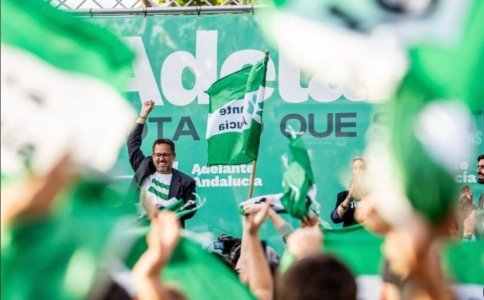
While María Jesús Montero of the PSOE and Antonio Maillo of the Communist Party of Spain (PCE) and IU have performed within the expectations of their respective parties (which in both cases speaks to the resilience and the social and militant body of both political spaces), Jose Ignacio García’s Adelante Andalucía has added more to the left-wing bloc than expected, exceeding all predictions, with the good and not-so-good that this entails. Today, the role of VOX in this legislature and the potential consequences for people’s lives are a major concern for the people of Andalusia. This concern must be kept in mind from the outset to stay attuned to public sentiment and to prepare a response.
To try to explain the result of Adelante Andalucía we will talk about four factors: the predictability of the result, the place of Adelante Andalucía, the new Andalusianism and its communication policy.
First, the predictability of a right-wing victory opened a window of opportunity. In a context more open to the possibility of a change of government than the current one, there would have been more pressure on the emerging force, fostering the anti-political mantra of unity for unity’s sake, which is resurfacing like the boy who cried wolf in certain sectors of the left. Therefore, the 2026 scenario presented possibilities, and Adelante Andalucía understood this from the outset.
Second, was the platform from which Adelante opposed the Moreno Bonilla government. Although somewhat weakened, the call did not come at a time of social and political weakness for the right wing. However, Adelante Andalucía has been better able than other political forces to channel the rejection of the PP’s policies. The pertinent question is, why? In our opinion, the PSOE and Por Andalucía share a common denominator: their coalition government at the national level. The result demonstrates that there are thousands of Andalusians who, while disagreeing with Moreno Bonilla’s government, also do not applaud the one led by Sánchez, supported by certain left-wing forces in Madrid. In other words, there are voters who identify with the left-wing spectrum who, had they not been appealed to by this third independent space, would possibly have swelled the ranks of abstention, as in 2018 and 2022.
Thirdly, we must point to the “new Andalusianism.” For over a decade, we have witnessed a resurgence of Andalusian nationalism within associations, the cultural sphere, social movements, and so on. From the Andalusian feminism of Mar Gallego to the housing movement in the form of “corralas” (traditional tenement buildings). From Andalusian historical memory with activists like the Maqueda sisters, to the proliferation of popularisers like Antonio Manuel; influencers with an Andalusian accent like Manu Sánchez, Sara Laupers, Juan Amodeo and Sandri; or artists like Califato ¾, La Plazuela, Dellafuente… It is no surprise that Andalusia is the cradle of great cultural creators and social and political activists. What is new, however, is that in the last 15 years we have seen a resurgence of concerns about Andalusian identity, both in popular and cultural terms. All of this, within a turbulent national context and an international crisis, has contributed to building a sense of belonging, pride, self-esteem, and a reconnection with our own history. Ultimately, it has nurtured and rebuilt our sense of community. Given this, it was only a matter of time and initiative before this social impulse would find its political counterpart. While other political movements have used Andalusia as a bargaining chip, some, since the emergence of Podemos, have been charting their own course. An Andalusia for itself, for its people, and for humanity, an Andalusia that, from a sovereign perspective, now has its place.
Fourth, regarding the importance of communication, we want to highlight the analysis carried out by activist Macarena Hernández in her article La alegría como brecha: cosas que ha entendido Adelante Andalucía (“Joy as a Breach: Things Adelante Andalucía Has Understood.”) Without going into detail, we highlight some key ideas: Jose Ignacio’s role as Teresa Rodríguez’s [5] replacement; the appeal to joy; and the continuous media exposure of recent years.
Regarding Teresa, she has faced bias due to her identity as a young, combative, feminist woman, and, crucially, an Andalusian with a strong accent, making her the perfect target for hate from pundits and digital "gentlemen." José Ignacio, on the other hand, operated from an angle of less media resistance; a gender and profile advantage that the campaign skillfully exploited.
In this scenario, Jose Ignacio has focused on highlighting concrete elements that connect with general, tangible dynamics—the things we eat—without resorting to abstractions. In this sense, the discourse that Jose Ignacio has intelligently crafted, supported by his communications team, can foster a greater degree of connection with multiple sectors, in contrast to more in-depth analyses that might widen the gap between the spokesperson and the voter. The key, therefore, will be to develop these specific elements to convey more complex explanations to the public in the medium term, appealing to the universal material problems of the poor. Adelante’s potential to become a viable alternative actor with a solid long-term social base may depend, in part, on this. This also requires taking shape, participating, and organising in assemblies and social spaces.
Regarding “joy,” we recall a reflection by Miguel Romero, who stated that “politics cannot be done without people’s feelings.” Therefore, we echo the words of Macarena Hernández when she affirms that “people don’t just vote for proposals; they vote for emotional frameworks in which they can recognise themselves.” We are feeling-thinkers, and we don’t think unless the issue moves us. In this campaign, joy has been named and conveyed as that of someone who has nothing to lose and everything to gain.
Finally, and equally important for us, we must point out that none of the above is very effective without media visibility. In this regard, we believe it is necessary to highlight the results of 2022 and the political work carried out over these four years. Campaigns can only do so much, but without certain conditions—good spokespeople, good platforms, and good speeches—they can’t work miracles. You simply can’t ignore the social and political conditions of each era.
Who Voted For Adelante Andalucía?
In the absence of further post-election studies, our hypothesis is that Adelante Andalucía has consolidated most of its base (those 168,960 in 2022), has brought many people who voted for the forces of change in the 2010s wave out of abstention (less structural -long-term- and more cyclical -2018 and 2022-), and has played an important role in attracting new voters.
Thus, on the one hand, the consolidated vote has a matrix of continuity from the period prior to the refounding of Adelante Andalucía in 2021, that is, it is a voter who has mostly made the journey from the convergence of 2018 to the present and moves between left-wing and Andalusianist coordinates.
On the other hand, regarding the vote from abstention, our hypothesis is that most of it comes from the remobilisation of part of Podemos voters in 2015 (among those 592,371 votes that gave 15 deputies in Andalusia). This profile, which perfectly aligns with the position from which Adelante Andalucía has been in opposition, is a voter who before 2015 may have supported PSOE or IU due to tradition or ideological affinity, but who is defined by being more informed, less passive, and more critical of both the social and political situation and the internal dynamics of the parties. We must also consider that activist sector and those voters who were critical of the regional and municipal coalition in 2018 and 2019. And now, in a context of erosion of the state coalition government (due to various issues), that voter has been reactivated in a specific way, nothing more and nothing less.
A more detailed analysis would be warranted for the phenomena occurring in provinces with a greater presence of Adelante Andalucía, such as the Province of Cádiz, where the struggles within the territory and the former Mayoralty of Cádiz may have opened a crack in the base of the Por Andalucía space (especially IU) if we consider the loss of votes compared to 2022 (being the constituency where it loses the most voters).
And finally, without confusing wishes for reality, we do believe that Adelante has been one of the main forces attracting new and young voters, perhaps because of its fresher and more up-to-date character.
With all the above elements, the result for Adelante can explain at least up to four of the seats taken from the right (Cadiz, Cordoba, Malaga and Seville), which have taken away the PP’s absolute majority. It also took two seats from the PSOE (Huelva and Granada), not because it lost votes, but because Adelante performed well among new voters and gained more support from those who had abstained. Meanwhile, in Andalusia, it held steady with almost unchanged results, with negligible net vote transfers.
New problems, good problems
The relaunch of Adelante Andalucía in 2021 arose as a response to the "weak hypothesis" of the left, subservient to the PSOE. Faced with the frustration generated by coalition governments that fail to address the underlying causes of inequality, Adelante proposes an independent Andalusian political entity with a genuine ambition for its own power. It’s "strong hypothesis" is based on a forceful confrontation with the right wing, political independence from the PSOE-A, and the definition of Andalusia as a Political Subject (sovereignty to break with its historical role as an extractive periphery), compatible and articulated with an open and universal class and popular solidarity.
Now it’s time to consider how the opposition to the right wing in Andalusia will continue and what role Adelante will play. These are some questions that we believe should be asked at some point: What parliamentary strategy will Adelante follow and how will it integrate it with a stronger territorial presence where it is still insufficient? What conditions must be met for any kind of collaboration with other progressive forces? How can we restore confidence in the plurality of a left-wing political space without resorting to backroom deals or fictitious alliances? And what about expectations for the municipal and general elections? Will Adelante Andalucía remain focused on its own territory or will it look further afield? Will we settle for a Frankenstein territorial solution à la Rufián, [6] without any real common debate or proposals? Will we seek a cordial solution consisting of "each in their own territory" but turning our backs on each other without any programmatic agreement for the period ahead? Are we giving up on setting conditions (no subordination to the PSOE, redistribution of wealth, ecological transition, no to war or militarism, breaking ties with Israel) to make collaboration possible in a broad-based meeting place? Or will we seek common programmatic points for the period, demanding flexibility from all actors to acknowledge the independence of parties, with compromise electoral solutions in specific territories, based on a framework of agreed-upon agreements and differences? On the other hand, is the Portuguese experience of the Bloco and PCP [7] one from which to learn and surpass?
All these questions, and many more, don’t have a direct answer within the dynamics of political parties. Rather, from our perspective, it would be a mistake for the Andalusian working people to delegate the strategic debate to Adelante or any other party. Without social, cultural, and political struggles gaining influence in Andalusian society, taking root, and forging new paths, there will be no electoral victory or lasting political power.
Today the right-wing bloc is based on the mobilisation of 2.5 million Andalusians (805,155 more than PSOE, Adelante Andalucía and Por Andalucía) with a participation of around 64%. These figures, if we recall, haven’t been achieved by the left-wing bloc since 2004 and 2008, with the absolute majorities won by Manuel Chaves’s PSOE-A, with one caveat: back then, voter turnout was more than 10 points higher than it is now. The left and Andalusian nationalists have valuable experience from that period. The right does too. We mustn’t confuse our wishes for reality. The game is on, and we have to play it. If we fail to show up or simply repeat the same old tactics, we already know the outcome. The right wing is far from relinquishing control; we’ll have to wrest it from them with all our energy and intelligence. Today we’re far from our goal, but after the May 17th regional elections, we’re a little closer to making our mark on the history of Andalusia in the next decade.
In 2011, three months before the outbreak of the 15M movement, the comparsa [8]“Los Currelantes,” led by Jesús Bienvenido—the same Jesús Bienvenido whom the PP so fears and wants to censor—accompanied by a young lead singer, José María González “Kichi,” sang a pasodoble dedicated to Marcelino Camacho with a clear message for the working class. Today, 15 years later, we continue to say the same: “Always Forward and always to the left…”
"It is necessary to dream, but on the condition of believing in our dreams. Of carefully examining real life, of comparing our observations to our dreams, and of scrupulously realising our fantasies."
Lenin
25 May 2026
Translated and annotated by David Fagan for International Viewpoint from Vientosur.