
 Version imprimable
Since this wave of xenophobia swept through the country, hundreds of spaza shops — small local grocery stores — run by foreigners have been looted and physical assaults have taken place, leading to the exodus of 25,000 people.
Social breeding ground
To explain these mobilizations of hatred, social misery is often rightly highlighted. Nearly two-thirds of South Africans live below the poverty line in what remains one of the most unequal countries in the world. Indeed, 10% of the population — the majority of whom are white — owns 93% of the country’s wealth. The post-apartheid system, plagued by corruption and negligence, has proved incapable of meeting the aspirations of the population, while mass unemployment feeds despair.
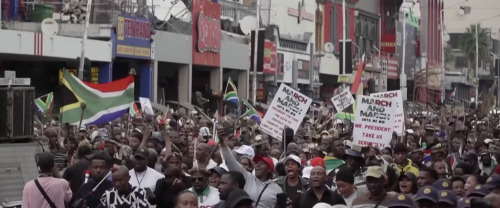
Such a situation is ideal for organizations like Operation Dudula. The latter has made a name for itself through actions aimed at prohibiting foreigners from accessing hospitals. More recently, the March and March organisation, born in KwaZulu-Natal and led by former radio host Jacinta Ngobese-Zuma, continues to associate migrants with all the country’s ills: unemployment, delinquency, violence and so on.
Political manipulation
Beyond this social stagnation, some politicians are stirring up hatred towards foreigners and supporting, including financially, Operation Dudula and March and March. This is notably the case with the Inkatha Freedom Party, whose electoral base is mainly Zulu, the former mayor of Johannesburg Herman Mashaba, founder of ActionSA, who claims to be a libertarian, as well as Jacob Zuma, a former president of the Republic forced to leave power following corruption cases on an unprecedented scale. All of them are seeking to instrumentalize these mobilizations in the run-up to the local elections scheduled for November 2026.
While the leaders of the African National Congress (ANC) are now calling for calm, their responsibility in this deleterious climate is immense, as illustrated by the crackdown on the Stilfontein mining site in January 2025. The authorities then starved 93 illegal miners to death while conducting a campaign insisting on their foreign origin. By dint of media hype, they had managed to banalise, for some of the public, contempt for the lives of these migrants.
Resistance organized
In response to these events, a front of 160 trade union, political, social, religious, customary and human rights organizations has formed to combat what is now being called “Africaphobia”. Julius Malema’s Economic Freedom Fighters (EFF), despite the many criticisms that can be levelled at some of their positions, have maintained, with a certain political courage, a line of solidarity towards migrants, in line with their proclaimed pan-Africanism.
As for the Abahlali baseMjondolo movement, which brings together several hundred thousand inhabitants of the townships, it has said: “Xenophobia will not fix broken toilets, unemployment, or housing. It will not ensure a fair distribution of land and wealth. It will not restore the dignity of the oppressed. A person is a person wherever they may find themselves. A neighbour is a neighbour and a comrade is a comrade wherever they may come from”. [1]. May this statement be heard.
Translated by International Viewpoint from l’Anticapitaliste.