
 Version imprimable
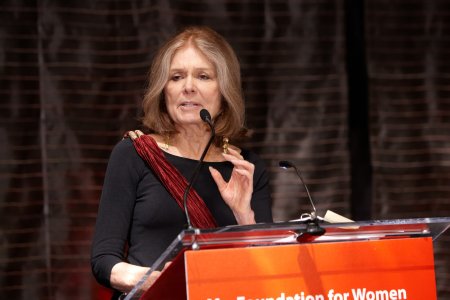
Yet all of her adult life Steinem was a champion of women’s full economic, social, and political equality. She argued that women should choose whether or not they wished to marry and have children. She advocated women’s right to be able to work in all jobs and professions and to be paid equally. She believed that women should have sexual and reproductive freedom, free universal childcare, and that men should take equal responsibility for child rearing and domestic work. While initially critical of the trans movement, she evolved to become a stalwart supporter. [2] In an early interview she said, “The guts of the movement is the working woman…. It’s the blue-collar working woman who needs these reforms the most. Also poor women and welfare women. And it’s an important bridge between Black women and white women.”
But it is also true that she hobnobbed with the wealthy and politically powerful; that she often chose the political establishment over its critics and opponents. And she never challenged either capitalism or the liberal state.
Steinem, whose parents divorced and father left when she was ten, had to care for her mentally ill mother, so didn’t go to school until she was eleven. An avid reader, she graduated from high school and was then accepted into the prestigious Smith College where she graduated cum laude in 1956. She became a journalist, working from 1958 to 1962 with the Independent Research Service (IRS), a CIA front organization that attempted to influence the Soviet-sponsored international youth festivals in Europe. When the CIA’s role was revealed in 1967, she disingenuously defended its work as promoting dialogue. She ignored its role as an agent in the organization of imperialist coups and wars in Guatemala, Vietnam, and Chile.
She first won recognition as a journalist when in 1963 she worked undercover as a “bunny” at the Playboy men’s club and wrote an exposé on the sexist treatment of the young women employed there. As a freelance journalist her articles on birth control, women’s wages and working conditions, the women’s liberation movement, and politics were published in the glossy magazines New York, Cosmopolitan, Vogue, and Glamour.
In 1971 she founded Ms. Magazine, Ms. referring to the neutral title, as opposed to Miss or Mrs. that became popular in the 1960s and 70s because women felt they should not be defined by their relationship to men. Ms popularized—some said diluted—the feminists’ program.
Steinem used her growing fame and influence to advocate for political causes. In 1971 she joined with other feminist leaders such as writer Betty Friedan, congresswomen Bella Abzug and Shirley Chisholm to found the National Women’s Political Caucus to support women running for political office. When Chisholm, the first Black woman to be elected to Congress, became the first Black woman candidate for president on the Democratic Party ticket—in the face of the hostility of both the male leadership of the Black civil rights organizations and of the Democratic Party—Steinem became a Chisholm convention delegate.
In the 1980s and 90s, Steinem was an honorary chair of the Democratic Socialists of America. Yet though DSA endorsed Sanders, she chose to support Hilary Clinton and ridiculed women who backed Sanders, saying, “When you’re young, you’re thinking: ‘Where are the boys? The boys are with Bernie,’” She was widely criticized for her shockingly sexist remark and later apologized.
In supporting Clinton, she seemed to have forgotten what she said in 2011, “Revolutions that last don’t happen from the top down. They happen from the bottom up.”
7 September 2026