
 Version imprimable
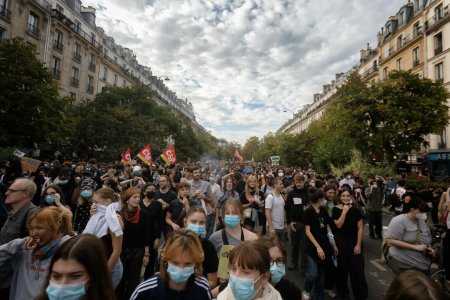
This movement began in working-class neighbourhoods, where secondary school pupils face the harshest study and living conditions in the country, with a lack of resources – including staff shortages and the poor state of school premises – that undermines their ability to study, alongside social discrimination embodied in particular by Parcoursup [2], linked to pervasive racism and authoritarianism. It is the ‘unrestrained’ repression, in the words of the Minister of the Interior – by which we must understand that the police allow themselves to maim, blind, torture, beat and imprison people… – that has extended the mobilisation to the youth as a whole. Whilst trade union and political organisations have been reluctant in recent years to launch protests, young people can be proud of their united response. Young people are championing the social struggle, the anti-racist struggle and the struggle for Palestine.
A mobilisation to be understood in its context
This mobilisation can only be understood by analysing the social situation and the ongoing political and class conflicts in France. Buying power has deteriorated sharply, particularly due to food and energy prices, whilst the quality of public services is increasingly deteriorating (transport, housing, education, healthcare!), and the government’s legitimacy is very low. Protests were planned for 17 October and 5 November to demand improved purchasing power, following an initial day of action (29 September) on the civil service, which met with a mixed response.
The violence perpetrated by the government must also be understood within this context: those in power are afraid; they realised very quickly that the movement could spread and give rise to a widespread expression of social and political anger. They believed that the authoritarian and racist atmosphere would enable them to make this repression acceptable, but they miscalculated. It attempted to curb the mobilisation on 6 October with widespread bans on gathering outside secondary schools – a completely unprecedented and ultra-authoritarian measure – and here too it was both unable to enforce this ban and completely overwhelmed by the scale of the mobilisation. This measure also shows, once again, that the danger of dictatorship does not come solely from the RN. It is even possible that, to resolve the current crisis, the ruling class is prepared to form an alliance between the right and the far right.
And now? Let’s build!
An extraordinary movement must consolidate and – without a doubt – will consolidate. The government’s attempt to set aside time for debate in secondary schools over the coming days will fail miserably, because it does not meet young people’s need to express themselves freely, without institutional constraints, and because the movement has already spread far beyond secondary schools.
To consolidate, several points are essential:
• Demands. The movement must seek to adopt a platform of demands, with a budgetary package at the forefront to lift students out of poverty – for example, 20 billion euros (the FSU [majority teachers’s federation] is calling for an emergency plan of 5 billion per year for 10 years) – and a maximum class size of 25 pupils. It must categorically oppose any form of selection: we must put an end to Parcoursup and MonMaster, and return to the principle that ‘every student has the right to enrol on the course of their choice at the university of their choice’ (the Savary Act of 1984). Other demands will emerge within the movement, concerning resources, teaching methods, Palestine, racism and the environment, even if it will be difficult to give them the concrete strength needed to succeed. The disarmament of the police would be one feasible concrete demand.
• Self-organisation, mass mobilisation and unity. Every movement must strive to maximise the self-activity of the masses. This concern creates constant tensions between self-organisation and the unity of organisations, between the radicalisation of a minority and the need to bring everyone on board, and between the structures of self-organisation and the organisations themselves. It is the responsibility of activists to work towards building democratic frameworks for self-organisation – that is, frameworks which do not merely bring together a minority but constantly seek to mobilise more broadly and in a united manner, which means making compromises. To make compromises and build democratic representation that enables political action, we must seek to establish national coordinating bodies and a central strike committee.
• Make the general strike a real threat. For over 40 years, no movement – particularly a youth movement – has succeeded without making those in power fear the possibility of a general strike. The movement must therefore make it a priority to reach out to workers. Without abandoning the youth sector – we do not remove secondary school pupils from their struggle simply to go and campaign outside workplaces – but with great determination, particularly in discussions about the pace of the movement and in engaging with trade union organisations – from the grassroots to the top. The first step is to organise a strike in the education sector, as blockades by a minority will not be enough and the government will find ways to circumvent them, such as through distance learning.
Beyond the youth movement, activists and organisations have a responsibility not only to relay the key demands of the youth movement, but also to broaden them to include wages, pensions, all forms of income and public services. Demands for a net pay rise of 400 euros and one million new public-sector jobs are measures that can broaden and strengthen the movement.
Building a political confrontation
The mobilisation already has a strong political dimension: it addresses Palestine, racism, class divisions, the legitimacy of the government and Macron. Politicisation is an asset for the movement provided it does not make it lose sight of the need for concrete demands and grassroots actions that strengthen it.
In this struggle, some on the left will seek to sow division by denouncing the trade union apparatuses or politicians seeking election in 2027, or by calling for social revolution. On the other hand, certain organisations will seek to negotiate, to stabilise the situation, or will refuse to call for Macron’s resignation.
But politicisation must be the concrete expression, at a given moment, of the movement’s level of maturity – Marx said that humanity only poses the problems it is capable of solving. For the time being, it seems possible – both to make gains on specific demands and to highlight the illegitimacy of the government, particularly in relation to the issue of repression – to work step by step on demands such as ‘Macron out’ or ‘Down with the Lecornu government’, to broaden the focus to the broader issue of the budget, the conflict between social needs and the drive towards war, to work towards a general strike (which, as everyone knows, cannot be decreed but must be built), a constituent assembly, and so on, depending on the movement’s level of development.
Preparations for the vote on the state budget are already being jeopardised, and that is a very good thing: the movement will put pressure on all political forces. Starting today, we must call on the entire radical left, particularly LFI, to ensure that unity is not merely electoral, but is also social. The budget debate must not remain confined to the National Assembly, as it was last year. The political organisations represented there have a responsibility to forge links with the social movement on the streets.
The current mobilisation calls everything into question: it is a crisis in the sense that a series of contradictions are coming to a head. It can therefore change everything, from the far right Rassemblement National’s position to the balance of power between the labour movement and other classes. And the outcome of the presidential election. It must therefore be taken with the utmost seriousness, for victory or defeat (which can take many forms, ranging from negotiations to a left-wing headlong rush) will determine a great deal for the coming months, if not years. All the more so as the protests in Spain, which brought down the government, and in Belgian secondary schools, are helping to pave the way.
6 October 2026
Translated by International Viewpoint from Inprecor.