
 Version imprimable
Since its first session in Porto Alegre 2001, the World Social Forums have brought together, on average every two years, tens of thousands of people from around the world and from diverse activist backgrounds to debate. Unfortunately, recent editions have only mobilised a few thousand people – with the exception of Nepal in 2024 – and have been largely centred around the host country, with other continents poorly represented. Furthermore, there has been a shift in the nature of participating organizations, with a decline in involvement from trade unions and political parties (which have never been formally integrated into the World Social Forums), and an increasingly prominent role for non-governmental organizations.
The banning of the Forum
This session was affected by pressure from the Beninese government, which decided to ban the World Social Forum. It is difficult to know whether it acted on its own initiative, particularly in the context of the elections held last April, or under pressure from imperialist forces. Their interests are indeed aligned: Romuald Wadagni, the new president of Benin, sworn in on 24 May 2026, succeeded Patrice Talon, whose Minister of Economy and Finance he had been since 2016, and who became President of the Senate on the very day the Forum was able to open. Their ties with international financial institutions, France, the United States, and Israel are well known.
Nevertheless, a few days before the opening, the government announced that the Forum was not authorized. It was unclear at the time whether it would be banned outright or tolerated, but the day before, a more formal prohibition was issued: the university, where the Forum was to take place, appeared to be closed, several activists were expelled, and the West African caravans [2], which had mobilised nearly 500 people who had arrived by bus, were turned back at the border with Togo. Initially, they were allowed to cross the border, but then the police forced them to turn back. The opening demonstration was also banned.
A meeting of volunteers was held on the afternoon of 4 August, and the atmosphere was subdued, despite the activists’ efforts to liven up the session. The International Council was virtually absent that day, entangled in negotiations with the government. The Council did not, in fact, establish any relationship of forces with the government, contenting itself with negotiating, no doubt hoping that its docility would convince the authorities to let things slide. Mobilization for the World Social Forum had already been very limited, and no international activist campaign was launched to put pressure on the government and denounce these actions. In particular, no strategy was put in place to openly protest, alongside Beninese organizations, against the ban on the demonstration.
On 5 August, fearing evictions and campus closures, the debates were held semi-clandestinely and self-organized. A WhatsApp group brought together dozens of activists, who reported debates taking place in hotel conference rooms or bars. Thus, the CADTM [3]. maintained its programme, continuing the momentum of its own global assembly held in the preceding days. The silence of the International Council triggered a grassroots response. Late that afternoon, it was announced that the Forum could finally take place starting the following day, 6 August.
A disorganized and very moderate Forum
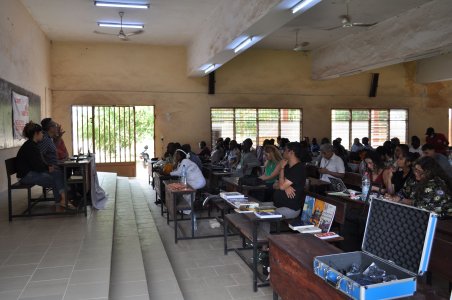
From then on, the Forum was able to take place under almost normal conditions, but with glaring limitations, not least the reduced attendance of around 3,000 people.
Like all social forums, it gave rise to irreplaceable encounters: activists from completely different backgrounds, trade unionists, members of associations, peasant organizations, and individuals who came were able to exchange ideas informally in the cafeterias, at the "festive intergenerational networking evenings," and during some of the debates. Among those present were trade unionists from the CFDT, Benin, and Mali, members of the Communist Party of Benin, the CRID, and representatives from associations in South America, Canada, and elsewhere.
But the ban caused great disorder: part of the debates had been held the day before in an alternative manner, which led to questions about the need to hold the same debates again.
The space where the forum was held—the vast University of Abomey-Calavi in the northwest of the city, the labour exchange in downtown Cotonou, and a few other halls and bars—was disproportionately large for the number of people present. This severely limited opportunities for interaction, as each organization tended to participate in the discussions it was leading without engaging in other initiatives.
The opening forum was held in the large "Idriss Déby amphitheatre" (several rooms in the university are named after African leaders whose construction was financially supported by their countries). But, like most major sessions, it was dominated by an NGO-like mindset : grand declarations of intent on the need for development, the rejection of war, and human rights, without any mention of the means necessary to confront imperialism and dictatorial regimes.
As with the ban, we witnessed a kind of wishful thinking, the hope that things would resolve themselves without any relationship of forces. A striking example was the Algerian delegation, composed of several dozen people and organized by the authorities, who staged a small demonstration at the university demanding rights for Western Sahara, displaying Palestinian flags, wearing t-shirts reading "Algeria: Another World Is Possible," and chanting the slogan "One two three, long live Algeria!" This action is symptomatic of the lobbying exerted by certain regimes on organizations participating in the World Social Forum. Not to mention the associations that are in reality businesses aiming to sell seeds or handcrafted clothing, with very little militant or protest-oriented substance.
The major absentees were the organizations and activists. Beninese people. A few organizations were involved, but this does not appear to have been the case for the majority, and in any event, the vast majority of the population and students on campus were unaware of the event. We were able to meet with a member of the Communist Party who assured us that only a few highly institutional organizations had been involved, such as the trade union federation close to the government, and that, overall, activist organizations had been neither involved nor consulted.
On the Fourth International side, there were about ten of us, from Belgium, France, Mali, Morocco, Pakistan, Switzerland, and involved in different delegations, in particular that of the CADTM, which organized a very comprehensive programme concerning its preferred area of focus, debt, but also the imperialist powers of the West and the East, debates on the nature of the regimes in the Sahel, the mobilizations of Generation Z, etc. [4]
What are the prospects?
The next World Social Forum (WSF) is expected to take place in Latin America, although the decision has not yet been finalised. This challenging edition serves as a reminder of the importance of social forums. Indeed, there is no comparable framework capable of bringing together tens of thousands of people to debate for several days. Some editions, particularly the early ones, as well as the continental social forums, have played a crucial role in the development of the alter-globalization, feminist, and anti-war movements.
In the preceding period, the decline of international and internationalist struggles certainly hindered the development of coordination frameworks and contributed to the dominance of less radical NGOs in social forums. But the resurgence of international struggles, with the Gaza movement, #MeToo, the climate movement, and the establishment of the Porto Alegre Antifascist Conference, demonstrates that it is possible to build internationalist actions that are rooted in grassroots struggles and independent of state apparatuses.
Various organizations are calling for a renewal of the social forums, which must involve independence from states, engagement with organizations of the workers’ movement—particularly in the host country—and grassroots construction. This means seeking funding from below, centrally amplifying major mobilizations, encouraging struggles in the host country, and so on. As in any social movement, maximum transparency, from the bottom up, is a tool for fostering self-activity and the broadest possible participation.
For their part organizations of thw workers’ movement should be concerned about their low participation, which contributes to the diminishing influence of demands within the World Social Forum. This is not inevitable; the World Social Forum can once again become a space for coordinating mobilizations, but this requires significant changes in its objectives and functioning. As the social movements of Latin America stated in a declaration: “The World Social Forum was born affirming that another world is possible. Today, faced with the situation we are confronting, we are called upon to affirm something more: another World Social Forum is necessary” [5].
August 20, 2026
Translated by International Viewpoint.