
 Version imprimable
In the autumn, students and high school students took to the streets in turn. They denounced corruption, demanded better study conditions and the possibility of living with dignity. Faced with a government that responded with repression, the resignation of prime minister Edi Rama — leader of the Socialist Party of Albania and vice-president of the Socialist International! — became a widespread demand.
It all starts with flamingos
Since the end of May 2026, the “flamingo revolution” has mobilized large segments of the population against luxury tourism projects in Sazan and Zvërnec, near the Narta lagoon. Linked to Jared Kushner, Donald Trump’s son-in-law, these projects threaten protected ecosystems and spark anger against the privatization of the coastline by large investor groups. The flamingos, numerous in the lagoon, have become the symbol of this continuous protest, some gatherings gathering more than one hundred thousand people.
Disputed area
However, the protest has spread to the capital, Tirana, gradually moving beyond the environmental issue. The protesters denounce corruption, the opacity of decisions, and a development model that favours oligarchs at the expense of the population’s needs: more social justice, equality, and better living conditions. The temporary suspension of work in Zvërnec was not enough to defuse the protest, which demands the complete cancellation of the project. A slogan is on everyone’s lips: “Albania is not for sale.” One demand is shared by all: the resignation of prime minister Edi Rama, accused of turning a deaf ear to their demands.
The youth take to the streets
On 13 October 2026, after more than four months of mobilization, the protests entered a new phase. Several hundred students gathered in front of the Ministry of Education in Tirana, denouncing the precarious conditions of study and university residences, the cost of studies, and the lack of opportunities that pushed young people to emigrate. To these difficulties was added a fed up with corruption, fuelled in September by the Vlora Hyseni affair. The director of Albanian intelligence (SHISH) was suspended and placed under house arrest. She is said to have had a romantic relationship with Ergys Agasi, an organized crime boss to whom she allegedly passed secret information. The case reinforces young people’s distrust of the government. Edi Rama’s resignation remains among their main demands, as it is for the participants in the “flamingo revolution,” who join youth gatherings.
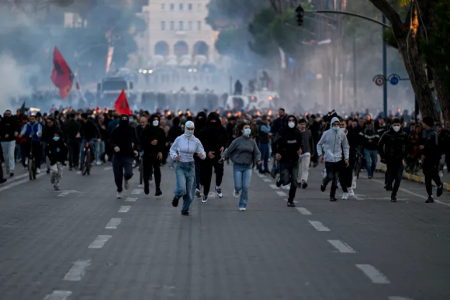
In the days following 13 October, the mobilization spread to several cities and high school students joined the students. The demonstrations were marked by clashes: groups targeted public buildings, banks, and buildings associated with oligarchs, while the police used tear gas, water cannons, and rubber bullets. Arrests multiplied, including of minors.
“A mess of capitalism and totalitarian communism”
As early as 18 October, higher education teachers launched a petition in support of students. It demanded an end to police violence, the resignation of Edi Rama, and the formation of a provisional government. As of 3 November, the petition had gathered more than 1,500 signatures. On 21 October, the University Staff Union (SPUSH) launched a boycott of courses in public universities, in solidarity with students and against repression.
Sali Berisha’s Democratic Party has tried to capitalize on the protest, but some protesters reject this appropriation. In the streets, the slogan already chanted by “the flamingo revolution” is repeated: “Rama in prison, Berisha in prison.” In a country whose political life has been dominated for more than thirty years by the Socialist Party and the Democratic Party, this slogan expresses rejection of the two parties that share power. Calls for a redesign of the political system, a provisional government, and the creation of citizens’ assemblies are heard, without a common and structured alternative yet being established.
This difficulty in building an alternative is not just an Albanian affair, even if it has deep roots in its history, marked by the Stalinist dictatorship and then by the disappointed promises of the transition to capitalism. Rejn, an 18-year-old architecture student interviewed by Reporterre, thus describes the current regime as “a mess of capitalism and totalitarian communism.”
The dictatorship, which claimed to be Communist, has long discredited the ideals of emancipation and equality it claimed to embody. Its fall in the early 1990s raised hopes for new freedoms, but also for growing prosperity and equal opportunities. For part of the youth, these promises today clash with the concentration of wealth, clientelism, oligarchy, and a lack of prospects. Yet the rejection of this social order struggles to translate into a political alternative, as the legacy of the dictatorship continues to weigh on the vocabulary and projects of the left.
Faced with the protests, Edi Rama refused to resign and expressed his support for law enforcement. On 17 October, rubber bullets hit several protesters and journalists. Seven police officers were suspended for alleged abuse of authority and disproportionate use of force. Yet, two days later, Rama announced a bonus of 2,500 euros for each frontline officer, as well as a salary increase starting January 2027.
A febrile regime that shows its teeth
Support for the police is accompanied by a discourse aimed at discrediting the mobilization. Rama accuses foreign actors of seeking to destabilize Albania and hinder its accession to the European Union. On October 19, he blamed Russia and Iran, as well as Antifas. To support this latter accusation, invoked Donald Trump by recalling that the American president has called Antifa a “terrorist organization.”
Rama threatens to deprive students accused of violence against the police of scholarships and public aid. To the parents of minors involved in the damages, he promises to make them pay for the damages, stating that the bill will continue to pursue them “to the end.” He also threatens to suspend or dismiss teachers who would use their professional authority to encourage minors to protest or organize their participation. Under the guise of protecting the youth, these announcements extend intimidation to their family and school circles.
These threats were also accompanied by an attempt to publicly discredit the protesters. On 23 October, Rama released photographs of 45 people he presented as delinquents posing as students. Among them was a 20-year-old medical student accused of producing and selling narcotics. He denied it and presented his academic results. Interviewed by BIRN (Balkan Investigative Reporting Network, an independent network of investigative journalists working on the Balkans and Southeast Europe), the prime minister’s services provided no evidence to support these accusations. On October 29, three other protesters initiated proceedings against Rama for insult and defamation.
At the same time, Rama states his desire for dialogue: he filmed himself setting up chairs in front of the government headquarters to invite the protesters to come and talk. The latter reject him. “We don’t want to talk to someone who despises us,” explains Tedi, a biology student. After months of mobilization without response to their demands, the protesters maintain their demand: the departure of the prime minister.
At the end of October, BIRN recorded about 320 arrests during demonstrations in Tirana, about forty of which involved minors. About a dozen people were placed in pre-trial detention and eight placed under house arrest. The number of injured remains uncertain. The interior ministry reported about a hundred protesters injured as of 30 October, a figure to be taken with caution. The anarcho-syndicalist collective GASP (Grupi Anarko-Sindikalist i Prishtinës, from Kosovo) had already reported more than 110 as of 18 October and reported several serious injuries during the 24 October demonstration. That day, Erjon Vishkulli, 28, was hit in the left eye by a rubber bullet. The scene was filmed and the Tirana prosecutor’s office opened an investigation into his injury.
Blackmail over EU membership
Accession to the European Union (EU) occupies a central place in Edi Rama’s strategy. By presenting himself as the man capable of leading Albania to accession, he seeks to inscribe his name in the country’s history. He also uses this promise to put pressure on the movement. By accusing the protesters of playing into the hands of foreign forces seeking to sabotage the negotiations, he aims to turn the massive protest against his government into a threat to Albania’s European future.
This prospect also serves the interests of Albanian oligarchs. Expanded access to the European market would offer large groups new outlets and new investment opportunities. The question is who would benefit from this opening, even as young people take to the streets demanding better study conditions, jobs, and the possibility to live with dignity in their country.
In the face of repression, the EU limited itself to calling for restraint and respect for the right to demonstrate. The youth of the Albanian diaspora must organize to gain the support of European left-wing and democratic forces so that they condemn police violence and support the demands of youth in Albania. Above all, it must build ties with young people who are mobilizing today in France, Spain, Italy, Portugal, Germany and so on, against austerity, for better living conditions, quality public services, and genuine equal opportunities. The fall of the Stalinist totalitarian regime allowed new freedoms to be gained, but the subsequent transition mainly benefited the country’s oligarchs. For these freedoms to become a reality for everyone, it is now the battle for equality that must be won.
By taking to the streets, Albanian youth first of all denounce a political system they consider corrupt and deceitful. By demanding accessible education, jobs, and the possibility of living with dignity in their country, they also raise the question of wealth distribution in an Albania that has become a paradise for oligarchs and a hell for youth. These demands can pave the way for a challenge to the capitalist order and serve as a support point for common struggles with young people mobilizing in other European countries. The future of Albania, within the EU or outside — it will be up to the Albanians to decide — belongs to those who live there and fight to transform it, not to Edi Rama.
3 November 2026.
Translated by International Viewpoint from Marx21.ch.