
 Version imprimable
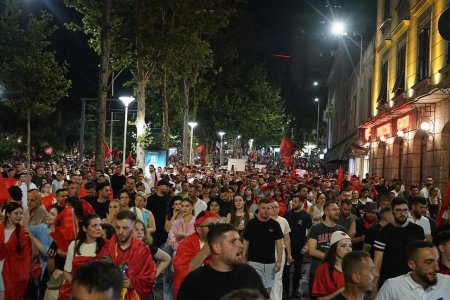
Sometimes, tens of thousands of people take to the streets – in a country with only 2.5 million people. What began as a mobilization against environmental degradation has become a questioning of the system. The Albanian national flag and KLA symbols fluttered in the wind alongside American flags and flamingos. What we are talking about here is nature, corruption, capitalism.
It all started because of a piece of coastline. On the island of Sazan, Atlantic Incubation Partners LLC, linked to Kushner’s investment company, Affinity Partners, wants to invest €1.4 billion. €4.7 billion is also earmarked for tourism projects in the Narta Lagoon near Zvërnec. These two areas are protected; In particular, it is one of the most important European stopovers for flamingos and other migratory birds. They are to give way to hotels, apartments, villas and a marina. For the government of Tirana, this is a prestigious project: international investment, luxury tourism, jobs, growth. For opponents, this is a telling example of the way the government treats Albania.
Initially, the protesters were calling for the withdrawal of the relaxations of the Protected Areas Act, which were passed in 2024 shortly after Kushner’s plans were released. They also called for the repeal of the Strategic Investment Law, which allows for an acceleration of the processing and approval of projects considered to be priorities. Atlantic Incubation Partners LLC has already achieved strategic investor status. But Kushner’s plans are only the tip of the iceberg. All over the country, projects are allowing land with historical and cultural sites as well as ecologically protected areas to pass into the hands of private investors, especially foreign investors, in an extremely opaque manner.
“Albania is not for sale”
This is the slogan chanted night after night by the crowds gathered in Skanderbeg Square in the city centre and on the streets leading to the government district. They no longer want to be mere spectators of an evolution that others decide. During demonstrations, Albanian flags are mainly fluttering, sometimes accompanied by a few KLA flags. The Kosovar-Albanian “Ushtria Çlirimtare e Kosovës” (Kosovo Liberation Army, KLA) still occupies an important place in what might be called the “emotional baggage” of the Albanian national consciousness. American flags are also sometimes seen.
At first glance, it seems paradoxical: a demonstration against an American luxury project – and next to it, the American flag... But it is precisely in this contradiction that the whole meaning of the movement lies.
Elsa Paja is 33 years old; She is a visual artist, graphic designer and activist. She participated in the demonstrations from the beginning. With other artists, she has set up a space where children can draw and express what they feel. “When you look at the messages conveyed by these drawings, you see how much this conflict affects even children,” says Paja. They draw beaches, flamingos, excavators, fences.
The politicization of the demonstrations was rapid: a fenced nature reserve, security forces who violently repressed the demonstrators in Zvërnec. The images of this violence have gone viral. "We were no longer allowed to set foot on our land, that was now clear,” explains Elsa Paja. And suddenly the question was who had the right to decide the future of this country.
The pink flamingo against the oligarchs
Melitian Nezai, a 29-year-old environmental biologist and activist, also became involved in the movement very early on. “The symbol of our revolution is the pink flamingo,” he says. The pink flamingo represents neither a party, nor a nation, nor a leader. It is the very symbol of a living space. Thus, it became the rallying point of a movement that was difficult to classify ideologically. “Left, right, liberals, conservatives: a lot of people are participating,” says Nezai.
The movement has indeed brought together an exceptionally broad coalition, including left-wing organisations, members of the LGBTQ+ community, environmental activists, representatives of the four religious communities, feminist collectives and, last but not least, conservative, nationalist and right-wing forces. This sometimes gives rise to conflicts: for example, it was not possible to wave a rainbow flag, since this was considered unrelated to the cause defended by the movement.
But the boundaries are also blurring. “Albanian boys now wear pink, the colour of flamingos, and think it’s cool,” says Elsa Paja. What unites the protesters: they are simply fed up with the government of prime minister Edi Rama, who calls himself a socialist and denounces the movement as part of an externally orchestrated “hybrid war”.
For Nezai and many protesters, opposition leader (and former prime minister) Sali Berisha is also part of the problem. It is not a question of replacing the government with the opposition party. The problem is the corrupt elites who control the political system.
The Albanian flag is omnipresent. Some of the emblems of the KLA can also be seen. But they do not constitute evidence of KLA’s organizational involvement. On the contrary: the KLA veterans’ organization itself has warned against the instrumentalization of its symbols for current political ends. Activists explain the presence of the many American flags by the traditional proximity of many Albanians to the United States. Similarly, Paja does not direct her criticism in general against foreign investment. “We want investments that benefit the local population, not just the oligarchs and foreigners who have come to take over our country.”
Who decides on land use? Who decides how to use the resources? Who benefits from it? Since the early 1990s, these issues have been troubling Albania.
After the end of the “Socialist People’s Republic of Albania” (1944-1990), the country was subjected to neoliberal shock therapy. While the institutions of a bourgeois democracy were still in their infancy and underdeveloped, privatization proceeded at a frantic pace and the country opened up to foreign capital. Few people benefited from it, and it led to significant social upheaval. The majority of Albanians had no experience of the capitalist market economy and were therefore vulnerable to manipulation. The rapid spread of satellite television made a large part of the Albanian population aware of all that had really or supposedly been missed in more than forty years of isolation under the regime of Enver Hoxha, thus fuelling the desire for quick enrichment.
The mafia pyramid schemes built on exorbitant interest rates, in which politicians from both parties were involved and where a large part of the population had invested their savings, finally collapsed in 1997. The state effectively ceased to function in some parts of the country; popular anger led to the “lottery insurrection,” and clashes worthy of a civil war left more than a thousand people dead.
It is not the chaos of 1997, but the shock therapy, euphemistically described as “transformation”, which has more or less lasted until today; it has become a permanent state. The generation that is demonstrating today does not know so-called “socialism” from personal experience. But it is living with the consequences of its collapse and the neoliberal shock therapy that followed.
A never-ending transition phase
“I’m 29 years old, and we’ve been immersed in transformation for 36 years now. My whole life so far has been just a transitional phase,” says Melitian Nezai. Personally, he is doing quite well: he works for an environmental NGO and earns more than the average salary of 630 euros. On the other hand, other young people his age, such as taxi drivers, work six days a week, twelve hours a day. But the average salary is barely enough to live on, with food prices worthy of Western Europe and small apartments that still cost 400 euros in rent, even in the suburbs of Tirana.
This is why many young Albanians leave the country. Almost five million now live abroad – almost twice as many as in Albania itself. (However, this figure also includes Albanians from neighbouring Kosovo and North Macedonia, who together make up almost two million people.) At the same time, Albanian tourism is booming. Beaches, mountains and historic towns are attracting more and more visitors. Along with the construction sector, tourism is now the main economic driver.
For the protesters, this is not a contradiction, but a facet of the same problem. “We feel like tourists in our own country,” says Elsa Paja. She describes how certain places, increasingly designed for visitors and investors, are now foreign to them. And a society in which young people look for their future elsewhere. “People are no longer there, so they can’t make their voices heard anymore,” says Nezai, who draws a direct link between the exodus and the question of political power. When young people leave, there are fewer people left who are able to oppose the attacks on their regions.
Elsa Paja believes that capitalism and neoliberalism are clearly part of the problem. “While a few benefit, everyone else is excluded,” she explains to describe Albanian society. “People from other countries are now coming to Albania to be inspired by this movement,” says Nezai. They are interested in how resistance against major projects can be organized.
Where is the movement today?
Albanian flags and flamingos: this movement seems to embody a patriotism critical of capitalism, which defends national sovereignty and demands social emancipation. It is above all an anti-corruption movement, without a clear direction and driven by Generation Z. Its symbol, the “Jolly Roger”, a flag adorned with a skull and a straw hat, is omnipresent during demonstrations. In addition to the two established parties, rejected by the movement, there are at least three smaller parties that support the protests.
In addition to a centre-right and a reformist party, Lëvizja Bashkë (“Together Movement”) is particularly worth mentioning: This is a radical, young, ecologically oriented and left-wing force that strives to nurture and build on feelings hostile to those who hold the levers. Lëvizja Bashkë activists were present in the protests from the beginning, documenting incidents – such as intimidation by security forces – and publicising them, allowing the movement to gain visibility beyond local borders. In a way, it constitutes the organizational backbone of the movement; it helps to coordinate demonstrations, speeches, banners and communication – without presenting itself as the only leadership. The movement is calling for new elections – Lëvizja Bashkë would benefit from this.
14 August 2026
Translated by International Viewpoint from Inprecor.