
 Version imprimable
The murderer said he had deliberately targeted people who seemed to him to be “North Africans or black Africans”. Living in another commune in Yvelines, Plaisir, he deliberately chose the city of Trappes. According to an investigation conducted among his entourage, fed on social networks and racist videos, leaning first towards hatred of Jews, with videos of Soral and Dieudonné, dreaming of assassinations like those committed in 2015 against Jewish customers of the Hyper Cacher, a store on the outskirts of Paris. He then turned to a hatred of Arabs, proclaiming his sympathy for the RN. He had printed militant material himself with posters bearing the RN logo.
For more than 30 years, the Front national (FN) and then the RN have systematically targeted working-class municipalities, where families from the Maghreb or sub-Saharan Africa live: Roubaix, Saint-Denis, Trappes, Vénissieux, Vaulx en Velin, the northern districts of Marseille and so on. So many “lawless zones” for many media and politicians. In 1996 Jean-Marie Le Pen proclaimed: “We have given you back Algeria, give us back Roubaix!” 26 years later, Marine Le Pen said: “If we let this happen, tomorrow, there will be a hundred cities like Roubaix, then 10,000 cities. So there is, objectively, an emergency.” Trappes has become, in the Paris region, the main target of this nauseating racist campaign. In 2021, Marine Le Pen wrote on Twitter: “In 30 years, Trappes has become a lost territory of the Republic, under the weight of massive immigration. Mass immigration has been the driving force behind the rise of Islamism in our country”. RN president Jordan Bardella outbid her on several occasions, notably in 2022, after the election of Ali Rabeh, candidate of Génération-s, as mayor: “Trappes is a small Islamic Republic in miniature”.
This tragedy has therefore occurred in a context where these speeches of the current leaders of the RN can spread in the media, without provoking the reactions that the declarations of Jean Marie Le Pen still provoked in the 1990s. The reason for this is simple. The political class, in its vast majority, now wishes to integrate the far right, the RN, as a respectable political force with which government agreements can be built and which can even, as in Italy, assume the leadership of a government.
This obviously implies a definitive break with what remains of the practices, put in place for decades and more or less assumed on the right, of isolating the RN, of refusing any alliance with it. This dam against the RN (which Macron had twice benefited from to be elected in the presidential elections of 2017 and 2022) had worked again for the legislative elections of 2024, allowing, thanks to numerous withdrawals, the avoidance of a majority of RN deputies in the National Assembly. But the New Popular Front and la France Insoumise (LFI) emerged victorious from this phase, and the right as well as the Macronists found themselves destabilized, with the presence of a relative anti-austerity majority in the National Assembly. Since then, the last two years have seen, along with the legitimization of the RN, a haunting mantra displayed in the media and in Macron’s camp, associating LFI and Mélenchon with anti-Semites, violent and enemies of democracy. France Insoumise has been ostracize, insulted and demonized to spread this mantra and create among the maximum number of people a Pavlovian reflex creating, from the very mention of LFI or Mélenchon, a feeling of disgust and rejection.
This has had its small effect in the Socialist Party, since, barely two years after the victorious alliance of the NFP in 2024 (and while no important political event has happened since then) a large number of officials have come to say that it would be out of the question to withdraw for Mélenchon or an LFI candidate against the RN in the next elections. This obsession, this anti-LFI logorrhea, once essentially the work of CNews - the propaganda channel of the billionaire Bolloré - has spread widely to the rest of the media. Thus, a symmetry has been established between certificates of respectability constantly attributed to the RN, the party of order, (carefully erasing all racist insults and provocations, the roots still very much in the ground linking this party to fascism and its criminal obsessions) and anathemas of a curse cutting LFI off from the democratic community.
The tragedy of Trappes has strongly shaken this nauseating system through which a cowardly complacency has been spread while racist words and slogans have just killed and almost provoked a mass murder, since the killer used 128 rounds of ammunition in his shooting. This created a large mobilization in the population, through outpourings of solidarity in Trappes itself, the day after the attack, while in Orléans a demonstration of 26,000 people against the congress of the RN strengthened the desire to create an anti-RN front and a real unity of social and political forces on the left. This was followed by a rally of 12,000 people in Trappes on 30 October.
Despite this, with boundless cynicism, Macron and Lecornu certainly condemned the attack in Trappes, but Lecornu dared to compare the death of Pengo Bossio Wangi to that of the neo-fascist activist Quentin Deranque, who succumbed to his head wounds, received during the confrontation between his group and left-wing activists. As for Macron, he persisted in symmetry, comparing the criminal racism of the far right to the supposed anti-Semitism of the left. To do so is to deliberately erase the mortal danger that the far right represents.
Since then, of course, the media and the government have been trying to put the lid on this tragedy, which should nevertheless require the silencing of Islamophobic words and insults. As Ali Rabeh, the mayor of Trappes, says, racism, Islamophobia, the theory of the great replacement, are not ideas, opinions, they are crimes that should be treated as such in order to put an end to the trivialization of these ideas that lead to discrimination, daily racism, insults and murders. To say that Jews rule the world is, rightly, condemned by the law against anti-Semitism. Is the assertion that Arabs and blacks will replace whites in France less of a crime?
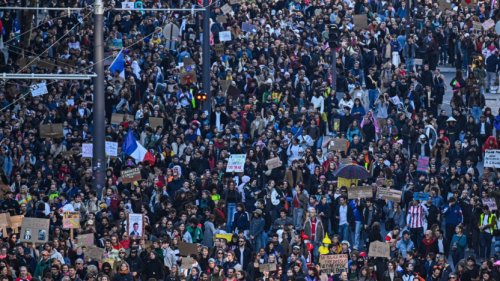
It is in this context that, since 17 October, Macron and his government have been facing a showdown in the streets, with two new major days of demonstrations on 24 and 31 October – which, despite the bans and the anxiety-provoking bludgeon, brought together 800,000 and then 500,000 people – and the approach of 5 November, a major day of mobilization called by the unions for a month and called for by the Gilets jaunes and youth organizations.
In practice, the government creates a climate of violence and repression, describing the country as on the verge of chaos, prey to hordes of ultra-leftists. To do this, in a loop for the past two weeks, the only thing that has been happening in the media are scenes of “urban violence”, testimonies of police officers describing their preparations for order to reign, shopkeepers exposing the looting of their shops... and the need for order to reign.
It was in the name of the freedom of trade and the protection of traders that many demonstrations were banned on 24 and 31 October, that routes away from city centres were imposed, that local curfews were introduced, it was in the name of the risk of riots that the Minister of the Interior issued orders placing people under house arrest and prohibiting the demonstration of environmental or trade union activists by applying measures relating to the law on the fight against terrorism. Similarly, the justice minister, Gérald Darmanin, had pushed for the extension to 72 hours of police custody for young people arrested, including minors, extensions provided for by law only in the context of the fight against organized crime.
Four UN rapporteurs published observations and recommendations on 28 October, saying they were dismayed by the repression of student demonstrations. “The use of force, violence and mass arrests are not appropriate responses to a social protest movement...” [2] All these legal shifts, these exceptional decisions reflect the political impasse of a government with its back to the wall, seeking to stifle the movement, to discredit it, and above all to frighten by increasing repression tenfold. This repression, this anxiety-provoking climate, these numerous mutilations of the eyes or arms, or jaws, suffered by many young people, contrast with the joyful, humorous character of the slogans of the placards and the songs that dot the processions of the youth, despite the tear gas and truncheons. This joyful serenity, but serious in its demands, is the antithesis of a government in desperation that is looking for all the means to get out of the trap which the movement is now setting for it.
He is providing a security and repressive response all the more because his back is against the wall, not wanting to call into question an economic policy totally devoted to the interests of large groups and a social policy aimed at dismantling public services and social systems. In his draft budget, Lecornu also proposes to reduce APLs (personalised housing aid), family allowances, pensions, basically benefits that employees normally receive from the social part of their salary but which, since 1995, have been captured by the state budget. In return, he receives violence in the streets that is a reflection of that exercised by his police and the daily social violence that his policies inflict on millions of men and women of the popular classes.
Macron and Lecornu are using the police (and soon the army perhaps) to protect class politics and “small shopkeepers”, whose protection has been taken as a virtuous pretext, cynically using a social category which, as far as real artisan shops and independent shops are concerned, is just as despised by the Macron government. Far from being treated in the same way as the large capitalist groups with which they sometimes feel solidarity, small craft businesses and retail and local shops (less than 3 employees) see their situation deteriorate year after year, 14162 insolvencies in 2025, +5% compared to 2024. These shops are often hit hard by the decline in purchasing power, online commerce and the development of shopping centres around large distributors and outside city centres. These consequences of ultra-neoliberal policies are much more destructive than the 1160 shops in the city centres of Paris (many of which are large group brands), Marseille and Bordeaux strongly affected by damage and looting.
Nevertheless, after having treated the high school movement from popular neighbourhoods with contempt and violence, the generalization of the movement to all young people attending school in October, the power of 17 October forced the government to open the door to some concessions. These were announced on 26 October. And at the same time, this also leads to schizophrenic behaviour, for example in the attitude towards social networks. On 17 October, the online media Blast revealed a letter from Lecornu sent to the leaders of the four Internet Service Providers (ISPs), Orange, Bouygues, Free and SFR, asking them to be ready to cut off access to TikTok, Snapchat and Instagram, on the day of the 24 October demonstration: “I ask, if I give the instruction, to proceed without delay with the temporary suspension of the services concerned.” Lecornu also asked them to “keep the confidentiality necessary for the preparation of this measure.” [3] In a scathing attitude, a few hours before receiving the youth organizations, Lecornu, the education and higher education ministers received eight influencers so that they could echo the measures announced for the youth, even before receiving the youth organizations, hoping to bypass them. The day before, on a trip to Marseille, Macron did not hesitate to say: "Social networks are damaging our society.”
Lecornu’s announcements obviously testify first of all to the balance of power created by the movement and its legitimacy among the entire population, a balance of power imposing after 7 weeks a “move”, to advance answers to the demands put forward. But, compared to the situation in schools, the consequences for hundreds of thousands of young people, before and after the baccalaureate, these announcements are a smokescreen showing again the extent to which this government takes young people for fools or gullible trade unionists, because as several politicians said, “promises are only binding on those who believe in them”.
The truth is that the high school and student movement demanded an immediate budget extension of 10 billion in 2027 for high schools and the faculty, (the AES- Plus jamais ça, moreover, estimates at 50 billion the budget needed to renovate and adapt the buildings). But in total, behind the loud announcements of 26 October (“the government is committing 5 to 6 billion to the budget” declared Lecornu), the real figure represents, according to the calculations of the main economic daily, Les Echos, a budget line of... 500 million for the 2027 budget, more than 10 times less! [[Les Echos Stéphane Loignon, Budget 2027: ce que vont vraiment coûter les mesures pour les lycéens et les étudiants, 27 October 2027.]]
The government has announced:
– Four billion in the form of loans at reduced rates granted to the regions by the Banque des Territoires. These would therefore be loans committed by the regions, without any additional budget from the state.
– One billion to finance university renovations... by 2029, i.e. 200 million by 2027.
– 15,000 additional places in higher education (in the 2027 budget, 190 million), while youth organizations are calling for 150,000 places, i.e. 10 times more so that every young person who has passed their baccalaureate can have a place in higher education.
Moreover, on Parcoursup, far from abolishing the university selection platform, as requested by the youth organizations, the FSU and Sud Education, the government postpones “changes” to 2028 that does not commit it to anything, and does what it knows how to do best, “working groups”. Otherwise, selection would be maintained as it is with only a written explanation of the cause of the refusals!
The only more concrete gain, 1,200 teaching positions in the BTS (Higher Technician Certificate, two years of study after the baccalaureate), 500 positions in secondary school to reach 28 students per class in 50% of the most disadvantaged high schools. The movement would therefore make it possible to slow down the job cuts but, with one additional teacher for seven high schools, we are far from the need to reach 25 students per class in general and technological secondary education, 20 in high schools in priority and vocational education, as requested by the teachers’ unions.
In total, unsurprisingly, the government is not moving. To a request of 10 billion, it responds with 500 million euros! It is out of the question for it to question the 270 billion euros offered to capitalists, mainly large groups. It is out of the question to subject to income tax the 13,000 tax households of millionaires who are exempt, out of the question to tax the 500 largest fortunes in this country who have multiplied their wealth by 14 times over the last 30 years, now amounting to 1,128 billion euros . [4] But tomorrow, it is not 10 billion that the employees, the categories on strike on 5 November, will demand. It will be the upgrading of salaries with the delay since Covid and high inflation, with food and fuel prices, miserable budgets, not only for national education, but also for hospitals and public services. It is this balance of power to impose these demands that is being built for 5 November.
To arrive at a generalized confrontation, a real general strike in the coming days is obviously necessary to settle accounts with Macron’s policies. This is all the more difficult because this government is at the end of its rope, taking refuge behind the shields of the CRS. Nuñez and others like Manuel Valls, like to say that only “the state holds the monopoly of legitimate violence”, partially quoting the seventeenth century English philosopher Thomas Hobbes and the nineteenth century German sociologist Max Weber. For Weber this “legitimacy” came from the fact that the population accepted state authority, or as Hobbes expressed it, this legitimacy came from a social contract with the population that accepted the validity of authority within the framework of this contract. So for them it was not so much violence that was legitimate as the state itself, whose legitimacy was recognized within the framework of the social contract... The problem is that Macron is in no way legitimate, imposing a deeply unpopular government and policies in this country.
31 October 2026
Translated by International Viewpoint.