
 Version imprimable
As expected, unfortunately, it amounted to little more than a few crumbs: “With this government, it’s five euros and not even a Mars bar”, summarised Sophie Binet, general secretary of the CGT, as she left this “conference”, which was, unsurprisingly, confined to a few hours of government announcements.
The big media stunt was to raise the net monthly minimum wage (currently 1,477.93 euros) above 1,500 euros from 1 December: 1,501.57 euros to be precise, representing a rise of roughly 23 euros. In practice, this simply involved bringing forward by one month the automatic increase in the net monthly minimum wage, as provided for in the Labour Code. Even without industrial action, this would have raised the minimum wage to 1,497 euros. This automatic mechanism for setting the minimum wage ensures that it keeps pace – always retrospectively, at least once a year – with official inflation and the ‘basic hourly wage for workers and employees’, as calculated by government departments. The government’s major achievement is therefore a ‘boost’, a monthly increase of 5 euros. This falls far short of even the most moderate demands from the trade unions (100 euros net for the CFDT; the CGT is calling for 150 euros net and the introduction of wage indexation to prices, i.e. a sliding wage scale; whilst Solidaires is proposing 2,000 euros net for the SMIC, representing a 500-euro increase) .
For the past 10 years, governments from Macron to Lecornu have remained faithful servants of ‘supply-side economics’ and the interests of capitalist groups. Today, amongst all European economies, France is the one that has taken the freezing of the minimum wage at the official inflation rate the furthest. From July 2016 to July 2026, the SMIC rose by 24 per cent in France, but by 40 per cent in Belgium, 50 per cent in the Netherlands, 63 per cent in Germany, 76 per cent in the United Kingdom and 86 per cent in Spain. [2]
Although the MEDEF is up in arms against this ‘boost’, it is primarily to force the government to maintain the scale of exemptions from employers’ social security contributions on wages. Businesses benefit from significant relief on wages up to three times the SMIC (currently €5,469.09). These exemptions, introduced in 1993, have skyrocketed since 2012 – the start of François Hollande’s five-year term – from 25 billion to 86 billion today. 86 billion that should be going into the Social Security and UNEDIC funds. This exemption (the single degressive general reduction, RGDU) is calculated using a degressive scale ranging from 1 to 3 times the minimum wage. Consequently, the more the minimum wage rises (whilst other wages do not!), the more these exemptions increase across all wages up to 3 times the minimum wage; however, this primarily serves to trap millions of workers at or around the minimum wage level. As at 1 January 2026, 2.1 million private-sector workers were paid at the minimum wage level.
The other major development in these negotiations is that the government has asked employers’ organisations in the various sectors to meet urgently to resolve the issue of pay scales whose entry-level pay is below the SMIC (as of 1 December 2026, this now applies to 164 out of 230 sectors, covering 14 million private-sector workers out of a total of 22 million). This is, above all, a derisory ploy to try and lure trade union leaders with a new round of sector-level meetings in the coming months.
Moreover, upon leaving the meeting with Lecornu, Force Ouvrière and the CFDT rushed headlong into this new round of meetings to postpone any real call for mobilisation among private-sector workers, with Frédéric Souillot of FO declaring, “Now, we are going to negotiate”, and Marylise Léon of the CFDT stating, “these are the final fortnight of opportunity”, as if this round of meetings were to begin and conclude in the coming days. Lecornu gave the CFDT the opportunity to brandish the threat of sanctions regarding contribution relief for sectors that do not align their thresholds with the minimum wage.
In practice, an initial assessment would be carried out within the next six months, followed by another six months later, with no consequences in the meantime for sectors that have not brought their thresholds into line. See you in 2028 – enough to make employers across the various sectors tremble. In practice, unfortunately, neither the leadership of FO nor that of the CFDT is seeking, in the coming weeks, to build a genuine balance of power, a broad-based mobilisation, or genuine strikes in the public and private sectors. Yet the aim of a sustained general strike to bring Macron’s policies to a halt is essential if he is to be forced to back down.
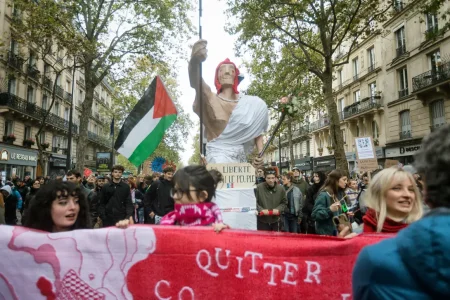
Whilst a wave of mobilisation has begun to take hold, Lecornu and the employers can hope that it will be delayed and, above all, that the youth mobilisation will remain isolated, given that it has itself achieved only symbolic victories – consisting mainly of non-binding promises and a few minor measures that fall far short of what is needed. On the other hand, it is precisely this mobilisation that has changed the political climate in the country, spurred a fighting spirit amongst many sections of the activist movement and encouraged the development of struggles. But the facts are clear.
Without the building of a large-scale mobilisation, this government, now on the back foot, will remain faithful to its pro-business policy in order to resist and hold out until the presidential election. It has demonstrated this through the crumbs it has thrown to young people, continuing to engage in mere window-dressing. It did so again on 9 November during a second meeting with youth organisations and teachers’ unions regarding Parcoursup. These meetings are designed solely to wear down and erode the movement. At this meeting, the government went so far as to make a derisory provocation by inviting the UNI, a far-right student union, and the MEDEF, causing the vast majority of those present to walk out of the room.
This refusal by the government to make any real concessions was confirmed by the meeting on Friday 13 November with the civil servants’ unions. All the unions were united in demanding an increase in the value of the index point that determines civil servants’ salaries. The erosion of the index point’s value relative to inflation is constant. From 1994 to the present day – a period of 32 years – inflation has risen by 64.34 per cent, whilst the index point value has risen by 26.3 per cent. In practice, the figures put forward by successive governments regarding a positive trend in average salaries and purchasing power within the civil service are largely attributable to a hiring freeze and the ageing of the civil service workforce. Furthermore, 862,000 civil servants currently have a basic salary below the minimum wage. The State, which is obliged to pay its employees at least the minimum wage, pays a top-up allowance. This does not prevent their retirement pension from being calculated on the basis of their index-linked salary, excluding these allowances. Furthermore, according to teachers’ unions, on average 25 per cent of civil servants’ pay currently consists of bonuses – which are individual, opaque and unpredictable – thereby widening the pay gap between men and women. Therefore, during the meeting with the civil service unions, Lecornu confirmed the pay point freeze for 2027, announcing only an adjustment of the index-linked pay scale to the new minimum wage level for the 1.1 million staff who would otherwise fall below it, and a small increase for 200,000 staff (approximately 23 euros net per month), whose wages – slightly above the minimum wage – would otherwise have been brought down to that level. In this way, the government is making its intentions clear, setting an example by freezing pay scales for sectoral negotiations in the private sector.
But above all, the recurring theme emerging in the presidential campaign and in employers’ proposals – and present in the statements of many political leaders, from the far right to Glucksmann – is the idea of ‘increasing net pay without touching gross pay’: basically, not increasing wages, but taking a portion of the wage allocated to social security contributions and transferring it into the net wage. This further calls into question what is known as ‘the socialised wage’ – that is, the portion of the wage that funds the social protection system: sickness, pensions, child benefit, independence support, disability support, housing, training and pensions – in other words, the entire social security framework and unemployment benefits (Pôle Emploi/UNEDIC). 443 billion of the total wage bill in 2025. Social security contributions paid by employees account for around 22 per cent of gross pay and, before exemptions, 40 per cent for the employer’s contribution.
However, this system has already been reduced by 86 billion through exemptions granted to companies to ‘reduce labour costs’. In practice, the employer exemptions granted by the government are offset (though not entirely, as there was a shortfall of 2.7 billion in 2025) in the annual Social Security budget (the Social Security Financing Act) through budgetary expenditure. Broadly speaking, it is the taxes paid by employees that fund the exemptions granted to employers, via income tax and VAT. These 86 billion in contributions that employers should be paying form part of the 270 billion in unreciprocated handouts from which large companies benefit most – either directly or indirectly – by enabling a reduction in the ‘labour costs’ of employees at small subcontracting firms working for major corporate groups.
So, for the time being, the government is holding firm, even with its back against the wall. There has been no real backtracking, either on issues affecting young people or on those affecting employees in the private and public sectors. On the other hand, with regard to farmers, the government has been quick to announce a new subsidy of 725 million ‘to adapt agriculture to climate change’, following on from the 1.5 billion provided last autumn to tackle the drought and heatwave. Clearly, the government fears a resurgence of protests in rural areas and a possible convergence of social struggles. But this new aid is primarily directed towards export-oriented, high-yield agriculture (2,200 new chicken coops by 2036…), “accelerating the disappearance of small-scale farmers from the countryside” according to the Confédération paysanne.
Moreover, despite some hesitation on the part of the FO and CFDT, all the trade union organisations are calling for a further day of action and strikes on 17 November, following on from 5 November, in both the public and private sectors.
The movement in secondary schools and universities remains strong in terms of militancy but is waning in the face of heavy-handed crackdowns by the police and the authorities, which have stepped up school closures, police attacks on blockades, and the organisation of a national press campaign for ‘a return to order in secondary schools’.
The government is also attempting to consolidate the reactionary camp with the new draft bill on the ‘licence to kill’, that is to say, the presumption of self-defence for any murder committed by a police officer. This bill is now before the Senate, following the Senate’s own vote on a ‘rioter pays’ bill which, in practice, aims to criminalise mere participation in a demonstration in the vicinity of damage or offences committed against the police. A reactionary media campaign and draft legislation to strengthen the repressive apparatus: these are, for the time being, the government’s concrete responses, showing utter disregard for young people’s educational conditions and the living conditions of the working classes.
It is against this backdrop that the government and the media are seeking to stifle the fallout from the racist attack in Trappes on 23 October, carried out by a National Rally (RN) sympathiser. Investigations show, however, that the murderer – without ever having been questioned or even arrested – had committed several assaults in the preceding days and years, including one three days before the deadly attacks in Trappes. On that day, in Levallois, in the Paris region, a Black person was attacked and severely beaten by him. After the police intervened, he was allowed to leave freely without even being questioned, whilst his victim, covered in blood, was arrested and suspected of assault… The government had pledged a national tribute in memory of the young man murdered in Trappes, but for the past fortnight we have mainly witnessed the unabashed resurgence of racist statements equating crime, violence and immigration.
Social mobilisation therefore continues, seeking ways to strengthen the movement.
14 November 2026
Translated by International Viewpoint. Published in French in Inprecor and in Spanish Viento Sur.