
 Version imprimable
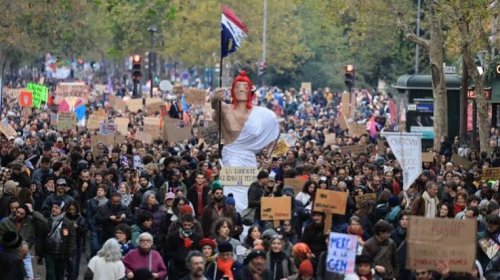
It was, therefore, a resounding success that also succeeded in sweeping aside Macron’s attempt to ban demonstrations or impose routes that excluded city centres. The strength of previous mobilisations had succeeded in securing routes through city centres, as in Paris and Marseille, for example, In Toulouse, where the demonstration along the route chosen by the Intersyndicale had been banned by the Prefecture, 80,000 demonstrators made their presence felt despite police violence – police violence which also occurred in Lyon and was condemned by the municipality’s left-wing elected representatives. The atmosphere was festive throughout all these marches, with a growing number of symphony orchestras and brass bands responding to the call issued in Paris by the Orchestre du Nouveau Monde.
Thus, the balance of power shifted a notch, with young people maintaining their demands and the trade unions highlighting their platforms on wages. Clearly, there was one common thread: the demand to put an end to 10 years of policies that have undermined the living, working and housing conditions of the working classes, and policies that have eroded purchasing power.
All eight national trade unions (CGT, CFDT, CFTC, CGC, FO, FSU, UNSA, Solidaires) had called for a national day of strikes and demonstrations to demand:
– an increase in the minimum wage (SMIC), all wages, pensions and the index point value for civil servants,
– an increase in all forms of social support (housing benefit, child benefit, student grants, Active Solidarity Income – RSA),
– environmental and industrial planning to relocalise and decarbonise industry, and resources to combat global warming and adapt towns, buildings and transport to its effects,
– increased funding for public services,
– tax justice measures to tax wealth, inheritances and dividends, and to ‘assess, condition and redeploy’ the 211 billion euros in public aid distributed to businesses.
This was the day that saw the genuine convergence of the country’s entire trade union movement with the youth movement, and above all the call for the entire working class to mobilise. Whilst this call had initially been announced in parallel with the youth movement, it took on a different meaning with the explicit convergence called for by both youth organisations and the Yellow Vests collectives.
Faced with the strength of the mobilisation, cornered and fearing he would be overwhelmed by the spread of strikes in both the public and private sectors, Lecornu played his ‘emergency’ trump card. An emergency ‘social conference’ has been convened, bringing together trade unions, the government and employers from Monday 9 November ‘to provide answers to questions regarding purchasing power and wages’. As a first minor manoeuvre, this ‘conference’ does not address the issues facing civil servants, their pay scales or their job grading systems.
To prepare for this conference, the government is meeting this weekend with leaders of the employers’ organisations MEDEF, U2P and Les Entrepreneurs (formerly CGPME).
Clearly, the government wishes to limit itself to whatever concessions employers might be prepared to make in order to drive a wedge into the trade union front and make it more difficult to organise a strike in the private sector. In practice, this would involve bringing forward by one month the automatic increase to the minimum wage (currently €1,477.93 net) – a rise of around twenty euros net that was due to take effect in January. Furthermore, Lecornu is reportedly proposing to employers that, in addition to the automatic increase, there might be a ‘boost’ – an extra increase. The automatic increase in the minimum wage is provided for in the Labour Code and, as of 1 January, is based on a calculation combining inflation and the rise in the basic hourly wage for manual workers and office staff, using data provided by the DARES public statistics service. This calculation formula has not prevented a steady loss of real purchasing power of the minimum wage in the face of inflation, as essential goods and energy constitute the main component of household expenditure for those on the minimum wage, and these costs have risen faster than inflation. Despite a 21 per cent increase since 2020, purchasing power has fallen by 18 per cent, as the SMIC has not received a ‘boost’ since 2012, with Macron having stubbornly refused to do so during his two five-year terms, in keeping with his ultra-liberal policy. Nevertheless, even at a low level, the minimum wage has for several years been higher than the minimum wages in 122 occupational sectors (out of 649). Sector-specific collective agreements set minimum wages by category and type of job. This highlights the lag in wage growth and the decline in the purchasing power of wages, as these agreements are under no obligation to increase wages in line with inflation.
The liberal push has reached such a level that employers, the right and the far right are up in arms against any increase in the minimum wage, and even the one-month delay to the automatic increase. ‘No pay rise, not even a slight one!’ proclaims Retailleau, the LR candidate. For Marine Le Pen, even a symbolic pay rise would mean that ‘we’re heading back to the USSR!’, making it clear that the rules on pay rises enshrined in the Labour Code must be called into question. Edouard Philippe also rejects any pay rise measures, with these three candidates clearly acting as spokespeople for the three employers’ organisations, which simply believe that they must stand firm and not call into question, even in the slightest, the servile policy of submission to capitalist interests.
On the trade union side, the CGT is calling for a €150 increase in the minimum wage, whilst Solidaires is proposing a minimum wage of €2,000 net. As a reminder, in 1968, to avoid further losses, employers, during the Grenelle Agreements, had conceded to a 35 per cent increase in the SMIG (the minimum wage at the time) and a 10 per cent increase across all wages – proof, incidentally, that a pay rise for everyone can be imposed in all companies through a national cross-sectoral agreement. For this to happen, the fear currently felt by the government would need to spread to the MEDEF.
The National Education and Research Trade Union Alliance (excluding the CFDT) is calling for a strike on 10 November. The eight civil servants’ federations, not involved in the ‘conference’, are calling for a further day of strikes and demonstrations, with the date to be announced early next week. As for the leadership of the national trade unions, Lecornu has managed to prevent a new date for industrial action from being announced on the evening of 5 November, as a majority of unions wish to wait for the ‘conference’. This is, of course, merely a postponement; the only outcome of this meeting will be the crumbs that employers are prepared to grant. Moreover, Patrick Martin, the president of MEDEF, has announced that he will not alter his schedule and will not take part in this conference.
Therefore, the condition – which has not yet been met – remains the launch of strikes in the private and public sectors, for which thousands of activists are currently mobilising within companies and militant trade union branches of the CGT, FSU, Solidaires and even within other trade unions. These strikes did not begin in the wake of 5 November, and this is clearly the key challenge: to strengthen and sustain the youth movement, to force the government and employers to back down within companies and the National Education system, and to secure a different distribution of wealth. Behind this, the challenge is also to build a political balance of power capable of defeating Le Pen in 2027.
5 November 2026
Translated by International Viewpoint.