
 Version imprimable
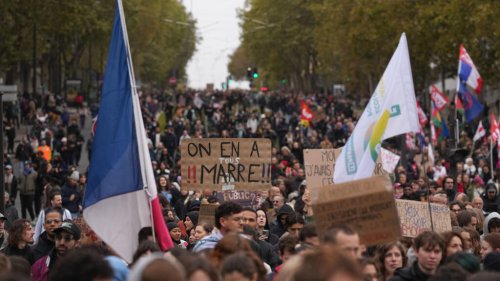
October 17th was a historic day of mobilization in France, comparable in numbers to the major pension protests of 2023. 800,000 people (550,000 according to the police), more than one hundred declared demonstrations, plus numerous others, undeclared, in towns and neighbourhoods.
A social crisis, with deep roots, is being dramatically expressed today, echoing similar crises in many other countries, always centred on the massive mobilization of youth. And the violence that has erupted in the streets across the country against businesses and institutional buildings, perpetrated by minority groups but widespread in every city, is unfortunately a reflection of the social violence experienced daily by millions of men and women who suffer from precariousness and poverty—a violence constantly exacerbated by the policies of Macron’s governments, which target the working class, remain indifferent to social misery, and protect the privileges of the wealthiest people and of large corporations.
The unprecedented nature of the protests
The first characteristic of the current mobilizations is their unprecedented nature, forcefully manifested on October 17th: a massive, even unexpected, surge, a convergence not only of anger but also of very concrete social demands, coming from the Yellow Vest collectives that emerged from the 2018 mobilizations, from high school and university student organizations and coordinating bodies, and from the CGT, FSU, and Solidaires unions. Thus, a broad mix, with young people at its centre, mobilized and self-organized in various ways for over a month. We can say that the current movement is a resurgence of the significant mobilizations that have appeared in the country over the past ten years: the Yellow Vests, the mobilizations in working-class suburbs against police violence and discrimination, and finally, the massive demonstrations by workers against pension reform. The strength of this movement cannot be understood without also considering the role of #MeToo, the mobilizations against social violence, and those against large-scale, unnecessary projects, notably the Sainte Soline mega-basin. In fact, the entire catastrophic record of the Macron governments since 2017 is exploding to the surface, a "supply-side policy", made up each year of 270 billion euros in subsidies and gifts to businesses and the richest layers of society [1], and of deep wounds for the working classes, for social rights, purchasing power and public services, leading today to the most stinging rejection of a president and a government since the beginning of the Fifth Republic in 1958.
The date of October 17th originated from a call on social media, starting on September 8th on TikTok , protesting the high cost of living and soaring fuel prices. Dozens of posters echoing the Yellow Vest movement’s themes circulated, organizing rallies in numerous cities across the country, from rural areas to small and medium-sized towns, using encrypted messaging. Joining them were the initiators of the "Block Everything" movement, who had already called for a major day of action in September 2025 against the high cost of living and tax injustice. They created a national map of the rallies, which quickly filled most regions and localities. Former Yellow Vest leaders, also active on social media, then took up the mantle.
This proliferation of grassroots calls, outside of any real political or union organization, is the first characteristic of October 17th, bringing together workers and those in precarious employment, often the first to be hit in recent months by heatwaves in inadequate housing, by the soaring price of food, and by the cost of energy. The anger is obviously all the greater because the minority government of Macron and Lecornu is constantly cutting back on social redistribution programmes and has been promising, since the summer, a 2027 budget that once again exempts the wealthy, capital gains, and large corporations from taxation, multiplying exemptions, aid, and subsidies for them, while severely impacting the working class, young people, and pensioners. The Yellow Vest movement in 2018 and 2019 was a profound wave of mobilization across the country, particularly in semi-urban areas. It began in protest against increased fuel taxes, the price of which had already risen sharply in previous years, but quickly broadened to include a rejection of the tax burden and the loss of public services in rural and semi-urban areas, resulting in job losses, hospital closures, and disruptions to public transportation. Essentially, it mirrored the situation experienced in working-class neighbourhoods of major cities. The movement grew by organizing around more than 1,000 Facebook groups, with over 4 million members. Around 3 million people participated in the Yellow Vest protests across the country, expanding their demands to include lists of grievances in their lists of grievances. The Yellow Vest movement witnessed an explosion of police violence, with people maimed by LBD (“sub-lethal” defence weapon) fire or stun grenades: one death, 613 people injured, 23 who lost an eye, five hands torn off. "The police have injured more protesters in a few months than in twenty years." [2] The violent way of dealing with popular demonstrations had already been organized in 2016 by the Socialist government of Manuel Valls in response to the protests against the El Khomri labour law. The Office of the High Commissioner for Human Rights and Amnesty International have since condemned this violent handling of the demonstrations, the abuses, and the use of "intermediate force" weapons, such as LBD 40s, Tasers, tear gas grenades, and crowd control grenades, described as "sub-lethal" but which have repeatedly become deadly weapons.
The power of the youth movement
The initial strength of the October 17th movement stemmed first and foremost from this deep-rooted popular momentum. Then, of course, came the power of the youth movement, which began in high schools in underprivileged suburbs of France’s overseas territories in early September and continued unabated for over a month until October 17th, despite the violence and police repression it faced.
The triggering factor was the poor learning conditions: teacher absences, unsanitary facilities, and overcrowded classrooms, all the more unbearable after weeks of sweltering heat in their homes. Here too, it was a grassroots movement that quickly took hold. Initially, without much resonance in mainland France, blockades began in Mayotte and French Guiana at the start of the school year, in late August and early September, demanding the renovation and ventilation of classrooms, protesting cafeteria prices, and generally denouncing the state of neglect and the feeling of social exclusion—clear demands and great determination.
In France itself, the blockades began on September 17th at a high school in Créteil, in the Paris region, echoing the demands put forward by teachers. There, too, the issues of facilities, but also overcrowded classrooms, teacher shortages, impossible schedules, and the demand for the repeal of two measures introduced at the beginning of Macron’s first term in 2017-2018: the Blanquer reform (dismantling the academic tracks—literature, science, economics—in high schools and replacing them with "a choice of specializations") coupled with the implementation of a ruthless selection process for university admissions after the baccalaureate, "Parcoursup." This platform closes the door to numerous programmes, excludes students from working-class backgrounds from many higher education pathways, and, for example, in 2026, left 126,000 young people out of nearly 900,000 baccalaureate graduates without a university placement. The verdict is unequivocal: despite a "baccalaureate for all," since 80 per cent of an age group obtains a baccalaureate, 57 per cent of that same group do not obtain a general baccalaureate, the only qualification required for access to university bachelor’s and master’s programmes. "Parcoursup," with its algorithm, ensures a remarkably efficient form of social sifting. All studies demonstrate the harsh reality of social reproduction, and its intensification since 2020. [3]
Young people in working-class neighbourhoods
Among young people, those in working-class neighbourhoods experience the daily violence of social discrimination, alongside that experienced by their parents and that perpetrated against them by the police. This violence has intensified significantly in the last month with the school blockades, which were criminalized from the outset and classified by the Ministry of the Interior as urban violence, are unfortunately a long-standing issue in the country.
For twenty years, young people in disadvantaged neighbourhoods have repeatedly expressed their anger and demands in the face of their exclusion and social marginalization. This began in 1990 in Vaulx-en-Velin, a suburb of Lyon, and again in 2005 when two teenagers, Zyed Benna, 17, and Bouna Troré, 15, were killed in Clichy-sous-Bois, pursued by the police and electrocuted in an electrical substation where they had sought refuge. Several weeks of riots ensued in the neighbourhoods, demanding social justice, avenging the deaths of the two young men, and denouncing police brutality.
This mobilization, instead of being treated by the government as a social issue, was treated as riots of urban violence, perpetrated by "vandals, thugs," and "scum," as the then Minister of the Interior, Nicolas Sarkozy, called them.
"Nothing has changed," as Mekki Daouadji Djilali, president of ACLeFeu , a collective created in Clichy-sous-Bois after the deaths of Zyed and Bouna, reiterated in an interview twenty years later. The collective had drawn up a list of grievances outlining the population’s priorities. At the time, 20,000 contributions were gathered from 120 cities. Twenty years later, the problems and priorities remain the same. "Since 2005, all the reforms implemented have been security-focused, not social," adds Mohamed Mechmache, a founding member of ACLeFeu. But, for political leaders, young people from working-class neighbourhoods, especially those from post-colonial immigrant families, cannot be political actors, bearers of social struggles and demands. The same pattern has been repeated several times, for example in June 2023, with the death of Nahel Mezrouk, a 17-year-old killed at point-blank range by a police officer during a traffic stop in Nanterre.
This profound dynamic originating in high schools in working-class neighbourhoods quickly spread to other high schools, universities and, unprecedentedly, to the "prestigious" grandes écoles HEC, IEP, Ecole des Mines explicitly in solidarity against social segregation, [4] 90 per cent of universities blocked the week of October 11-17, universities where more than 100,000 places are lacking to accommodate students .
The demands put forward by the high school student movement have been clear from the start: unions and coordinating bodies have united in their demand for the abolition of Parcoursup and the Blanquer reform, the creation of sufficient positions to address the shortages of teachers, nurses, and social workers, and a €10 billion euro budget increase to allow for the renovation of school buildings and their adaptation to climate change. The government has so far refused to provide any concrete response to these demands, even treating them with contempt.
But the underlying trend among young people reflects a multifaceted awakening of consciousness. LFI MP Louis Boyard explains the four main drivers of youth politicization:
- -the #MeToo movement and the prominent role played by young women with a feminist culture,
- -global climate strikes,
- -the revolts of working-class neighbourhoods against racism, particularly after the death of Nahel,
- -Palestine and the horror of the genocide committed by the Zionist regime.
All of this calls into question Macron and his world, and his sinister continuity in what the far right promises. [5]
The movement of youth and the Yellow Vest movement converge with the broader social concerns of workers : the lack of response to social needs, inadequate public services, the cost of living, starting with energy and food, and the increasing impoverishment of the working class. The poverty rate (60 per cent of the median income) is 15.4 per cent, affecting 9.8 million people, a rate that has been rising since the mid-2000s. France was once one of the countries with a low poverty rate thanks to its redistribution systems. The dismantling of these systems since the mid-2010s has undermined this safety net.
The combined effects of pension reform, the rising cost of living, job insecurity, housing difficulties, and stagnant or meagre wage increases are creating an increasingly difficult situation for workers and their families. The mobilizations against pension reform in 2023 expressed this widespread discontent and demanded a different social policy. The rejection of Macron’s policies and their budgets, which disproportionately impact the working class, was expressed electorally in 2022 and 2024. Successive minority Macronist governments have since survived only thanks to the leniency of the Socialist Party, which saved the adoption of the 2026 public finance and social security budgets and accepted farcical social negotiations with Bayrou and Lecornu that led only to dead ends: in the spring of 2025, Bayrou’s "conclave," and in the autumn of 2025, the "suspension of pension reform" and the "conference on pensions and work" justified the Socialist Party’s (PS) reprieves granted to Macron’s government and made possible a division among the unions. the unions. Indeed, on two occasions, the CFDT, CFTC, and CGC unions seized this opportunity, which led to no government backing down.
This autumn, a new landscape is emerging, and the role of militant unionism could be decisive in the outcome of the current social conflict. Following a joint day of mobilization and demonstrations on September 29th, public sector unions had set November 5th as the date for a future day of action focused on defending public services and increasing the minimum wage and salaries. Many felt that November 5th was too late, given the urgent need to strengthen and support the youth mobilization. Furthermore, October included several key events for the youth movement and the Yellow Vest protests. Solidaires, therefore, preferred to wait until October 17th o make a call for action on November 5th in order to mobilize first during October. And, in practice, the CGT, FSU, and Solidaires unions supported the blockades throughout October, protected the high school student marches from the police, and were present on October 17th. The rest of the national inter-union alliance did not follow the same movement, although many unions, at least the CFDT and FO, were involved locally and through their education federations.
Also, on the 17th, the role of the unions was very important, providing the link to all the other components, and they were not spared by the police forces, as in Toulouse where the front line of the union procession was hit by grenades, resulting in injuries to four union leaders.
A turning point
Now, we are at a pivotal moment in the movement.
The government and the right wing were completely destabilized by the scale of the high school student movement and the political prominence it gained. For several weeks, they played the card of isolating young people from disadvantaged neighbourhoods, seeking to discredit and criminalize them, and portray them as being manipulated by La France Insoumise (LFI). The generalization of this movement to all young people was therefore surprising, but Lecornu remained steadfast in his refusal to back down or accommodate the students’ demands. The students’ interlocutors were the police and the Minister of the Interior. The method was to strike hard through repression, with a systematic smear campaign by the media, systematically stigmatizing young people as vandals and accusing "the far left, supported by LFI, of aiming to destabilize the Republic." The Republican Party even called for the dissolution of La France Insoumise and the imposition of a state of emergency. [6]
The violent crackdown by the police went hand in hand with mass arrests of young people as a form of political propaganda, aimed at deterring them from continuing to take part in the movement: 10,000 arrests, including 7,000 minors, between early September and 17 October. Nights spent in police custody in often appalling conditions, such as those reported in Bobigny; summary court appearances; and prison sentences even at the first hearing for young adults. Arrests have become political tools, previously used against young people in the suburbs in 2005 (5,643 young people arrested) and against the Yellow Vests (6,786 arrests). This mass intimidation and criminalisation has failed to prevent either the continuation or the expansion of the movement, nor its convergence with the trade union movement.
With the current movement, the government has been caught off guard, having assumed that the left and the working classes would be paralysed by the fragmentation of the left and the moderation of the trade union front. Lecornu wanted to be able to continue with a policy and a 2027 budget that would hit the working classes, imposing over 40 billion in cuts to social spending, with attacks on pensioners and young people, and a freeze on civil servants’ salaries. These cuts were justified by invoking the unbearable level of public debt, whilst the government refuses to challenge the derisory taxation of capital gains and large corporations, and has approved a 6.5 billion increase in the military budget over two years.
This draft budget went hand in hand with an increasingly security-focused discourse that was increasingly permeable to the proposals and rhetoric of the National Rally.
Destabilised and shaken by the strength of the 17 October protests and the alliance with the militant wing of the trade union movement, Macron and Lecornu re-enacted the tragedy already scripted by the bourgeois leaders of the 19th century, and the great fear inspired by the Paris Commune: the working classes are, above all, dangerous classes; the rabble threatens the right to property; the police and the army must protect our lives and our property.
The images of smashed shop windows and hundreds of shops looted on 17 October in the centres of major cities were the trigger for a terrifying spiral of state repression: curfews in city centres, banned demonstrations, and heavy prison sentences. This spiral, applauded by the far right, was aimed just as much at silencing criticism of the police’s inability to protect city centres as it was at trying to paralyse and silence the social movement and to dissociate the trade unions from future protests. Following the example of Zemmour (who blamed ‘Arab-Muslim scum’), Retailleau, Ciotti, Bardella – all the leaders of the far right have, for several days now, been engaging in a barrage of racist rhetoric directed at young people and the protests, finding themselves, surprisingly, in lockstep with Trump and Netanyahu, who denounce ‘the Islamic invasion of France’. All the television channels are broadcasting endless loops of footage showing the vandalism of public buildings, shops and burnt-out cars. Day after day, editorialists condemn the intolerable violence suffered by shopkeepers, without ever having paid the slightest attention to, or shed the slightest light on, the working classes’ descent into precariousness and the impossibility of making a decent living. This everyday violence has very rarely been given a place in the media. But, caught out by its own security policy, the government has been accused of failing to protect small shopkeepers or even town halls, as in Marseille.
Since then, Macron and Lecornu have been stammering, calling both for order and for a ban on demonstrations, invoking “the Republic in danger and the seditious threat posed by La France Insoumise and its proxies”, and, after a month of refusal, rushing into hasty meetings with representatives of the youth movement, on Monday 26th with the Prime Minister, then finally on the 23rd with Macron himself, only to announce that they would provide answers later! On the 24th, dozens of demonstrations were banned by the prefectures, then authorised, diverted from their planned routes, with some bans even overturned by the administrative courts. The authorities are stepping up their crackdown, striking hard, yet at the same time hesitating for fear of revealing their weakness and lack of authority in the face of a movement that persists and remains determined to secure its demands. Today, it is Macron and his government who are caught in a trap, and this makes them all the more dangerous.
The government now fears that the movement, far from running out of steam, will spread like wildfire in the coming days with strikes by workers, particularly around 5 November. Consequently, Macron and Lecornu are continuing to isolate themselves by refusing to make even the slightest concession to young people (…whilst announcing a meeting with youth organisations on Monday 26 October and an ‘overhaul’ of Parcoursup) and are taking a decisive step towards repression and authoritarianism. During the forthcoming demonstrations, the Minister of the Interior plans to deploy not only the police and the gendarmerie, but also the RAID – a police unit responsible for counter-terrorism operations – and forces from Operation Sentinelle, military personnel also tasked with counter-terrorism operations on the mainland, as well as the BRI (the brigade responsible for combating organised crime)… All this illustrates a hardening of authoritarian tendencies, applauded by the RN and the LR, who are calling for the imposition of a state of emergency with the suspension of civil liberties, but it also reveals the government’s political weakness. Over the weekend of 24 and 25 October, dozens of demonstrations have been banned or prevented from following their planned routes through town centres.
So clearly, the movement is heading for a make-or-break moment. Either the police crackdown will succeed in stifling the movement whilst bombarding public opinion with images of ‘terror organised by the far-left and LFI’, or the protests will converge with sections of the workforce through rallies, joint actions in towns and cities, and, above all, with professional sectors going on strike, particularly around 5 November.
Solidaires has explicitly put forward this strategy by calling for general assemblies in workplaces and raising the prospect of strikes across as many sectors as possible from 5 November onwards. The CGT, through Sophie Binet, has also set its sights on strikes on 5 November and beyond; the FSU is likewise calling for discussions on the follow-up to this day of strike action in workplaces, having already served notice of strike action running until the end of November. Thus, in different ways, these three trade unions are setting out their priorities without allowing themselves to be held back by the pace set by the national inter-union alliance with the other unions (notably the CFDT, FO and UNSA). This is clearly the lesson drawn by the militant trade unions from the strikes of 2023. This issue is recognised by all the militant elements within the trade union movement.
The threat of the National Rally
Last but by no means least. Everyone on the left understands that the motivation behind the current mobilisation is also the fight against the threat of the National Rally on the brink of political power. There is a growing fear that the fragmentation on the left – exacerbated by the victory, for the time being, of the most social-liberal wing within the Socialist Party (with Glucksman’s candidacy) and the rejection of Mélenchon’s candidacy by the other partners of the former NFP (the Ecologists, the PCF and Après) – will lead to a fratricidal war on the left and to a victory for Le Pen. The current movement could therefore also shift the political landscape through a grassroots movement, making it necessary to build unity as had been achieved in 2024.
Few people have taken notice, but in Orléans, a broad unity on the left – bringing together the PS and LFI side by side – was forged to call for opposition to the RN’s congress on the weekend of 24 and 25 October. In contrast to the current situation on the left, left-wing forces in the Loiret issued a call ‘to build a popular and united front’. In order to oppose the RN and “prevent Pétain’s heirs from regaining power”, they called on “all progressive forces – associations, trade unions and political parties – the cultural sector, and all citizens deeply committed to the democratic values of peace and freedom to join this popular and progressive gathering”. [7]
Building a social balance of power capable of forcing Macron and Lecornu to back down is possible, even if this was not the case a few weeks ago, but the energy of all activist forces will be decisive in achieving this. This can and must be combined with the struggle to forge a united political and social front to oust Macron and his clique and prevent the RN from gaining access to the presidency.
24 Octobre 2026
Translated by International Viewpoint. Available in French on ESSF and Castilian on Viento Sur.