
 Version imprimable
Stéfanie Prezioso: What is new and surprising about the social mobilisation of young people in France and the alliance forged with other sectors of society around the issue of cost of living on 17 October, which points to the crisis of social reproduction?
Olivier Besancenot: What is new and surprising about the mobilisation on 17 October and the alliance that has formed is that it is taking place outside traditional structures. We had already seen social outbursts – whether sector-specific or thematic – that clearly eluded the organisations of the labour movement, be they trade unions, social organisations or political parties – the Yellow Vests, for example. But for a convergence to begin taking place, outside these organisations, between completely different sectors of society, with the support and participation – whether implicit or explicit – of certain structures: as far as I can recall, this is unprecedented.
This explains both the surprise that has caught the political establishment off guard, whilst also highlighting the movement’s limitations in terms of democratic organisation. I think this really points to the global crisis we are living through, which is also a crisis of labour movement organisations, to a transformation of society, and to a new type of proletariat which, in fact, is emerging through this sort of experience.
SP: You often refer to the French Revolution and the Paris Commune – and the social and democratic aspirations driven by the working classes – when reflecting on the events we are witnessing today. Why are these historical references so pertinent?
OB: It is true that my primary point of reference has always been the Paris Commune of 1871, far more so than the French Revolution, which I am learning to discover – or rediscover – through the struggles, particularly that of the Yellow Vests. That movement was a turning point: this history has re-emerged in the mobilisation in a subliminal way – or perhaps not so subliminal after all. The large demonstrations in December, which marched up the Rue de Rivoli to the Place de la Concorde in order to reach the Élysée Palace at any cost and confront Macron there, naturally evoked the great peasant revolts – led in particular by women – who would go and fetch the king from his castle to bring him back, for example, to Paris. Not to mention the French flag, which was not merely an expression of the far-right currents present at the start of the movement, or La Marseillaise, sung at the top of people’s voices, which I have learnt to listen to in a different light.
This Marseillaise can be heard, for example, in schools and in the secondary schools taking part in the protests, particularly in working-class neighbourhoods and the suburbs. So there is an underground history. And when one learns to rediscover it — as I am doing at the moment, notably by reading Jules Michelet’s History of the French Revolution — one realises that something truly extraordinary did indeed happen: the people, from the grassroots up, put an end to centuries of domination, organisation and the monarchical mode of production, and decided to do away with it all—on several occasions between the storming of the Bastille; the act of going to fetch the king in October 1789 to bring him back to Paris—a mass abduction the likes of which we no longer see; later, by beheading him; and later still, by organising days of insurrection and communalist action.
This inevitably leaves its mark, which, for my part, I had underestimated. We belong to a very distinct current, deeply shaped by the political era that began with the October Revolution of 1917 and ended in 1989, and one realises that there is something profound there after all.
SP: What does the scale of repression in France today – carried out by a supposedly centrist government, which is in no way inferior to that of Giorgia Meloni’s far-right administration – tell us about the convergence of the more or less extreme right-wing movements in Europe and around the world?
OB: The scale of the repression is, in fact, absolutely unprecedented. In terms of the number of people taken into police custody since the start of the secondary school pupils’ movement, it far exceeds even that experienced by the Yellow Vests movement, which itself had far surpassed the protests against the First Employment Contract (CPE) or those of the 1990s. In fact, working-class neighbourhoods have served as a testing ground for the systematisation of a repressive apparatus that is now being rolled out to every type of social upheaval. This tells us, first and foremost, something about liberalism and its policies, which require an authoritarian turn.
Secondly, it tells us something about the ongoing ‘fascisation’ – that is what I call it, despite everything, even if the term is open to debate, for it at least has the merit of highlighting what is actually happening: a whole series of measures have already been put in place by the Macronist government, even before the far right has come to power. In July, for example, the presumption of self-defence was granted by law to the police, which is a long-standing demand of the far right.
And there are many more examples like this. In this process, we can also see the extent to which the Macron administration is losing control of its own repressive apparatus. There is therefore a loss of control over the situation and, in this race against time, there is what Daniel Bensaïd called the ‘discordance of times’: between social time, which is becoming more radicalised, and political time, which is nowhere near that stage.
SP: The media have placed great emphasis on the unprecedented violence of 17 October, which undoubtedly reflects heightened anger. But what surprised us most was seeing hundreds of thousands of demonstrators converging across France, united in their shared rejection of social injustice and the denial of democracy. What conclusions do you draw from that day?
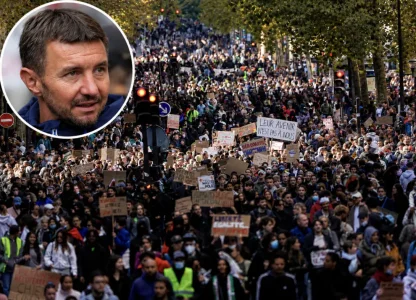
OB: To assess the 17th, it is extremely important to understand the scale of what is happening. I took part in this demonstration, and I have never experienced anything like it in my life, in terms of its sheer size, determination and the mix of people. It was a tidal wave, a human tide. Of course, when you get home in the evening and see the mainstream media and political coverage of these events – which, incidentally, did indeed take place – you get the impression that you weren’t part of the same thing. And this, for the time being, is being overlooked in the French political debate, as it is a sense of bewilderment that prevails, alongside the political exploitation of what happened: shops vandalised, and in some cases looted.
But all this cannot simply vanish overnight, for there is something too powerful, too profound in what has just been expressed, and which we have yet to understand: a movement that was organised solely through social media and subsequently supported by a number of organisations.
This points to a new phase, one that throws everything back into question, full of new possibilities, and which – despite the ongoing political unease of the moment, which persists and is catching up with this phase – must give us cause for hope.
SP: The hundreds of thousands of people who have mobilised no doubt feel today that the demonstrations are insufficient to bring a hardline government to its knees, a government that has no qualms about imposing a partial curfew. The call for a general strike is on everyone’s lips, just as it is in Spain. What do you think?
OB: The mobilisation will, indeed, lead to an outcome that, by its very nature, we cannot predict.
Nothing is over, because this movement isn’t going to stop: it’s too deep-rooted, too entrenched. It also has an international dimension. When you look beyond our borders, you can see that, amongst young people, similar events – or events we’re tempted to compare – are taking place in Belgium, Italy and Albania. There’s also the movement unfolding in Spain. There is also something happening from a generational perspective, which means that this movement will not be halted by the imposition of a curfew or by other authoritarian measures which, I am sure, will not be long in coming – perhaps even the dissolution of a number of organisations; we do not yet know.
The challenge now, in fact, is for the labour movement to take up the baton – that is to say, for the working class to take up the baton. If there is no strength in numbers – in terms of reminding society of the place occupied by workers – then, unfortunately, it will not be enough, and we will not succeed in ensuring that this legitimate revolt leads to a fully-fledged class consciousness, based on partial victories, or at least on a visibility that gives us reason to believe in it. This is what is at stake behind the call for a general strike. A day of cross-sectoral action has been called for 5 November: the challenge now is to ensure that the workers of this country do not remain mere spectators of what is happening, that they are not paralysed by the situation, especially as there are still grey areas.
There is talk of deaths in connection with the demonstrations, without a full explanation; accounts, theories and hypotheses are being put forward, but we have reached this level of gravity. We are therefore only at the beginning, and we are of course eager to see what the future may hold, even though we are, on the other hand, extremely — how shall I put it? — weighed down by the political anxiety of the moment, because we can see that all the ingredients of this period, this grim period in which we are living, are re-emerging.
20 October 2026
Translated by International Viewpoint from marx21.ch.