
 Version imprimable
At the heart of Serbia’s political transformation lay a mass student movement, and behind that was a conflict between two elites: the political elite built by the Vučić regime over the preceding decade and a half, and an academic elite that had remained relatively independent of his system of governance. The decisive factor was the latter’s ability to forge an alliance with the student movement, which had developed a distinctive form of participatory populism. This alliance enabled the political mobilisation that led to a change in government.
This populist movement did not emerge around demands for a radical transformation of Serbia’s economic or foreign policy. In many areas it replicated the existing political consensus, promising that similar policies could be implemented without corruption, organised crime, nepotism, or hiring based on party affiliation. The greatest challenge facing the new government will be to dismantle the clientelist mechanisms of the previous regime while simultaneously demonstrating whether its relatively popular economic model can be sustained without resorting to those same mechanisms of capital accumulation and political control.
A single-party system within a multiparty democracy
One of the most significant features of Vučić’s political dominance was the systematic weakening of the multiparty system, even as the formal institutions of parliamentary democracy remained in place. The Serbian Progressive Party sought to incorporate nearly all political actors with significant electoral support. Political organisations and their leaders were offered positions within the ruling coalition—often through guaranteed spots on joint electoral lists—while those who refused to cooperate faced various forms of pressure, marginalisation, and political destruction.
The result was an attempt to establish a kind of single-party system within a formally multiparty democracy. Almost all significant ideological positions found a place within the governing coalition—from nationalist and conservative currents to liberal, pro-European, and socially oriented ones. Ideological conflicts shifted, to a large extent, from the arena of electoral competition to the internal relations of the ruling bloc. Elections increasingly became referendums on the exercise of power and attitudes toward the Vučić regime, rather than contests between alternative political programmes. Opposition parties that remained outside this system failed to build a sufficiently broad social base or to establish a distinct political agenda.
At the same time, Vučić developed an exceptionally extensive party and electoral apparatus. Its functioning relied on political loyalty, control over public-sector employment, the securing of so-called "capillary" votes—votes garnered through granular, localised networks—and various forms of pressure on voters. Membership in the ruling party, or a willingness to secure votes for it, became a key prerequisite for obtaining employment, advancing one’s career, and accessing public resources. Gradually, this system extended beyond its electoral purpose, becoming a fundamental mechanism for organising social and economic relations.
For a teacher who had spent years on temporary contracts, a healthcare worker awaiting a permanent position, or an employee of a public-sector enterprise, party affiliation could directly determine one’s professional future. Similar mechanisms extended into the private sector through business networks, public procurement, and privileged access to state resources. Alongside the major financial scandals reported in the media, corruption became an everyday experience for a large segment of the population. Almost anyone seeking employment, career advancement, or access to certain entitlements could find themselves confronting the consequences of partisan clientelism.
Alongside systemic nepotism, the regime was beset by serious scandals that raised questions about the links between state structures and organised crime. These include the Jovanjica case—which involved the discovery of a large marijuana plantation allegedly protected by members of the security services—and a murder in a Belgrade restaurant, the alleged cover-up of which implicated the then-chief of the Belgrade police. The problem for Vučić was that, once established, the network of loyalties required the ongoing protection of its members. Penalising individuals for criminal activity or corruption could threaten the stability of the entire system, which rested on the expectation that political loyalty would be rewarded and protected.
Consequently, the electoral machinery gradually became a burden for the regime itself. The mechanisms that enabled it to remain in power simultaneously generated increasingly widespread social discontent.
The academic elite that Vučić failed to incorporate
Unlike the political and business elites—which he successfully brought into his fold through a system of mutual interests—Vučić never managed to fully incorporate Serbia’s academic elite.
By "academic elite," I mean a broader stratum of highly qualified professionals—professional managers, economists, lawyers, intellectuals, university professors, researchers, and individuals working in non-governmental organisations. Their social authority is based primarily on education, professional qualifications, and experience, rather than on control of the party apparatus. Throughout his tenure, Vučić sought to attract segments of this elite. The appointment of Ana Brnabić to high-level government positions and the rise of Siniša Mali were key elements of this effort. Through figures such as these, individuals from the business and academic worlds, as well as from the NGO sector, were brought into the state administration and political leadership to provide the regime with professional legitimacy and an image of modernisation.
This alliance remained relatively limited and unstable. Universities—with the University of Belgrade at the forefront—never became solid strongholds for the ruling party. University faculty and researchers had long expressed their discontent with the regime, though this dissatisfaction was not necessarily linked to a shared oppositional ideology. Shortly before the outbreak of student protests, the conflict intensified following announcements that foreign private universities might gain access to public funds earmarked for higher education. A model of this kind—similar to certain educational voucher systems—raised the possibility of diverting budgetary resources from public universities to private institutions. The academic community viewed this as a threat that would lead to the further subordination of education to corporate interests linked to political power. Consequently, the conflict between the universities and the regime also affected the immediate material interests of the academic community.
When the roof of the reconstructed Novi Sad railway station collapsed in November 2024, resulting in the deaths of sixteen people, this pre-existing conflict took on an entirely new dimension. The tragedy was widely seen as emblematic of a system in which political loyalty, opaque management, and corrupt relationships had displaced expert knowledge and professional accountability. Regardless of the specific technical causes of the collapse, the question arose as to how a major infrastructure project—touted as a symbol of the country’s modernisation—could have been completed without adequate safety oversight.
The student rebellion that followed received broad support from university faculty. This alliance also had a very immediate basis: students and professors already knew one another, met daily within their faculties, and shared the same institutional space. For the students, the academic elite included their own professors, with whom they could communicate and cooperate directly. Despite occasional conflicts surrounding blockades, universities—the University of Belgrade in particular—became crucial pillars of the movement, providing it with institutional, moral, and practical support.
The regime responded to the rebellion by relying even more heavily on party cadres. The formation of Đuro Macut’s government, following the political crisis triggered by the protests, did not lead to any meaningful reconciliation with the academic community. Individuals who had failed to demonstrate sufficient loyalty to the party were further sidelined from the government—a dynamic that reinforced a system in which real political power resided within the party’s informal hierarchy, while ministers and other formal officeholders enjoyed only limited autonomy.
Student plenaries and the emergence of a populist movement
The student movement that emerged from university occupations developed a distinctive organisational model based on direct democracy. General assemblies were established within the faculties, where students made decisions regarding their demands, protests, and other activities. Participation in these assemblies varied considerably, and over time, informal hierarchies emerged. Working groups tasked with preparing proposals often gained substantial autonomy, while the assemblies would ratify decisions crafted by a relatively small number of active participants. As the movement progressed, the number of students directly involved in day-to-day decision-making gradually declined.
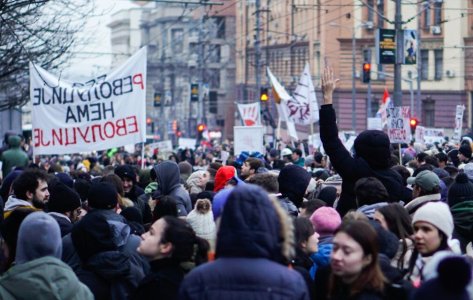
Nevertheless, the plenary assemblies remained the primary source of legitimacy for the student movement. Their importance also lay in their capacity to generate broad social mobilisation. Student marches between cities, multi-day treks, bicycle journeys, mass demonstrations, and complex logistical operations all involved a large number of young people. Many did not necessarily participate in formulating political demands, yet by organising these activities, they became active members of the movement. The student movement allowed them to integrate into a broader political community through collective action, without requiring them to adopt a specific political ideology beforehand.
The students carefully avoided ideological and political stances that might undermine broad social support, and sought to present themselves as a movement representing the interests of society as a whole. Although the organisational model of the plenary assemblies bore affinities to anarchist and horizontalist traditions, its political content was not revolutionary. Broad participation fostered the reproduction of prevailing social attitudes, since only those demands acceptable to a large number of participants could garner support. The radicalism of the student movement lay primarily in its methods of organisation and its challenge to the existing government, rather than in its ideological programme.
The alliance between populism and expert knowledge
The most unusual feature of the student movement was its alliance with the academic elite. In many contemporary Western societies, populist movements develop in opposition to educated elites, experts, and professional managers. Academic institutions are often portrayed as part of an alienated establishment, detached from the everyday concerns of ordinary people. In Serbia, a mass populist movement embraced the academic elite as a natural political ally. Education, expert knowledge, professional qualifications, and cultural capital became central elements of its political identity.
This was clearly reflected in the way the students were presented to the public. They were portrayed as educated, honest, responsible and capable young people—future doctors, engineers, teachers and specialists. Particular emphasis was placed on the message that they wished to remain in Serbia and build their professional futures in their own country. This narrative resonated directly with the prevailing discontent regarding the Vučić regime. In a society where employment and career advancement depend on political connections, the natural alternative is one that values knowledge, qualifications, and professional competence. The fight against corruption and nepotism thus became the link between the academic elite and the populist base.
This alliance also entailed a certain fetishisation of expert knowledge: the expectation that individuals with the appropriate training and professional qualifications—free from ties to the discredited political class—would be better equipped to govern the country. Such a belief overlooks the fact that expert knowledge in a specific field does not automatically translate into political competence, and that professional elites have their own social interests, which do not always align with those of the majority of the population. Nevertheless, the combination of populist mobilisation and the authority of expert knowledge enabled the student movement to extend beyond the universities and emerge as a serious political alternative.
This was also reflected in the composition of the Student List. Among its candidates were university professors, economists, lawyers, specialists from various fields, and a significant number of individuals from non-governmental organisations.
Why the student movement did not develop a new ideology
When the student movement decided to stop addressing demands to the existing government and instead call for parliamentary elections, it took a step that may at first have seemed like an abandonment of its original logic of direct democracy. However, this decision was consistent with the populist character of the movement. Although based on principles of direct democracy, the student plenums reproduced another dominant social belief: that parliamentary elections are the main mechanism of political change.
At the same time, they kept their distance from existing political parties. This was often explained by the organisational characteristics of the student movement. Since the plenary assemblies had no permanent representatives authorised to negotiate on behalf of the movement as a whole, cooperation with political parties was institutionally complicated. There was also a deeper ideological reason. It was difficult for the student movement to negotiate a common platform with parties that held clearly defined political positions. Cooperating with liberals, conservatives, nationalists, or social democrats would have required the movement to take a stand on issues over which its own base was divided. Its political strength depended on its ability to prevent such divisions from emerging.
The Student List represented what society broadly perceived as political normality. Its core demand was for a state free from corruption, for institutions that functioned properly and for expert knowledge to take precedence over party affiliation. Consequently, the election campaign was largely free from traditional ideological conflicts. Vučić sought to portray the Student List as a political force that would alter economic and foreign policy, jeopardise relations with Russia, or call into question existing social benefits. The Student Slate generally responded that such changes were not their objective, and that they would implement existing policies with greater effectiveness and responsibility. There was considerably more programmatic continuity between the two major electoral slates than the intensity of their political confrontation might have suggested.
Even when the Student List expressed its opposition to the cheap-labour policy promoted by the Vučić regime during its early years, the distinction was not entirely clear. Over the preceding decade, the regime itself had sought to move away from the image of a country that attracted foreign investors solely on the basis of low wages, promoting instead technological development, investment in science, and more sophisticated industrial investment. There is a substantial gap between political rhetoric and actual economic outcomes, but the conflict centered largely on who was capable of delivering the desired economic model.
A similar logic was applied to foreign policy. The Vučić government sought to maintain relations with the European Union, Russia and China, while avoiding full alignment with any single international bloc. This policy enjoyed relatively broad support within society, leaving the Student List with little reason to challenge it in any radical way. The core electoral choice was much simpler: the continuation of a system based on party loyalty, or its replacement by one that promised professional governance.
A victory with the characteristics of a plebiscite and the defeat of the political establishment
The election results confirmed the strength of this political mobilisation. According to preliminary data from the Republic Electoral Commission, the Student List secured 52.65% of the vote, while the list led by Aleksandar Vučić received 39.22%. Voter turnout was approximately 69%, and seat projections indicated that the Student List could form a parliamentary majority on its own. Vučić’s electoral machine managed to retain a substantial portion of its voter base, but it could not match the exceptionally broad mobilisation of voters seeking political change.
The student movement succeeded in turning the elections into a referendum. The vote was framed as a decision as to whether the existing system of government should survive, and this climate effectively eliminated any space for the traditional opposition parties. Most withdrew from the electoral race, and those that remained garnered negligible results. Apart from the two dominant lists, no other list managed to cross the electoral threshold. The student movement thus defeated Vučić and effectively replaced the previous opposition.
This may be the most significant political consequence of the elections. Serbia has not gained a new governing party that represents a clearly defined ideological alternative to the previous administration. A movement whose legitimacy rests on a combination of mass mobilisation, a rejection of corruption, and a reliance on expert knowledge has secured a parliamentary majority.
Real estate development: the drug that fuels Vučić’s economic model
The Vučić regime survived thanks to its electoral machinery and clientelist networks, but its political stability also depended on its ability to deliver economic growth, a relatively stable standard of living, and increased purchasing power. The economic policy of the previous government was more complex than is often portrayed within opposition circles.
Over the previous decade, Serbia benefited from certain advantages stemming from its foreign policy stance. Maintaining relations with Russia provided access to relatively affordable energy, while cooperation with China brought in significant investments particularly in industry, mining, and infrastructure. In this regard, Serbia’s economic model shared certain similarities with the policies implemented by Hungary and Slovakia. At the same time, maintaining a stable exchange rate for the Serbian currency against the euro served as an important tool for preserving purchasing power. For a population whose consumption relies heavily on imported goods, and for citizens with loans or other obligations denominated in euros, exchange rate stability held immediate economic significance. The regime also sought to ensure increases in pensions, public sector wages, and various social benefits. Regardless of the actual scope or the distributive effects of these measures, they helped sustain social support for the existing economic model.
Real estate development became one of its most important pillars. Major infrastructure projects, the development of residential and commercial complexes, the Belgrade Waterfront project, preparations for the EXPO due to be held in Belgrade in 2027 and other related urban developments sustained construction activity, created jobs, and contributed to GDP growth. The problem was the economy’s excessive reliance on large-scale construction projects—often luxury developments—whose contribution to economic activity largely ended once the work was completed. Furthermore, a substantial portion of the labour was carried out by foreign firms that brought in their own workers and departed after finishing the projects, leaving limited long-term benefits for the national economy.
In Serbia, real estate development also served a distinctly political function. Large-scale construction and infrastructure projects were among the key mechanisms that linked political and business elites. Control over land, urban planning decisions, public procurement, and investment projects created opportunities for the private accumulation of capital. Real estate development thus became one of the mechanisms through which individuals with ties to political power could themselves become capitalists. This model created a strong interdependence among political authorities, investors, and the construction sector. Political control provided access to profitable projects, while those projects contributed to the economic growth upon which the government based part of its legitimacy.
In this sense, real estate development became a kind of drug for the Vučić regime. It made it possible to simultaneously satisfy two key demands: the continued enrichment of a politically connected business elite, and the maintenance of a level of economic activity high enough to keep living standards rising. Each new major project extended the life of this model while, at the same time, increasing the dependence on its continued expansion.
The future of major urban development projects thus took on political significance. The Student List’s opposition to plans for the commercial redevelopment of the General Staff complex in Belgrade—linked to the investment interests of U.S. President Donald Trump’s family—was a visible expression of the rejection of the previous approach to the management of urban space and public resources. Consequently, the new government will face a serious problem: if it intends to dismantle the corrupt mechanisms of the previous regime, it will also have to change the way one of the key drivers of economic growth functions.
The new government’s economic constraints
The Student List presented an ambitious reform programme, particularly in the areas of education, science, culture, healthcare, and social protection. This programme reflects the group’s social composition and the significant role played by the academic and professional elite in its development. Fulfilling these promises will require substantial public resources.
One of the assumptions underpinning the new government’s optimism is that combating corruption will free up sufficient resources to fund its promised reforms. More transparent public procurement, more rational investment, and a reduction in the misuse of public funds could undoubtedly generate substantial savings. It remains unclear, however, whether these will be enough. Even with a significant reduction in corruption, Serbia would still face low productivity, limited public revenue, a reliance on foreign investment, and structural weaknesses within its national economy.
A potential reorientation of economic development presents a particularly complex challenge. Should the new government attempt to reduce reliance on real estate development and place greater emphasis on export-oriented production, it would encounter limitations stemming from the existing monetary and economic model. Strengthening the competitiveness of the domestic agricultural sector and certain industrial sectors, for instance, could raise questions regarding the true value of the dinar, the national currency. Depreciating the national currency could improve the price competitiveness of exports, but it would also make imported goods more expensive and erode purchasing power. Such a measure would not automatically resolve production-related problems and could have serious social consequences. Preserving purchasing power was one of the key promises made by the Student List. Its populist base does not expect an economic policy that asks citizens to accept a declining standard of living in the name of long-term development goals.
Similar limitations apply to the emigration of young people and those with an educational background. Over the last two years, the student movement has strongly emphasised that young people want to remain in Serbia and build their futures there. However, the emigration of skilled workers is not solely a consequence of corruption or authoritarian rule. The experience of Croatia demonstrates that even EU member states can face large-scale labour emigration, and that the free movement of people within the European labour market can facilitate migration toward wealthier countries.
Therefore, the new government will face a series of problems for which there are no simple technical solutions. Its response to the question of future economic development centres primarily on increasing productivity—one of the most difficult tasks in economic policy—which requires long-term structural change rather than merely a change in political personnel.
Will the populist base control the new elite?
The most important question following the electoral victory is the relationship the new government will establish with the movement that brought it to power. Over the last two years, student plenary assemblies served as the movement’s primary source of legitimacy. They determined political demands, methods of mobilisation, and, ultimately, the transition into parliamentary politics. Furthermore, the process of forming the "Student List" demonstrated the movement’s insistence on maintaining control over its representatives. The candidates underwent extensive vetting processes regarding their personal histories and professional integrity, with the aim of preventing the nomination of individuals whose pasts could compromise the entire movement. This approach reflected the core political message that power should be entrusted to competent, untarnished individuals.
The entry of some 140 representatives from the Student List into parliament creates an entirely new situation. These deputies will now possess formal political legitimacy, access to state institutions, and the capacity to participate directly in decision-making. They will no longer be mere delegates of a protest movement, but rather holders of parliamentary mandates. The question is whether the new government will continue to recognise the authority of student plenaries and other participatory forms of organisation. The plenary assemblies themselves have already weakened considerably: their activity is declining, and fewer students are participating. If they manage to preserve their organisational structures and their connections to elected representatives, they could function as a mechanism of social oversight over the new government, limiting the autonomy of professional administrators and their ability to implement policies that run counter to the expectations of the movement’s electoral base.
There is also the possibility that the connection to the student movement might gradually be severed. In that scenario, the academic elite—who already hold a prominent position within the Student List—could emerge as the dominant political force in the new administration. Its representatives might begin to behave like the professional political and managerial elites found in Western societies, justifying unpopular measures by invoking economic necessity, fiscal responsibility, or the demands of the market.
The representatives from the Student List hold diverse political convictions. Some lean toward liberal and pro-European positions, others toward conservative or nationalist ones, while some candidates align themselves with socially-oriented policies. As long as the primary objective was to topple the Vučić regime, these differences did not necessarily have to become politically decisive. Once the new government confronts concrete issues—such as taxation, privatisation, public spending, labour legislation, and international relations—ideological conflicts may well become inevitable. It is easy to imagine that liberal, conservative, nationalist, or left-wing groups might gradually emerge within the parliamentary majority. Such an evolution would mark the end of the specific populist unity that made the electoral victory possible and it could pave the way for neoliberal reforms, austerity policies, or other measures that directly threaten the living standards of segments of the population.
Between Political Normalisation and a New Democracy
The victory of the Student List demonstrated that even an exceptionally sophisticated party machine can be defeated through broad social mobilisation. The student movement united a large segment of the population around demands to put an end to corruption, nepotism, and partisan control of institutions. Its core promise was political normalisation.
The immediate consequences of this victory are already visible. From the perspective of Radnički glas (Workers’ Voice)—an organisation to which I belong, which works with trade unions in education, research, culture, and other sectors—the shift in political relations was felt almost overnight. Barely a day after the elections, we have already observed changes in the behaviour of certain directors and managers, while questions arise regarding the future of numerous proceedings initiated against employees who opposed the government. A military union, which announced several months ago that it was ceasing its activities due to political pressure, has now issued a new statement suggesting that it might resume its work.
Partisan nepotism was an everyday experience for a large number of employees. For many, the victory of the Student List therefore brings a sense of relief from immediate pressure. The ability to speak more freely at work, to refuse to follow a political directive, or to plan a professional future without relying on party loyalty represents a tangible change. This helps to explain the massive celebrations that followed the elections.
The victory has also opened up the possibility of transforming political representation itself. Here, we encounter what is perhaps the most interesting—and seemingly paradoxical—similarity between the Student List and the Vučić regime. Both, in different ways, displaced the traditional multiparty system, which was based on competition between ideologically defined parties. Vučić incorporated various political options into his governing coalition and subordinated them to the party apparatus and its hierarchy. The Student List brought together ideologically diverse representatives around a common political goal, yet it built its legitimacy through mass participation rather than through a traditional party organisation.
The absence of clearly defined party programmes does not necessarily constitute a weakness of the new political order. Competition between political parties—in which citizens periodically choose among pre-formulated platforms—is not the only possible form of democratic representation. The student movement demonstrated that it could mobilise a vast number of people who had never belonged to political parties nor previously engaged in political activism. Their involvement went beyond protests: they organised the election campaign, protected polling stations, and directly supervised the electoral process. People who had previously been mere voters became active participants in political life.
The question is whether this form of participation can be sustained following the electoral victory. Student plenaries have already weakened, but the social energy unleashed by the movement need not remain tied exclusively to them. It is particularly significant that many candidates from the Student List are established professionals with no prior political ambitions. Their willingness to accept parliamentary mandates does not necessarily imply a desire to become professional politicians. Viewing a political office as a temporary social responsibility could help establish a different kind of relationship between representatives and those they represent.
Trade unions could play an important role in this process. Unlike student assemblies—whose activity is tied to the shifting composition of the student body—unions possess more durable organisational structures, direct connections to workers, and concrete demands that arise from day-to-day labour relations. In the political space that opens up following the fall of the previous regime, they could establish themselves as one of the voices organised from below.
This would also entail a different relationship with parliamentary power. Trade unions would not have to limit themselves to traditional social dialogue, appeals to government ministries, or occasional negotiations with government officials. They could forge lasting ties with the representatives from the Student List—following the model of the cooperation they developed with student assemblies during the protests—and leverage these relationships to articulate workers’ demands and exert pressure on the government.
Such a relationship could offer a way to move beyond the limitations of representative parliamentary democracy. Organised social groups could participate directly in shaping policy decisions and overseeing their implementation. Parliament could then become a space where the demands of the grassroots are articulated, rather than an institution where professional politicians make decisions independently between one election cycle and the next.
The most significant possibility opened up by the Student List’s victory lies in the opportunity to free political representation from its exclusive dependence on party competition, and to build a more enduring bond between elected representatives and an active, organised society. The student movement has already demonstrated that mass political participation can exist outside the framework of traditional political parties. Its next challenge will be to show whether such participation can endure when the movement’s representatives form the governing parliamentary majority.
27 October 2026
Translated by David Fagan International Viewpoint from Viento Sur.