
 Version imprimable
The Lebanese people have every right to be overwhelmingly angry at what they perceived as their country’s entanglement in a confrontation beyond its capacity, through a decision made unilaterally by a military organization operating on behalf of a foreign state, parallel to the country’s official institutions. This is especially understandable since these institutions’ legitimacy from the electoral democratic standpoint is beyond question, especially when compared to the regional political context.
What has exacerbated the public anger is that the cause for which Hezbollah reignited the war with the Zionist state is not one on which a larger segment of the population may agree – unlike solidarity with the Palestinian people in general, and the people of Gaza in particular, in the face of the genocidal war they endured. Indeed, the cause for which Hezbollah entered the fray this time is not even an object of consensus among the Lebanese Shiites themselves, the religious sectarian social base among which the party has built its constituency. The party’s initiative to launch missiles at Israel was ostensibly in retaliation for the assassination of the head of the Iranian state, the Guardian Jurist or Theologian (Vali-ye Faqih in Farsi), according to Iran’s theocratic constitution.
Hezbollah has never hidden its affiliation to the Iranian state. Its late Secretary-General, Hassan Nasrallah – a cleric himself according to the theocratic rule that presides over the party’s organization in accordance with the Iranian model – once famously boasted: “We are the Party of the Guardianship of the Jurist” (Wilayat al-Faqih in Arabic). This is a fundamentalist theocratic doctrine elaborated by the founding father of the Islamic Republic of Iran, Ruhollah Khomeini, a Grand Ayatollah (Great Sign of God), one of the highest-ranking clerics of Twelver Shiism (the mainstream branch of Shiism) and one of the millions of alleged descendants of the Prophet of Islam, recognizable among clerics – like his successor Khamenei, or Nasrallah himself for that matter – by the black turban they wear, which distinguish them from the rest of clerics who wear a white turban, and by the title of Sayyid (master or lord).
Khomeini’s doctrine was never consensual among Shiite clerics. Its fundamentalist political interpretation deviated significantly from the original strictly religious understanding of the attributes of the Guardian Jurist. This became even more salient when the same position, at Khomeini’s death in 1989 and as a result of political maneuvers within the new regime, was entrusted to Ali Khamenei, who had only attained the lower rank of Hujjat al-Islam (Argument of Islam). This move necessitated a constitutional change, removing the requirement of the supreme theological degree for the Guardian Jurist, who is elected by the Assembly of Experts – an assembly composed of 88 clerics elected after vetting by the Guardian Council’s twelve members, half of whom are appointed by the Guardian Jurist.
The same pattern of appointment of a lesser-ranking cleric to the supreme position was repeated with Khamenei’s son, Mojtaba, who like his father at the time of his accession to power, has not gone beyond the rank of Hujjat al-Islam. Thus, the Guardianship of the Jurist, as interpreted in the Islamic Republic of Iran, has become a mere ideological veneer for a regime that is theocratic in form, but lacks spiritual requisites and relies instead on very temporal institutions and interests. Central to these institutions is the Corps of Guardians of the Islamic Revolution, better known in English as the Islamic Revolutionary Guard Corps (IRGC), which is the major ideological component of Iran’s armed forces and controls an economic empire – a military-industrial-social complex funded with Iran’s oil revenues.
Lebanon’s Hezbollah was founded with direct Iranian involvement amidst the resistance against the 1982 Israeli occupation of half of Lebanon. It thus combined the characteristics of an organization resisting occupation with those of a local armed tentacle of the Iranian regime. This duality became most evident when the party intervened massively in the Syrian civil war, starting from 2013, to shore up a regime that bore no connection whatsoever to Khomeini’s ideology, but rather claimed adherence to an ideology rather opposed to it (Arab nationalism and “socialism”). That involvement constituted the main component of Iran’s intervention on behalf of the Syrian Baathist Assad regime, which was guided by Iranian state interests and only ended with that regime’s collapse at the end of 2024.
From this perspective, Hezbollah’s initiative to ignite a new war with the Zionist state, as part of the Iranian regime’s strategy of regional expansion of its resistance against the U.S.-Israeli aggression launched on February 28, is the second major act that confirmed in the eyes of most Lebanese the party’s prioritization of the Iranian regime’s interests over the interests of its own country and people, including the interests of its own popular base already exhausted by the two-year war that the party has waged in solidarity with Gaza starting from October 2023 – more specifically in support of Hamas, another ally of Tehran, but one that is also an anti-Zionist fighting force, unlike the Assad regime.
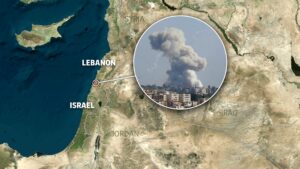
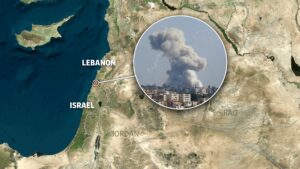
However, there is a clear common thread between the current Zionist onslaught on Lebanon and the onslaught on Gaza following Operation Al-Aqsa Flood of two and a half years ago. Like for the latter operation, Hezbollah’s launching of its rockets has been seized as a pretext by the current Zionist government – the most rightwing extremist government in the history of the State of Israel – to pursue long-standing expansionist ambitions that lie at the heart of the original Zionist ideology and are fervently upheld by the Israeli far-right, dominant in the present Israeli cabinet. Indeed, the parallel is striking between the way Israel invaded the Gaza Strip, ordering a gradual displacement of its population north to south, and what it is now doing in southern Lebanon.
And as with Gaza, the most extreme members of the Zionist cabinet are revealing the true objective their government is pursuing. Finance minister Bezalel Smotrich declared on March 24 that “the Litani River must be our new border” with Lebanon (the river is 15 to 30 km – 9 to 19 miles – north of the present border, delimitating a region that constitutes over 10% of Lebanon’s area). Smotrich advocated Israel’s permanent seizure of this portion of Lebanon just as it occupies a portion of the Gaza Strip, with the intention of perpetuating the occupation and annexing it later. On the same day, minister of war Israel Katz, a member of Netanyahu’s Likud party, declared that the coveted region constitutes Israel’s “security zone.”
In these wars, the Israeli government is exploiting the presence at the White House of a president who is certainly the most lenient toward Zionist ambitions of all U.S. presidents, a Donald Trump who, during his first term, had already been the first U.S. president to recognize the annexation of East Jerusalem and the Syrian Golan Heights, occupied by Israel since 1967. He was also willing to support the annexation of most of the West Bank, had it not been for the Gulf monarchies’ veto, including the “red line” set by the closest of them to Trump, the rulers of the United Arab Emirates. Benjamin Netanyahu and his cabinet hope that the U.S. president will turn a blind eye to their invasion of Southern Lebanon, if not openly support it. They have retained control of more than half of the Gaza Strip, in the hope that Trump, or the failure of his “peace plan,” would allow them to prolong the occupation with a view to later annexing most of the Strip. They also contemplate annexing most of the West Bank, which is undergoing violent creeping appropriation and population displacement by Jewish settlers with governmental support.
The far-right Zionist government hopes to replicate this situation in southern Lebanon, whose territory it is currently in the process of occupying after emptying it of most of its inhabitants. Just as it uses the continued existence of Hamas and the threat it poses to the State of Israel as a pretext for the perpetuation of its occupation of Gaza, it intends to use the existence of Hezbollah and the threat it represents to its state as a pretext for a long-term occupation of southern Lebanon. From this perspective, Hezbollah’s resistance to occupation, like Hamas’s resistance, is turned into an argument for implementing and perpetuating the occupation.
But a renewed Israeli occupation of southern Lebanon can only bolster the national legitimacy of Hezbollah’s resistance. It confers renewed rightfulness on its fight against the occupation, in the hope that its harassment of the Israeli army could ultimately force its withdrawal, like what the Hezbollah-led resistance of the 1990s achieved in 2000. True, that withdrawal was carried out by a government led by the Zionist Labor Party, and it is unlikely that the current Israeli government would repeat it. But the Israeli government could change hands in the not too-distant future.
Under these circumstances, the best that the Lebanese government can do is to actively lobby the Arab states, particularly those with the greatest influence on the White House, i.e. the Gulf monarchies, to bring them to exert pressure on Trump in order to prevent a prolonged occupation of southern Lebanon. These monarchies surely understand that the Israeli occupation of part of Lebanon in the last two decades of the 20th century led to the rise of Hezbollah and the regional expansion of Iranian influence. They thus have a vested interest in preventing a repeat of this scenario. This is what the Lebanese government should focus its efforts on in the face of Israeli aggression – not on disarming Hezbollah under U.S. pressure, a task that is beyond its capabilities.
Worse still, the Lebanese government has clearly seen that, despite the withdrawal of Hezbollah’s forces from the region south of the Litani River and the deployment of governmental Lebanese Armed Forces (LAF) troops there, in accordance with the ceasefire agreement of November 27, 2024, Israel has not stopped its airstrikes and incursions in that region. And yet, the Lebanese government’s reaction to the new Israeli invasion was to withdraw its troops from the south and raise its voice against Hezbollah, declaring its military action illegal at the most inappropriate moment.
The country’s best interests require it to aim at a peaceful agreement to integrate Hezbollah’s armed forces within the LAF – a move that will only become possible when the regional equation undergoes a fundamental shift. Any attempt to disarm Hezbollah by force is but a recipe for a renewal of civil war in a country that has already been devastated by fifteen years of such war, between 1975 and 1990.