
 Version imprimable
What is the background to this international conference?
Eric Toussaint: On 8 January 2023, shortly after losing the presidential election to Lula, Jair Bolsonaro attempted a coup d’état in Brazil. Citing alleged electoral fraud, supporters of the neo-fascist former president stormed the headquarters of Congress and the Federal Supreme Court, mirroring the storming of the Capitol by Donald Trump’s supporters two years earlier. These events highlighted the danger posed by the rise of the far right. From this realisation emerged the idea of organising an international anti-fascist initiative.
Why was the city of Porto Alegre, in southern Brazil, chosen?
The symbolism is powerful, as it was in this city that the World Social Forum (WSF) was born: in January 2001, 20,000 people gathered there to define a common agenda for the anti-globalisation movement, which was then in full swing.
Secondly, because by defeating Jair Bolsonaro in 2022, the Brazilian left proved that it is possible to block the path of the neo-fascist threat: parties – from the social-democratic PT to the radical-left PSOL – popular movements and trade unions overcame their differences to secure Lula’s victory. These actors are represented within the united committee organising the conference.
Scheduled for May 2024, the meeting had to be postponed due to the severe flooding – a consequence of climate change – that hit the state of Rio Grande do Sul the previous month. Given the increase in military aggression by Donald Trump since the start of his term, we have since decided to add an anti-imperialist component to the event.
Is the world currently experiencing a neo-fascist turning point?
The Trump administration is at the helm of the world’s leading power. It is implementing a policy characterised by extreme nationalism, supremacism and homophobia, whilst using the ICE militia to carry out mass deportations of non-white people. It can therefore be described as neo-fascist. A shift explicitly symbolised by Elon Musk’s Nazi salute at Trump’s inauguration.
At the same time, the far right threatens to come to power in most European states; in Russia, Vladimir Putin’s regime bears striking similarities to Trump’s; India is led by a radical Hindu nationalist and Islamophobe, Narendra Modi. Meanwhile, in Israel, Benjamin Netanyahu’s neo-fascist government has been carrying out a genocide in Gaza for over two and a half years.
In Latin America, the election of Javier Milei in November 2023 was followed by that of Juan-Antonio Kast in Chile in 2025. Meanwhile, Ecuador’s president, Daniel Noboa, is modelling his regime on the authoritarian rule of Nayib Bukele in El Salvador. And the far right will do everything in its power to win the presidential election this autumn in Brazil, against Lula, with the support of an international network. If it succeeds, this will have terrible repercussions across the entire continent, which has endured brutal dictatorships over the last century.
The radical right appears to have a strong global network. Is this the case?
We are witnessing the emergence of a kind of neo-fascist international, driven in particular by Donald Trump’s United States. In his national security strategy published in 2025, the US president clearly lends his support to the ‘patriotic’ parties of the Old Continent. In Latin America, which he once again regards as a ‘backyard’, he does not hesitate to interfere directly in political and electoral processes to favour far-right candidates.
Admittedly, these forces do not have a single global command. But coordination structures are already in place. The Conservative Political Action Conference (CPAC) brings together the radical right-wing parties of the Americas and Europe every year. It has recently organised conferences in the United States, Hungary and several Latin American countries. Launched by the Spanish party Vox, the Madrid forum is another event that brings these parties together.
Is the Porto Alegre conference intended as a response to this neo-fascist globalisation?
On the left, we are lagging behind: we have not yet begun to internationalise our response to the far right. Admittedly, the forces fighting fascism and imperialist aggression are very diverse, and there is no question of erasing these differences. However, it is essential to build a broad front, on a global scale, against these increasingly threatening enemies. This convergence must include all forces willing to defend the working class, the peasantry, migrants, women, LGBTQIA+ people, people of colour, oppressed minorities and indigenous peoples – whilst defending nature and supporting the struggles against imperialism. Our conference will seek to provide the beginnings of a response to this challenge.
In practical terms, what might this initiative lead to?
One of the keys to success is to remain modest. The idea is not to create a new global structure, but to bring together parties, prominent figures and activists around a space capable of convening and supporting joint initiatives and mobilisations against the far right. All whilst supporting the battles being fought in different countries.
Following this first global meeting, a second significant step forward would be to organise a similar initiative in the world’s major regions, starting in 2027.
THOUSANDS OF ACTIVISTS EXPECTED
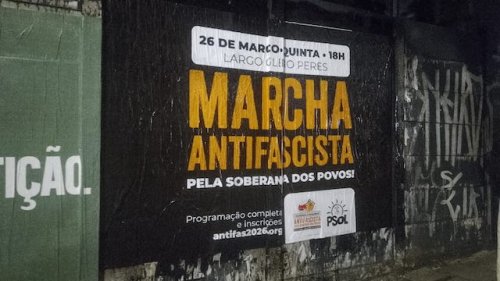
Several thousand people, from around 70 countries, are expected to attend the First Anti-Fascist Conference for People’s Sovereignty, to be held in Porto Alegre from 26 to 29 March. The event will open with a large demonstration in the streets of the capital of the state of Rio Grande do Sul. Over three days, it will feature eleven thematic plenary sessions and 150 self-organised activities. Discussions will focus on strengthening social, feminist and trade union movements, as well as international solidarity in the fight against fascism – but also on the potential and limitations of institutional action. Solidarity with Gaza, the struggles against climate denial and for agrarian reform, and the situation on the American continent will be other key themes. The debates will conclude with the adoption of a charter at a general assembly.
Whilst a large proportion of the speakers will come from the Americas, a wide range of organisations and movements will be represented in the capital of Rio Grande do Sul, which was the birthplace of one of the main social movements on the Latin American continent, the Landless Workers’ Movement (MST), in the 1980s. This is evidenced by the more than 1,500 prominent figures and activists from five continents who have signed the international call inviting people to the conference. They include, notably: leaders of grassroots and political organisations from Latin America, including the leader of the MST, João Pedro Stédile; feminist authors and activists Nancy Fraser and Tithi Bhattacharya; Indian journalist and activist Vijay Prashad; Haitian economist Camille Chalmers; Solange Koné, of the World March of Women (WMW) in Côte d’Ivoire; Frei Betto, a Brazilian writer and figure in liberation theology; MEP (La France Insoumise) Rima Hassan and Thiago Silva, participants in the global Soumoud flotilla for Gaza; Ada Colau, the former mayor of Barcelona; Annie Ernaux, winner of the 2022 Nobel Prize in Literature; former leader of the British Labour Party, Jeremy Corbyn; the leader of La France Insoumise, Jean-Luc Mélenchon, alongside Italian and Spanish parliamentarians and members of DSA, the left-wing faction of the US Democratic Party. In Switzerland, sociologist Jean Ziegler, former UN Special Rapporteur on the Right to Food, has signed the appeal. Mathilde Marendaz, an activist with the Solidarité & Ecologie party and a member of the Ensemble à gauche group in the Vaud Grand Council, will be travelling to Porto Alegre.