
 Version imprimable
The Labour Party lost control of 38 English councils as well as the Welsh assembly. Wales has been a strong Labour base since the 1920s but this year they came third behind Plaid Cymru and Reform. In Scotland Labour was also beaten into joint second place behind the Scottish National Party and tying with Reform.
This was the first major test for the Labour government, elected in 2024 with a huge parliamentary majority after the Conservative government finally collapsed after years of scandals and internal crisis. Labour won a majority but had 2 million fewer votes than it got in 2019 when Jeremy Corbyn was the left leader.
Since winning power, Labour leader Keir Starmer has proven to be utterly useless; continuing the austerity agenda, attacking migrants rights, turning against transgender people and failing to tackle the housing or adult social care crisis. It has performed many U-Turns as policies have been proposed and then scrapped, including increasing inheritance tax on farmers, scrapping the winter fuel allowance for many pensioners and keeping the child benefit limit to two for each family, a policy that casts hundreds of thousands of children into poverty.
The Labour faction around Starmer are only good at one thing – purging the left. They won power by lying about the policies they would implement (which appeared relatively left wing), scrapping them all then going to war against the Labour left. Now Starmer’s future as leader looks very uncertain as many MPs blame him directly for the losses.
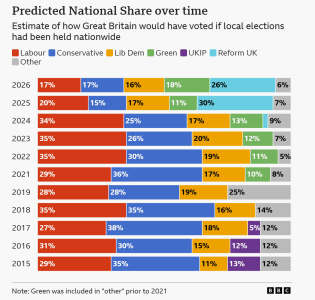
In power they have dealt with a huge growth of Reform, a far right party led by Nigel Farage, the leader of the Brexit movement 2015-19. Reform was only launched 3 years ago but has nearly 277,000 members. Their most popular policies are to prevent refugees arriving and to limit immigration more generally, but they also propose dismantling the welfare state and huge cuts to government spending, as well as financial deregulation to appease their main backers who are crypto-millionaires. They are also a climate change denial and anti-vax party as well as one that generally paints itself in the image of Trump.
But they now have competition to their right with Restore Britain who claim nearly 100,000 members. Restore are even more racist and reactionary, calling for mass deportations and ending asylum completely. They have started to win support in GreatYarmouth where their MP Rupert Lowe is based.
In the election in England Reform won 1,372 councillors and took control of 14 more councils. They are still the most popular party in the polls and would likely win the next general election, possibly in coalition with the remains of the Conservative Party.
The bright spot in the election was the success of the Green Party of England and Wales who have a new left- wing leader called Zack Polanski. Polanski has turned the fortunes of the Green Party around, with outspoken left policies aimed at tackling wealth inequality and the decline in living standards. The Greens membership grew from 90,000 to 250,000 within a year after he became leader, and has now largely filled the political space to the left of Labour. They won 577 councillors and took control of six local councils for the first time. Three of these were in areas where they had a history of organising, three – all in London – they subjected Labour to surprising defeat
However ecosocialists are critical of the Greens as they are an entirely parliamentary party and as such are wedded to using the imperialist and deeply capitalist British state as the main vehicle for change. Their internal structures are very weak with local units hardly meeting and conferences being open to every member. No doubt the closer they get to power the danger of triangulation and compromise will appear, just as it did for the Labour party 100 years ago.
The failure of Your Party launched less than a year ago by Jeremy Corbyn and another former Labour MP Zarah Sultana, destroyed from within by internal faction fighting before it was even launched compounded by major undemocratic practices by Corbyn and his clique presents a serious problem for the radical left.
Despite having first past the post elections and not proportional representation in both English council elections and for the Westminster parliament – a system that has always favoured the two main political parties of Labour and Conservatives - the UK is now increasingly a multi-party system. Pro-independence parties are running the administrations in Wales and Scotland, while increasing numbers of areas in England went to the far right or the Green Party. Sixty-four councils in the elections ended up in No Overall Control, meaning that no party got a majority.
Given the victories of the nationalist parties, there is a real possibility of the break-up of the UK in the next few years which would pose huge changes to the structure of politics and society on the British Isles.
This fragmentation of UK politics is the result of decades of neoliberalism and austerity, with declining living standards since 2008 and a general sense of decline. The Conservative party used 14 years in power to further impoverish and punish working people whilst the offensive against immigrants and refugees gathered pace. Labour was politically bereft of any meaningful ideas or radical differences from the Conservatives, with the exception of the Jeremy Corbyn years when the left briefly won control of the party. But the relentless attacks against Corbynism were deeply damaging and showed that the Labour right would never accept social democracy back into the party.
Now the hope for Labour is a soft left leader like Andy Burnham – currently mayor of Manchester. Burnham was one of the candidates defeated by Corbyn in 2015 and his re-emergence as a left leader shows how weak the Labour left actually is. His policy platform would be incredibly limited and continue to fail to tackle the main crises facing the country.
The threat of a far right government cannot be ignored or downplayed – a victory for Reform at the next election would be a strategic defeat for the working class.
12 May 2026