
 Version imprimable
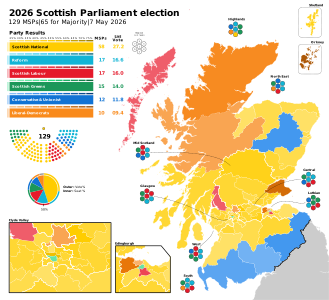
The independence-supporting Scottish National Party (SNP) [3] became the largest party for the fifth consecutive time since the Parliament was re-established in 1999, though it fell short of a majority. The SNP have been the largest party for 19 years and now move into their third decade of continuous leadership of the Scottish government - a remarkable outcome given the volatility of UK politics.
Despite the SNP falling back a little, the Parliament now has the largest majority supporting independence in the devolution era. This is despite the process of devolution and the electoral system being deliberately intended by the once-dominant British Labour Party to prevent independence.
While the right wing anti-immigrant party Reform UK has emerged as a significant force in Scotland for the first time, their gains in seats were entirely at the expense of the discredited rightward-moving Conservative & Unionist party [4], with the combined Reform UK and Conservative seat numbers being less than those held by the Conservatives alone in the last Parliament. Reform failed to win a constituency seat and had to rely on the regional list “top up” seats in the “two votes” electoral system.
The election was a disaster for the Labour Party [5] which had high hopes two years ago of emerging as the largest party, but they lost seats and fell to their lowest representation in the devolution era.
The big gainers were the left-wing Scottish Green Party [6], who nearly doubled their seats despite being ignominously bundled out of a joint governmental agreement with the SNP in the last parliament. The Scottish Greens won two constituency seats from the SNP for the first time in the largest cities of Glasgow and Edinburgh and won representation from all regions of Scotland. The small centre-right anti-independence Liberal Democrat party also grew but is still the smallest party in the parliament.
The SNP will continue to take the role of First Minister and nominate Government ministers as a minority, negotiating with other parties to get their legislation through. One policy of the newly re-elected government will be to demand another independence referendum from the UK Parliament at Westminster. This is very unlikely to be granted by the Starmer UK government majority, leading to a continuing “democratic deficit”. However the SNP will be strongly encouraged by the victory of Plaid Cymru [7] in Cymru/Wales to take control of government there and role of First Minister. The SNP are also working with Sinn Fein in the north of Ireland, once taboo due to Sinn Fein’s past and unionist sentiment in Scotland, but now becoming normal.
All three First Ministers and leading parties in the devolved legislatures of the UK state now support the break up and creation of separate states. The “Celtic Alliance” of the three First Ministers and parties, as it is increasingly called, will put significant pressure on the unionist forces in England. [8]
Similarities and differentiation across Britain
The separate elections took place across Britain on 7 May have provoked a crisis in the UK government of Prime Minister Keir Starmer that could see him ousted from power after only 22 months within days rather than weeks.
It is important to understand that although synchronous, the elections were to different bodies in different parts of the state in England, Scotland and Cymru/Wales, and even under totally different electoral systems and electorates. Unlike the Westminster Parliament, both Scotland and Cymru/Wales use systems for their national-devolved legislatures that are more proportional and give votes to 16/17 year olds. The electorate in Scotland includes all nationalities, the only part of the UK state where all immigrants are enfranchised.
But the common features across the UK state were a massive collapse in votes for the Labour Party compared to the UK general election in 2024, a continuing rise in support for the right wing Reform party of Nigel Farage, emerging from the Brexit Party, and a rising challenge to the Labour Party by parties setting out policies to the left of Labour or posing a radical challenge to the UK state union.
However these challenges to Labour were differentiated across different parts of the UK state - in England from the Green Party of England & Wales (GPEW) winning 5 councils and hundreds of councillors, in Scotland from the Scottish National Party (SNP) and the left wing Scottish Green Party (SGP) in Parliament, and, most dramatically, in Cymru/Wales from the left social democratic/nationalist Plaid Cymru that replaced a century of Labour domination and their 27 year uninterrupted leadership in the devolved legislature, Senedd Cymru.
There were no elections in the part of the north of Ireland occupied by the UK state, where Sinn Fein, the former political wing of the IRA, have emerged as the largest party in elections in recent year, reinforcing the fractures within the UK state on national lines. Elections will however take place for the Northern Ireland Assembly and local councils there under a more proportional system (Single Transferable Vote - STV) in May 2027 and for all the local councils in Scotland and Cymru/Wales, as well as for some councils in England. Scotland also uses the STV election system for council elections, while Cymru/Wales and England still use the less representative ’first past the post’ system for local councils.
A further fracturing and crisis of the political system into multi-party, multi-national politics in the 2027 elections and the multiple by-elections anticipated is likely to put pressure on the UK government, whoever is at the helm by then.
The results
Scottish Parliament Election results in seats (previous results in brackets from 2021)
Party Seats Vote Share Constituency / List (figures in brackets 2021 election)
SNP 58 seats (64), 38% (47%) / 27% (40%)
Labour 17 seats (22), 19% (22%) / 16% (18%)
Reform UK 17 seats (-), 16% (-) / 17% (-)
Scottish Greens 15 seats (8), 2% (1%) / 14% (8%)
Conservative 12 seats (31), 12% (22%) /12% (24%)
Liberal Democrat 10 seats (4), 11% (7%) / 9% (5%)
Unlike the UK Parliament, the Scottish Parliament is elected under an Additional Member System that resembles that used in Germany, where voters have two votes: one for a traditional ’first past the post’ constituency candidate and one for a party list top-up regional election that brings a stronger element of proportionality than the winner-takes-all Westminster system.
The SNP won the lion’s share of the constituencies taking 57 out of 73 seats, largely due to a significantly divided opposition. The SNP constituency vote however declined by 9.5% percentage points to 38.2% from the last election in 2021. Due to its domination of the constituencies, in the regional party list elections the SNP only took 1 list seat, with many SNP voters switching to other parties, particularly the Scottish Greens. But the net effect was to give the SNP a clear large lead over other parties, but short of a majority. The SNP have led a minority government on 3 of the last 4 occasions since 2007, only winning a narrow and supposedly impossible majority in a somewhat ’freak’ election result in 2011 that has yet to be replicated.
While Reform UK took 17 list seats and entered the parliament for the first time as joint largest party, this was entirely at the expense of the collapsing Tory vote. The Tories were originally a more liberal party in the Scottish Parliament, even supporting SNP budgets and advocating increased spending commitments while presenting a pro-LGBTQI image, but the process of Brexit transformed the situation and the Tories in Scotland followed their party at Westminster in moving rapidly rightwards and embracing anti-immigrant sentiment. However the Tories lost much support to the more media-savvy, more right wing populism of Nigel Farage’s Reform UK, particularly given the relentless promotion of Farage and scare-mongering against immigrants in the London-based media that Scottish unionism looks to.
The entry of the 17 members of Reform UK of a populist far right anti-migrant party into the national parliament will have a significant effect on Scottish politics. Reform UK have promoted far-right street protests against asylum seekers. Reform UK are opposed to efforts to stop climate change through development of sustainable energy. They will aim to move politics to the right. Yet, most Scots realise migration is needed to tackle an aging population and populate jobs in the economy and public services. North Sea oil and gas is nearly exhausted and due to its large land mass, Scotland is well placed to expand wind, wave and hydro sources of cleaner energy. The SNP have declared they will attempt to isolate Reform UK MSPs. Overall the combined right wing anti-immigrant parties have less seats than the previous parliament and there is a big 10 percentage points difference in electoral performance of Reform UK in Scotland than England.
The Scottish Greens were criticised from their left for standing in only six constituencies and concentrating on the list vote. The Scottish Greens are a decentralised party however, and decisions about where to stand were made in local branches. Against all the odds, the Scottish Greens took two constituencies/direct mandates, defeating two SNP ministers, and topped the list poll in five constituency areas in Glasgow and Edinburgh. Across the Glasgow region as a whole the Greens exceeded 20%, beating Labour and coming a narrow second to the SNP in what was previously regarded as Labour heartland (Labour ran Glasgow council for over 40 years from the 1970s and won all 7 Westminster seats in 2024).
The left of the left
Outside of the Greens, Labour and SNP, the left challenge completely floundered. The Scottish Socialist Party (SSP) contested the list vote in all eight regions in its own name for the first time since 2011, but its vote was minuscule (only 0.37%). The SSP was a significant force in the early days of the parliament, winning 6 seats in 2003 election and over 10% in Glasgow region. The SSP included most of the left groups to the left of Labour/SNP, but split badly over the leadership of its maverick biggest personality Tommy Sheridan, and has diminished to a small group of highly committed activists with a lost direction. Sheridan tried to reinvent his career by standing for a motley cobbled-together ’independence’ coalition arising from the ruins of the former Alba Party formed by former SNP leader Alex Salmond. Alba had turned to transphobia and the right, and has since collapsed. The Sheridan coalition also won less than 1% of the vote wherever it stood, as did the few candidacies by the George Galloway’s Workers Party and the remnants of the Militant Tendency/CWI and the Communist Party.
Despite an enthusiastic response and big conferences, the new party launched by former Labour MPs Jeremy Corbyn and Zarah Sultana has totally collapsed in Scotland and did not stand or support any candidates. Named ’Your Party Scotland’, the 300 strong conference in Dundee in February decided to form a separate but linked Scottish Party, to support Scottish independence and to contest the elections. A sizeable contingent including three councillors from the Scottish Green Party in Glasgow had joined Your Party Scotland, alongside a wide range of other left wingers who reflected the consensus by the vast majority of the radical left to support independence. But these moves to a new Scottish party were blocked by the England based clique around Corbyn supporters, despite claims to respect ’autonomy of nations’. This finally collapsed in April when it became clear candidates would not be permitted to stand and that a unitary party with the Scottish members constituting a ’branch office’, reflecting UK Labour practice, was inevitable. All the leading members of Your Party Scotland resigned, declaring it a failure, and are now engaged in a process around developing a new initiative.
The challenge ahead
In many respects the election campaign was dull. Despite their claims of being progressive, the SNP promised an element of continuity with little in the way of new thinking around tired and struggling public services. Their one radical policy - price controls over basic goods - was treated as undeliverable by the media. UK Labour threw massive spending on advertising, focussed on a presidential style campaign for their leader, Anas Sarwar, much of it funded by commercial interests and Labour supporters in England. Yet Labour failed due to the massive disillusionment among those who had voted Labour in 2024 to rid the UK government of the 14 year reign of Tories. While independence is a major cleavage in Scottish population, it’s mainly the Tories who raise it , unsuccessfully for them, as an electoral issue. Similarly with Brexit. The climate and ecological crisis was not a major feature - the main issue was the impact of the cost-of-living crisis and the failure of the UK government to tackle it.
The general feeling of voters was summed up in the old Scots language word "scunnered", meaning discontented and bored. Turnout was down ten points on the previous election to 53% - it had previously been higher than UK Westminster elections, though the electorate for Scottish Parliament elections is significantly larger due to the more inclusive electorate. The Greens tried to develop alternatives, for example by promoting an immediate policy of free bus fares to tackle both climate and poverty and having previously championed (and won) free bus travel for those under 22. But both the SNP and Greens present cautious social democratic incrementalism rather than radical change. It is Reform who are presented as the disruptors and their support mainly comes from a minority of disillusioned working class former Tory and Labour voters looking for scapegoats in the crisis.
Despite winning its largest ever Scottish Parliament majority, the movement for independence remains stalled. The Westminster UK parliament veto over a second independence referendum, established by the UK Supreme Court in 2023, remains in place. The focus on the day-to-day cost of living pressures makes it unlikely a successful mass movement for rupture will re-emerge in the short term, though the constitutional divide remains a significant cleavage, demonstrations regularly occur and polls put support for independence at 50-55%, rising to 60% if Reform UK came to power at the next Westminster election. The broader coalition against the union state is given a boost by the victory of Plaid Cymru and the liaison with Sinn Fein, though all three parties adopt constitutional gradualism and compromise with capital, relying on changing generations rather than mass mobilisation and rupture.
The SNP did put forward a radical policy in their manifesto - price controls over basic goods by the end of the year in the face of rapidly rising inflation due to war and trade. The Scottish Greens may pressure the SNP to make that policy more meaningful for a working class bearing the brunt of an economic crisis. The trade unions, increasingly disentangled from their Labour Party heritage, may support mobilisations and increase defensive actions incl.uding strikes. However, the powers of the Scottish Parliament to impose widespread price controls may be limited by the UK government using a post-Brexit Tory law over the UK internal market and their powers over fuel pricing and taxes. A confrontation over the right of the Scottish Parliament to take such measures is possible.
Whatever happens in the crisis of Labour at Westminster and the threat of a Reform victory in the UK government, there are some positives in Scotland in building a fightback.
14 May 2026