
 Version imprimable
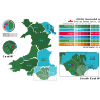
The Labour Party, the party that has dominated every election in Cymru, both Westminster and Senedd, for the last 100 years, did not win either the most votes or the most seats in the Senedd elections. From a party with 29 seats out of 60 It has fallen to just 9 MSs [MS - Members of Senedd] in an expanded 96 member Senedd.
Its vote collapsed so dramatically that First Minister Eluned Morgan failed to win a seat in the Senedd. This is the first time an incumbent First Minister in any part of the UK has failed to retain their Parliamentary seat.
Labour was pushed into a poor third by Reform who won 34 seats. This is the first time Reform have won seats in the Senedd although far right parties (UKIP and the Brexit Party) have previously been represented.
Cymru will now be run by a minority Plaid Cymru government relying on agreements on specific policies with the Green Party, Labour and possibly Liberal Democrats. The Green Party has already indicated they will support Rhun ap Iorwerth, leader of Plaid Cymru for the post of First Minister. By coincidence Plaid Cymru was founded 100 years ago, the last time: Labour failed to be the largest party in Cymru.
Why did Labour collapse so spectacularly?
It has been clear for some time that Labour was in serious decline. The massive goodwill built up under former First Minister Mark Drakeford for more competent handling of the Coronavirus pandemic in 2020 – 2021 than the then Tory government in Westminster dissipated very quickly. Mark Drakeford stood down as First Minister and leader of the Welsh Labour Party in 2024 and was replaced by Vaughan Gething, the then Health Secretary.
Gething lasted barely 4 months before being forced to resign following a vote of no confidence in the Senedd followed by resignations from his cabinet by 4 ministers. Among other issues Gething was accused of lying to the Covid-19 enquiry, allegations which led to the breaking of the cooperation agreement in the Senedd with Plaid Cymru. In addition, he was accused of accepting £200,000 in donations from a recycling firm whose owner had prior convictions for breaking environmental protection legislation. In his most recent statement, Gething takes no responsibility for Labour’s disastrous performance.
Gething was eventually forced to go and was replaced by Baroness Eluned Morgan who was chosen unopposed. (Yes, the Labour Party in Britain is headed by Sir Keir Starmerr and, until a few days ago the Labour Party in Cymru was headed by a Baroness. Definitely the credentials for leading a party that claims to represent the working class.)
The entire affair left Labour surrounded by an air of sleaze and corruption, a perception that was already developing when Drakeford and Gething both accepted free tickets, flights and accommodation to watch Wales play in the 2022 football World Cup finals in Qatar.
When Keir Starmer became UK Prime Minister in 2024 Eluned Morgan expressed her belief that things would now go much better with Labour governments at both ends of the M4 (the motorway that runs from London to Carmarthenshire in west Wales). There had been considerable tension between various Tory Prime Ministers in Westminster, particularly Bosis Johnson and the Welsh government in Cardiff. Morgan’s hopes have been decisively shattered.
On a whole number of issues that politicians in Cymru consider important the UK Labour government has failed to deliver. Demands to give Cymru control over policing, justice and the Crown Estate have been rejected. Even though those powers are devolved to the Scottish Parliament.
The (now largely abandoned) HS2 railway line from London to the north of England was classed as an England and Wales project even though not a single inch of the line was within Cymru. Scotland and the 6 counties of “Northern Ireland” received compensation, Cymru got nothing. Even more bizarrely the new line between Cambridge and Oxford is also classed as an England-Wales project though neither Cambridge nor Oxford are anywhere near Cymru.
All of this is ignored by Cardiff East MP and Welsh Secretary in Keir Starmer’s cabinet who, writing in Wales Online on 11th May conceded a few mistakes made by the UK government but then argues that the party in Cymru “became distracted by causes that were miles away from the bread-and-butter issues that people care about the most”.
She cites the 20-mph speed limit and the planting of trees in Uganda, issues frequently taken up by Reform who basically deny there is any climate emergency. Uganda of course fits neatly into their racism.
Trees were planted in Uganda as part of the Welsh government’s commitment to combatting climate change: they have also been planted throughout Cymru. But Jo Stephens appears to have no idea of the threat that life on earth currently faces. The environment does not figure at all in her analysis. Despite it being the single most important issue that can only be met through an ecosocialist programme.
Stephens, who is generally regarded as being far more loyal to Starmer than to the people of Cymru, claims that people are “rightly cross about the rollout of 20 mph speed restrictions” echoing Farage and the Welsh Tories (who actually supported the 20 mph limit initially but changes their stance when they realized they could make political capital out of claiming to be the champion of “the motorist”), ignoring the reduction in deaths on the roads since the introduction of the 20 mph limit on some roads – not the “blanket” speed limit constantly lied about by the Tories and Reform. Nor does she mention the reduction in costs for the NHS because of the fall in the number of road traffic accidents. In effect she uses the issue of the 20-mph speed limit on some roads in urban areas in the same way as the UK government uses immigration – show you can out-Reform Reform. That has not exactly been a roaring success.
There are serious concerns about the state of the NHS in Cymru, problems in education and the cost-of-living crisis. According to Stephens, any time spent away from those key priorities was time wasted’. So, all the work done by the Labour government in Cymru to tackle the ecological crisis was “time wasted”.
Jo Stephens demeans the Welsh working class by claiming they are only interested in bread-and-butter issues. This is a working class that mobilized in support of the Spanish Republic, welcomed Paul Robeson with open arms, opposed apartheid in South Africa and is now opposing Israeli apartheid and supporting the Palestinian people. This is a working class that welcomed support from the lesbian and gay movement through Lesbians and Gays Support the Miners. And the women of this working class started the movement opposing the deployment of cruise missiles in their march from Cymru to Greenham Common.
Rise of Reform
Reform campaigned as if they were fighting a UK wide general election, Their main themes were get Starmer out (not an issue for the Senedd), stop the boats (again not an issue for the Senedd), “end the Nation of Sanctuary” and opposition to environmental measures, including the 20 mph speed limit which they cynically and dishonestly claim is a “blanket” measure. If this is a blanket, then it has far more holes than material since virtually the only roads affected are those in urban areas and not every local authority has applied the reduced speed limit to the same extent. Some urban roads remain at 30 mph, and others are in the process of reverting to a 30 mph limit. Others are 40, even 50mph though you would not know this from the constant denunciations of the “blanket” 20mph speed limit from Reform and the Tories.
There is no doubt that the 20 mph limit is unpopular among many motorists, but the reality is that it does save lives. Reform’s attitude is in any case hypocritical: there are towns in England run by Reform that have also introduced 20 mph zones. Reform (and the Tories) constantly complain about a “war on motorists” while totally ignoring the “war on the planet” resulting from the internal combustion engine.
In many parts of Cymru a car is a necessity for work, shopping, hospital visits, entertainment etc. Outside the major cities public transport is very infrequent and virtually non-existent after 19.00, if not earlier, Charging facilities for electric vehicles are few and far between though some authorities are now trialing gutters in the pavement to allow cables to be safely laid across the pavement making it possible for people to charge their cars at home. But the main solution is to fight for regular, accessible, preferably free public transport available at times when it is needed. Neither Reform nor the Tories have the slightest interest in that.
Reform have also been active in opposing plans for pylons to carry electricity from both onshore and offshore turbines. There is a definite case that all cables should be underground: it is not very environmentally friendly to change the environment dramatically with large number of pylons or turbines. Authorities need to discuss openly with people and work in conjunction with them to create an atmosphere in which working class people can implement the measures needed to fight climate change and other environmental threats. Since Reform are climate change deniers who support Trump’s “drill, baby, drill” threats to the planet they are only interested in the siting of pylons and turbines if they can gain support. Farage has even argued for the reopening of coal mines in Cymru and restarting the blast furnace at the steel works in Port Talbot: both of which are not only undesirable but almost certainly impossible.
“The Nation of Sanctuary” concept has been shamelessly misrepresented by Reform as allowing all refugees to come to Wales where they will automatically be provided with whatever they want. Asylum is not a devolved issue therefore any refugee coming to Cymru will have previously been vetted by the UK government. 95 percent of those accepted under the “Nation of Sanctuary” scheme are refugees from Ukraine. This has been made clear by the Ukrainian community in Caerffili who played an important role in defeating Reform in the byelection held in October 2025. Yulia Bond, a refugee from Ukraine, has continued this work on her Facebook page.
While the Left actively campaigned about Reform’s racism and its threats to the NHS it failed to challenge Reform on environmental issues. This needs to be rectified as the threat to life on earth is real and requires urgent measures to prevent extinction of much of life currently existing on the planet.
Reform put a lot of resources into the Senedd elections, with Farage visiting on numerous occasions. He even posed for photographs beside the statue of Keir Hardie in Aberdare claiming Reform were the real continuers of Hardie’s legacy. Some of Reform’s millions were used to pay for Vote Reform posters to be wrapped around local newspapers.
Reform also benefitted from the collapse of the Tory vote. The Tories did even worse than the Labour Party, winning only 7 seats. The nominal leader of Reform in Cymru is Dan Thomas who up until 2025 was a Tory councilor on Barnet Council and has a record of privatizing council services. It is still by no means certain that Dan Thomas even lives Cymru, thereby calling into question his election to the Senedd for Casnewydd Islwyn. In reality Nigel Farage is the leader: not surprising since Reform is not actually a political party but a limited company with a single owner, Nigel Farage,
Farage spent a lot of time in Cymru, especially the South Wales Valleys, the former industrial heartland of Cymru. However, Farage was nowhere to be seen when the election results were being announced. Reform had failed to win in Merthyr Tydfil despite a lot of effort and, just as he did when Reform failed to win the recent Caerffili by-election Farage disappeared from the scene. The only time Dan Thomas will be allowed to take charge will be when Farage is not satisfied with the result. In fact, even that much is not certain. The task of answering questions at weekend press conferences was given to Llyr Powell, the defeated Reform candidate in the October byelection in Caerffili.
Nevertheless, Reform did win 34 seats making them the second largest party in the Senedd. That is despite Farage referring to Cymraeg (the Welsh language) as ‘foreign’ (it has much older roots in Britain than English), one of his candidates having to withdraw because a photo emerged of him making a Nazi salute and the dissatisfaction amongst some Reform members of the number of ex-Tories who were being included as candidates.
Nor did they appear to suffer harm from the ten-year jail sentence handed out to their former leader in Cymru, Nathan Gilll, for acting in the European Parliament on behalf of Russia.
Stand Up to Racism, Cymru’n Codi (Wales Rising) and other organizations did put in a lot of work opposing Reform but clearly with limited success. We certainly cannot be complacent, hoping that after Reform prove they are incapable of running authorities then people will reject them. That is dangerous nonsense, ignoring the damage Reform will do to local services: perhaps not quite akin to the stupidity of the Communist Party of Germany who proclaimed ‘after Hitler our turn’ but dangerous nonetheless.
Green Party – Limited Success
In both England and Scotland the Green Party did very well but much less so in Cymru, though they did win their first Senedd seats in the 2 constituencies covering Cardiff.
There are 2 main reasons for their relative failure. Firstly, the campaign was very much pitched as a straight choice between Plaid Cymru. Nobody seriously believed Labour’s claims they were the only challenger to Reform and that affected the smaller parties even more.
Secondly, the D’hondt voting system used for the Senedd is probably the least democratic of proportional representation systems. People vote for a party and the party ranks their candidates in order of preference, so voters have only a limited say in who their MS is. Individuals are able to stand but they probably need to win 13-15% of the votes cast to win a seat. Each of the 16 constituencies elects 6 MSs. Given the enormous size of the constituencies, it is exceedingly difficult for individuals to win votes in places they are not well known.
Even someone as well-known as Beth Winter, former Labour MP who since the general election in 2024 has been holding community meetings in her locality alongside former Plaid Cymru leader Leannne Wood, failed to win a seat. Beth stood as an independent because of the failure of Your Party to stand candidates and was supported by most of the left in Cyrmru.
In fact, Plaid Cymru and Reform both won more seats (43 and 34 seats) than they would have done under a fully proportional system (34 and 28 seats). Labour would have won 11 rather than 9, the Conservatives 10 instead of 7, the Greens 6 instead of 2 and Lib Dems 4 instead of 1.
The outcome of the Senedd elections does not just have significant consequences for Cymru. It also has significant consequences for the United Kingdom. A Plaid Cymru led government in Caerdydd/Cardiff, an SNP government in Edinburgh and a Sinn Fein First Minister in Belfast means there will be parties opposed to the United Kingdom in office in three of its four components. (Though there is a difference in the roles of the First Minister in Belfast compared to Cardiff and Edinburgh. The post of First Minister in the Six Counties requires a Deputy First Minister from the other designation [that is Unionist]. Both posts are of equal status and one cannot take decisions without agreement from the other).
While Rhun ap Iorwerth, leader of Plaid Cymru, has been clear that he will not be pushing for a referendum on independence for Cymru during the first term of government, debates, decisions and events in Scotland and the six counties will also have an impact in Cymru.
In addition the Green Parties in Scotland and Cymru both support independence, as do many Labour voters in Cymru, and may be able to put some pressure on the SNP and Plaid Cymru governments whether or not they are a part of a formal coalition. There is a very good chance that the Green Party in Cymru will establish itself as a separate party, no longer part of the Green Party of England and Wales.
However there are also important differences between Plaid Cymru and the Green Party, in particular in relation to the M4 relief road near Casnewydd/Newport. This project was shelved by the Labour government of Mark Drakeford but arguments about it have been resurrected by Nigel Farage and Reform UK, closely followed by the Tories. While the Greens and the Labour Party remain opposed (as are the Lib Dems) Plaid Cymru is not rejecting the idea.
This could clearly impact on the ability of Plaid to cooperate with the Green Party - as well as calling into question Plaid Cymru’s commitment to The Well-being of Future Generations (Wales) Act 2015, designed to improve the social, economic, environmental and cultural well-being of Cymru for current and future generations. Increasing the amount of road traffic very definitely puts at risk the well-being of current and future generations of Cymri (the people of Cymru).
What is clear is there will be no return to the two party system that has dominated British politics since the end of the first world war. Nor is there any chance that the Labour Party will return to dominate politics in Cymru in the same way as it has for the last hundred years. Prior to Labour’s domination the Liberal Party was the dominant force in Cymru. Today they can only return 1 MS, even under a more democratic electoral system they would only manage 4. The total eclipse of the Liberal Party is a warning to the Labour Party is that unless they stop taking the working class for granted, unless they engage in discussion with the working class they will follow the Liberal Party into irrelevance.
Sadly, Your Party has failed to make much of an impression in Cymru. Your Party started in Cymru before England or Scotland, holding a meeting in Merthyr Tudful in October 2025. The meeting was organized by Beth Winter and Mark Serwotka and attended by about 300 people. Zarah Sultana attended in the afternoon while Jeremy Corbyn spoke via Zoom. Since that meeting very little has happened other than the election to the CEC, won by a hardline "The Many” supporter, Maria Donellan. A meeting to establish Your Party Cymru is scheduled for 18 - 19 July so a definite lack of urgency. Beth Winter has since pulled out of Your Party and Mark Serwotka also appears to have taken a back seat, possibly because of hostility on Facebook because of his reactionary views on trans people.
The best opportunity for building a left current that can challenge Plaid Cymru, Labour and Reform lies with Cymru’n Codi, an organization that brings together activists from a number of different parties and organizations, including Plaid Cymru and the Green Party. The name Cymru’n Codi references back to the Merthyr Rising of the 1830s, the first time the Red Flag was flown in Britain. Cymru’n Codi conducted interviews with several candidates for the Senedd: Heledd Fychan of Plaid Cymru, Tess Marshall of the Green Party and Beth Winter all of which are available on the Cymru’n Codi Substack site – only Heledd was successful in the election. Cymru’n Codi members have also been involved in drawing up a programme for People, Planet and Peace which is also available on the Substack site where it is contrasted with the manifestos of Plaid Cymru, the Green Party and Welsh Labour and points out how these manifestos all fall short of what is required to resolve the crisis of capitalism in favour of the working class and of the planet. This ecosocialist programme is kept under constant review and updated as and when necessary. I would encourage everyone to subscribe to the Substack site https://cymruncodi.substack.com/p/cymrun-codi-programme.
12 May 2026