
 Version imprimable
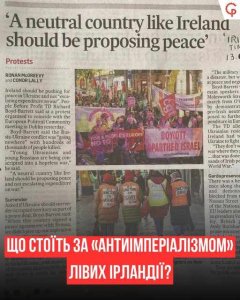
Response to the Irish Times article [1] is a telling example of how part of the Irish "left", under the guise of neutrality, love of peace and anti-imperialism, in effect promotes narratives that benefit the Kremlin. Richard Boyd-Barrett, a People Before Profit TD (member of the Dáil, the lower house of the Irish parliament), says that the war is "going nowhere", that Ireland should be offering peace, and that Ukraine must recognise that military resistance is futile.
But let us apply the same logic to the history of Ireland. Should the Irish, for the sake of peace, have laid down their arms, remained within the British Empire and abandoned rebellion and the struggle for independence [2]? Should pressure have been put not on the British authorities, who crushed uprisings, executed people by firing squad, threw them into prison and carried out punitive operations, but on the Irish who refused to submit? By that logic, the guilty party in the conflict would not be those who occupied and oppressed, but those who resisted.
That, in effect, is what is being demanded of Ukraine today. Russia occupies territory, destroys cities, abducts children and systematically bombs civilian infrastructure. Yet instead of demands addressed to Moscow to end its aggression, Ukrainians are urged to give up their resistance, and support for their defence is labelled "escalation".
It is particularly telling that People Before Profit and the Ireland-Palestine Solidarity Campaign combined, at the same rally, slogans calling for a boycott of Israel and the fight against apartheid with demands to end military support for Ukraine. In both cases the same logic can be traced: resistance to Russian imperialism is declared "escalation", while Russian aggression itself is presented as a conflict that has supposedly simply reached a stalemate. Such an approach can hardly be called consistent left internationalism, since it blurs the responsibility of the aggressor and in effect shifts it onto those who are defending themselves.
At the same time, the very forces that loudly criticise Trump’s policies and the United States are promoting a position that objectively coincides with the interests of the current US administration: weakening Ukraine, reducing pressure on Russia and opening the way to restoring trade relations, notably in the gas sector. According to Reuters and other media, in October 2026 Trump’s special envoy and son-in-law Jared Kushner held talks with Kirill Dmitriev, who is close to Putin, on the possible involvement of an American investor in the Nord Stream pipelines [3]. These are schemes that could allow American capital to profit from the resumption of Russian gas supplies to Europe once a peace agreement is concluded. It turns out, then, that some of Ireland’s "anti-imperialists", who oppose American influence, at the same time support a position in which Ukrainian territories and people’s lives become the object of deals made to restore trade with Russia.
When, in 2026, a politician offers Ukraine a "peace" that in effect means recognising Russia’s territorial conquests, and justifies it by Irish neutrality, the outcome is to strengthen the aggressor at the expense of the state that is defending itself. It matters little whether this is a conscious political position or an unwillingness to apply one’s own anti-imperialist principles consistently.
Genuine left internationalism means supporting the right of oppressed peoples to self-determination and their resistance to imperialism. This applies to the Irish in their struggle against the British Empire and to Ukrainians in their struggle against the Russian one. One cannot demand that Ukrainians capitulate by invoking neutrality while considering the Irish struggle for independence just. Whoever demands of Ukraine what they never demanded of Irish rebels applies double standards. And whoever, under anti-American slogans, supports deals that benefit the Kremlin and part of American capital displays a contradiction between their own rhetoric and their political position.
Peace without justice is not peace but capitulation under another name. The Irish once understood this well. It is strange that part of their "left" today has forgotten it.
13 November 2026