
 Version imprimable
Jean Batou: What has led the International Network for Solidarity with Ukraine (INSU, formerly European Network in Solidarity with Ukraine) to organise a convoy of associations and trade unions to support the resistance of the Ukrainian people and their popular organisations on the eve of the fifth winter of war under Russian bombing?
Alfons Bech: The need to respond in kind to the aggression. If the imperialist enemy is already using its most powerful instruments to destroy the fierce Ukrainian resistance, we in solidarity must also adapt and use tools that can respond to these challenges. Even more so now that Trump has dropped the mask and is obscenely aiding his current ally, Putin. The solidarity shown so far has been excellent, it has been essential. But now we must do more than all the good we have done so far. That’s why we’ve decided to revive the spirit of past internationalist actions and update them. Because together we are stronger. And we’ve decided to start, uniting the efforts of different actors even if we don’t yet have the perfect tool. We’ll refine it along the way.
J.B.: Could you describe what kind of material aid this convoy intends to deliver? Beyond the strictly material aspect, what undoubtedly matters most is the political importance of this internationalist initiative. What do the participants in this solidarity action and their Ukrainian partners hope to gain? Why is it so essential today to forge links between trade unions and progressive organisations in Europe and their Ukrainian counterparts?
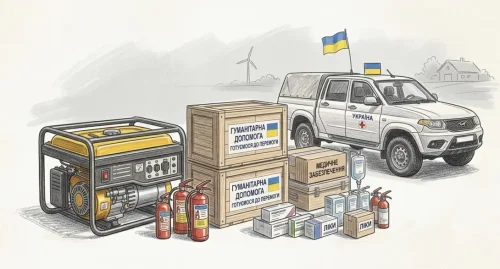
A.B.: We will accept all the aid we can collect until November 20th, when the convoys from each branch depart. We will try to collect as much as possible of everything requested. Our goal is to raise €100,000 to purchase generators and stoves. The destruction of energy resources will be used as a genocidal weapon by Putin because it affects everything: hospitals, schools, communications, and water purification. Our Ukrainian partners hope we can address at least a small part of their needs. We know our aid will be a drop in the ocean, but we are working on it.
Every euro we raise sends a message: Ukraine is not alone.
What is also important is that in the process of building this convoy we are already generating a synergy of relationships between our organisations, our Western societies, with those of Ukraine, between associations or cities. Some were already involved in solidarity efforts, but others weren’t. There’s a feeling that we need to help, but sometimes we don’t know how. The convoy makes that easier. For example, we’ve already held an on-line meeting between a large group of nurses and union members from a Barcelona hospital who had previously helped collect supplies for Ukraine and the Ukrainian nurses from "Be Like We Are." They’ve stayed in touch. From here, perhaps one or two of those compañeras will join the convoy. Several Catalan municipalities have also passed resolutions supporting the convoy and have become involved by providing financial support or helping to organise events. This creates ties that extend beyond the convoy itself.
We want the convoy to be seen in Ukraine as a show of support for trade unions and progressive organisations in Ukrainian society. We believe that Ukraine must play a significant role in the immediate future, and we want workers and their organisations to have a voice and a vote in everything related to reconstruction, rights, and the needs of the returning population. And that can only be guaranteed against the voraciousness of the oligarchs with strong labour, social, and left-wing organisations. That is also our message, and we want to establish those links to help them.
J.B.: Why do you think Catalonia has played an important role in organising this convoy? What support have you received from Catalan unions and political forces? Do you think this impact has anything to do with the memory of the Spanish Civil War and Catalonia’s long struggle for its national rights?
A.B.: In Catalonia, the memory of the wars in Yugoslavia endures. In many towns events were held, aid was collected, and people were welcomed. The Workers’ Aid Convoys to Bosnia were truly popular. That connection still persists after thirty years. For example, between the cities of Barcelona and Sarajevo, and also between some organisations. But, beyond the Balkans, the Catalan people in general have always shown solidarity with many just causes and against wars or attacks by imperialism on other peoples: Iraq, Cuba, Palestine…
This tradition is also linked to Catalan national sentiment. Catalonia has suffered persecution of its language; it is still an oppressed nation. Even today, its language is not recognised in European institutions, despite being spoken by 11 million people in Europe. But despite this awareness, the case of Ukraine is special. A significant portion of left-wing political parties and traditions were formed in the struggle against NATO, and always against American imperialism, which is undoubtedly still the greatest threat.
Political education has been incomplete in the Spanish state. While the Civil War and the Spanish revolution revealed the betrayal of the “democratic” powers, especially England and France, who abandoned the Republic to face international fascism alone, for new generations this has now been diluted. And a significant portion of the left, heavily influenced by Russian subliminal propaganda, sees only American imperialism as the enemy. Of course, they acknowledge that what Putin is doing is wrong… but NATO is still to blame for the invasion of Ukraine! It’s a capitulation to one of the most aggressive imperialisms, which is attacking a European country and, moreover, colluding with the other against Ukraine.
This ideology of neutrality toward Russian imperialism permeates all organisations, especially trade unions. It’s a neutrality very reminiscent of that adopted by the "democracies" in the face of fascism. The lack of decisive action in favour of Ukraine by many European states is related to this same attitude: not severing all ties with Putin, just in case... For this reason, it is very important that a major and historic union like Unió General de Treballadors de Catalunya (General Union of Workers of Catalonia or UGT) historically tied to the ruling social- democratic PSOE, is part of the project. The convoy has gained considerable political influence among left-wing and pro-independence parties, as demonstrated by the Catalan Parliament’s declaration in support of it. We hope that this influence, along with the convoy’s own activities, will help us convince other unions and more left-wing groups to join.
J.B.: How can broader sectors of the European left be convinced that support for resilient Ukraine is inseparable from support for resilient Palestine, since it is a struggle of two peoples for their right to exist in the face of a barbaric imperialist offensive, even though Palestine is in an even more dramatic situation today?
A.B.: The Catalan committee of INSU, like those in Madrid and Bilbao, participated in demonstrations in support of Palestine and Ukraine with a banner that read, “From Ukraine to Palestine, occupation is a crime.” What we found at every demonstration was support for the banner. Many people joined our march precisely because they agreed with this idea. They took photos with us, held the banner for a while… That’s what ordinary people and open-minded leftists do.
But it’s true that a few, very few, have told us that "it’s not the same." It’s not the same, indeed, if we consider that Palestine can only defend itself with stones or by putting its body on the line. Ukraine has a state, and that allows it to resist much more effectively. But beyond that significant difference, the underlying problem is the same: the right to self-determination of nations in the face of aggressive empires or sub-empires. Failing to understand that support for national self-determination is key to the victory of the working class and truly advanced, progressive, socialist options is a shortsighted mistake. It is useless to identify the nation with its current leaders, however reactionary they may be. What matters is not to side, actively or passively, with the oppressor. Today, we must stand with Ukraine, but that doesn’t mean we agree with Zelensky. We must choose which side of history we want to be on: either with the attacked nation or with the aggressor. Remaining neutral is aiding the aggressor.
Besides, beyond the national sentiment of a historically dominated and now aggressed nation, which bears witness to a legitimate democratic struggle, Ukrainian society is not only fighting on the front lines. Behind the lines, resistance is also being organised against the neoliberal and authoritarian policies of the regime. It is no coincidence that the student organisation Priama Diia (Direct Action) has addressed a message to French secondary and university students who are engaged in struggle. I have already mentioned the social mobilisation of healthcare workers. It is also important to know that Ukrainian soldiers have formed their own unions, organisations that would be prohibited in many Western armies, particularly in times of war, not to mention the Russian army.
J.B.: How does the caravan work?
A.B.: The idea of organising several caravans that converge on different routes towards Ukraine allows us to unite various centers of solidarity, but also to raise awareness in more countries and cities along the way about the cause of the Ukrainian people. Can you describe the routes followed, the stages chosen, and the support mobilised?
The caravans are organised along three routes, departing on November 20th and 21st: the Nordic, the Central, and the Southern. The Southern route will be further divided into two branches: the Italian and the Iberian, the latter primarily from Catalonia. The Central route begins in Scotland, passes through England, then Brussels, where participants join up with others from the Netherlands, and continues on to Berlin and Warsaw. The Nordic branch joins the Central branch directly in Warsaw, with the participation of some activists. The Southern Italian branch starts in Leche and Bari, then travels north through Milan, Monaco, Vienna, and Krakow. The Catalan branch departs from Barcelona, passing through Lyon, Geneva, Strasbourg, Prague, and Krakow. All routes converge in Lviv on November 26th and in Kyiv on the 27th and 28th.
Each route has key communication points to highlight its objectives. The Central route will be in Brussels on the 21st and 22nd; Berlin on the 23rd; and Warsaw on the 24th, with the Nordic participants. The Italian route will be in Leche and Bari on the 20th and 21st, Milan on the 22nd, Monaco on the 23rd, and Vienna on the 24th. The Catalan route will be in Lyon on the 21st and 22nd, Geneva on the 23rd in front of the United Nations and the International Labour Organisation; Strasbourg on the 23rd and 24th in front of the European Parliament; and Prague on the 25th. The two Southern routes will meet in Krakow. And on the same dates, the Central and Nordic routes will meet in Lviv and Kyiv on the 26th, 27th, and 28th.
In all these cities where we will be holding events, we have mobilised friends from the solidarity committees with Ukraine, some trade unions, such as in Switzerland, where the Union Syndicale Suisse, the Swiss Trade Union Confederation or USS and Unia (the largest member of the USS) will be present along with left-wing parliamentary friends, such as in Geneva and Strasbourg. In short, all those solidarity committees and groups will take advantage of the occasion to help make visible, in the media or with institutional meetings, or with more informal encounters, the solidarity of the International Convoy and its objectives.
The convoy thus opens an important stage for a more interconnected solidarity between friends of Ukraine and the West; it is a step forward towards a practical, humane internationalism that prepares for a just peace and the reconstruction of Ukraine with a vision of human and labour needs.
27 October 2026
Translated by David Fagan for International Viewpoint.