
 Version imprimable
Why in Evian rather than Paris?
– For security reasons: between the Alps and the lake, the area around this small town is relatively easy to control. Furthermore, the street demonstrations that such a summit is bound to provoke will have to be managed primarily by the Swiss police.
– For symbolic reasons: Évian is the perfect setting for a “diplomatic bubble,” isolated from the social tensions of the real world. The Hôtel Royal was, in fact, built in 1909 as a luxury hotel for the elite. Its name refers to King Edward VII. For over a century, it has welcomed sovereigns, heads of state, diplomats, industrialists, and the very wealthy.
– Due to Geneva’s proximity, its international organizations, and its globalized economic and financial position. Giant companies such as ADM, Alcon, Bunge, Cargill, Caterpillar, DuPont, Gunvor, L’Oréal, Logitech, Mercuria Energy Group, Merk Serono, MSC, Richemont, Trafigura and Vitol have their European or global headquarters in Geneva.
Growing rivalries
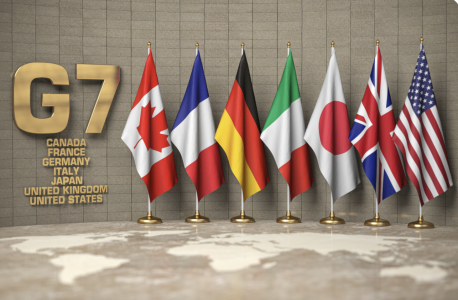
This G7 has little to do with the summits of the era of "happy globalization." We have entered fully into an era of rising inter-imperialist conflicts.
Signs of disagreement are multiplying between the United States, the European Union, and Japan. To name just a few: industrial, trade, and customs policy; the regulation of major digital platforms; the strategic and technological autonomy of European defence; the future of NATO; relations with China, Russia, and Iran; the status of Greenland; and the role of major international institutions (UN, ILO, WHO, WTO, etc.). On all these points, the divergences between the United States and the major European powers, and to a lesser extent with Japan, have only grown.
This is why there is little chance that the G7 will be able to agree on a common response to the crisis factors that are disrupting international relations: the rise of US protectionism, the loss of competitiveness of EU countries, the continued rise of the Chinese trade surplus ($1 trillion); the issue of energy security; the shortage of certain critical resources, particularly rare earths; the challenges of AI; the reshaping of development aid (more funding COMING from countries of the South, more private funding); the wars in Ukraine and the Middle East.
“Macron’s term is drawing to a close. His popularity at home is low. France is a ‘middle-ranking power’ with little chance of securing concrete commitments from the United States and China, let alone Germany. Moreover, China isn’t even a member of the G7. In 2026, we can expect a plethora of academic papers, scenarios, and speeches on global imbalances, which will only underline what we already know. But the United States and China, along with many European countries, are unlikely to change the policies that have created these excessive global imbalances, any more than they have in the past two decades.” (Mark Sobel, senior US Treasury official for 40 years, OMFIF, March 3, 2026)
Towards a G-Zero
In reality, the various organs of "global governance" are increasingly malfunctioning: the UN is considerably weakened, the WTO has been marginalized by the unilateral tariff policy of the United States, the G20 struggles to agree, even on a final declaration, the BRICS represent contradictory interests… It is in this sense that the very influential American political scientist, Ian Bremmer, author of US vs Them: The Failure of Geobalism ( 2018) , predicts a G-Zero .
"Geopolitical expert Ian Bremmer stated that the American operation that led to the capture of the Venezuelan leader reflected a deeper shift toward what he calls a ’G-Zero world,’ where no country is willing or able to assume global leadership. He argued that the United States was turning away from the international order it once established, based on collective security, the rule of law, and democratic norms, and replacing it with unilateral action guided by brute force." (India Today , January 7, 2026)
To plug the leaky hull of the "global governance" ship, various options are being debated. Some advocate expanding the G7 to include Australia, South Korea, and Spain, suggest inviting more middle-ranking powers, and strengthen its collaboration with international institutions to counterbalance the unilateral policies of the United States—the US would not necessarily participate in all discussions. Others advocate cooperation among the willing, with the EU, Canada, and the UK potentially taking the lead, aimed at creating leverage for negotiations with China.
The only points of agreement: intensifying the class war
On at least six objectives, the G7 members will agree without difficulty:
1. Continue to favour the enrichment of the richest; 2. Continue to dismantle our public services and social insurance; 3. Further reduce our freedoms and democratic rights; 4. Intensify the hunt for migrants ; 5. Turn a blind eye to climate change; 6. Accelerate the arms race.
But precisely, they hardly need to debate that in Évian. The matter is settled!
1. Continuing to enrich the wealthiest: the number of dollar billionaires grew from 1,810 in 2016 to 3,028 in 2025. Together, they hold $15 trillion, equivalent to the combined assets of the 5.5 to 6 billion poorest people (70% of the world’s population). But this staggering imbalance doesn’t interest the world’s elite, and for good reason.
2. Continue the dismantling of our public services and social safety nets. Whether they wield a chainsaw or a plane, businesses and governments are committed to a systematic reduction of social spending. Emmanuel Macron explicitly acknowledged this before the 80th session of the United Nations General Assembly on September 23rd, feigning regret, of course:
“Everywhere, we are reducing and undermining our shared ambitions to finance major global challenges. Collective funding for healthcare is collapsing, as is funding for food security and education.”
3. Further curtailing the freedoms and democratic rights we have acquired through more than 150 years of struggle in order to establish more authoritarian regimes. Indeed, the governments of the G7 countries are now looking enviously towards Russia and China, where authorities and businesses do not have to take into account trade unions, political parties, or associations independent of the regime in power. Imperialism on its last legs has never been compatible with democratic rights…
4. Intensify the hunt for migrants : Over the past ten years, 30,000 people have died trying to enter Fortress Europe illegally — Frontex relies on several thousand agents (10,000 planned for 2027) — not counting the much larger forces of national police forces — a budget of one billion euros, dozens of physical barriers, sophisticated weaponry, and several hundred detention camps. In the United States, 7,000 people have died attempting to cross the border; ICE has more than 20,000 agents and a budget of 11.3 billion dollars.
5. Turning a blind eye to climate change. A leader in this area, the United States actively promotes fossil fuels, reduces federal regulations on greenhouse gas (GHG) emissions, and lowers its international commitments. The other G7 countries also play a key role in reducing the COP climate targets.
6. Accelerating the arms race. The United States currently spends $1 trillion annually on armaments, and Donald Trump has announced plans to increase this colossal budget to $1.5 trillion. The EU and the UK allocate approximately $500 billion to their military spending, and these amounts are expected to approach $800 billion by 2030.
It is against these six objectives shared by the Swiss government and the Geneva financial centre that we must mobilize in Geneva and in France, from June 13 to 17.
Servility towards the United States
Despite growing disagreements, the subservience of G7 members to the United States and the bluster of its president is impressive…
During the preparation period for the Summit, the six other G7 countries made numerous conciliatory gestures so as not to irritate Donald Trump.
First, South Africa, a regular guest at G7 summits, was not invited this year under pressure from the United States. To ensure Africa wasn’t completely excluded from the festivities, France had to call upon Kenya…
Why didn’t Trump want South Africa?
– Because of its complaint against Israel before the International Court of Justice for violation of the Genocide Convention in Gaza.
– Because of its land reform allowing the expropriation of certain lands without compensation to correct the inequalities inherited from apartheid.
– Because of the alleged persecution of white farmers, presented by Washington as a premeditated “white genocide”.
Then, regarding Iran, on January 14, the G7 foreign ministers, unflinchingly echoing Donald Trump’s rhetoric, published a joint statement outlining the following undertaking:
No opposition to the war in Iran…
"The G7 members remain ready to impose further restrictive measures if Iran continues to repress protests and dissent in violation of international human rights."
Yet, on February 28, the US and Israeli aggression against Iran made no further mention of "international human rights." It was now solely about uranium and missiles. Furthermore, it strengthened the powers of the petro-theocracy of the Revolutionary Guards and massively intensified domestic repression, while exposing the civilian population to the direct and indirect effects of massive bombings, also causing significant shortages.
Silence in the face of increased repression by the Revolutionary Guards
Repression has intensified in Iran since the beginning of the American-Israeli aggression.
From November 1, 2025 to February 28, 2026: 121 death sentences were carried out
From March 1 to May 31, 2026: 321.
(Source: Iran Human Rights )
This did not prevent the G7 foreign ministers from using doublespeak on March 1st, jointly declaring that they "would continue to closely coordinate their actions in the face of the various challenges facing the international community."
However, despite repeated calls from Donald Trump, this time his allies did not lift a finger to help him get out of the impasse he has plunged headlong into in Iran.
The German chancellor went even further, recalling American failures in Iraq and Afghanistan, referring to a quagmire, and even adding that Iran had
"humiliated" the United States. This was more than the champion of " Make America Great Again " could bear, and he announced the withdrawal of 5,000 American troops from Germany.
Trump’s latest whim
As if all that weren’t enough, "President Trump, in order to organize a boxing match under a tent erected in the White House gardens on his own birthday, imposed the postponement of the G7 summit in Évian. Trump’s circus thus forces the postponement of the ceremony honouring Marc Bloch, the historian, author of *Strange Defeat*, resistance fighter, and hero who died for France" (Pierre Ouzoulias, Communist senator). Indeed, the interment of Marc Bloch in the Panthéon, initially scheduled for June 16, exactly 82 years to the day after his assassination by the Nazis, had to be postponed to June 23.
4 June 2026
Translated by International Viewpoint from marx21.ch.