
 Version imprimable
In January, 1919, following the suppression of what became known as “the Spartacist Uprising” in Berlin, Rosa Luxemburg wrote:
“Because of the contradiction in the early stages of the revolutionary process between the task being sharply posed and the absence of any preconditions to resolve it, individual battles of the revolution end in formal defeat. But revolution is the only form of ‘war’ — and this is another peculiar law of history — in which the ultimate victory can be prepared only by a series of ‘defeats.’
“Where would we be today without those ‘defeats,’ from which we draw historical experience, understanding, power and idealism?”
(From Order Prevails in Berlin January 14, 1919. Rosa Luxumburg, along with Karl Liebknecht, were murdered the following day by right-wing paramilitaries.)
Although there is more room for partial victories in contract fights and organizing drives than there is in “individual battles of the revolution,” Luxemburg’s comments are worth keeping in mind as we consider the condition of the U.S. working-class movement and the attacks against it in the context of defeats and setbacks, with occasional victories, that have marked the movement for the past 50 years.
Since the mid-1970s when politicians and bankers demanded, and city unions agreed to, layoffs and contract concessions during New York City’s fiscal crisis, followed by the concessions made by the UAW in talks with Chrysler in 1979, workers and their unions have been under relentless assault.
Around the same time, deregulation in the trucking and airline industries set the stage for massive job losses, concessions on wages and benefits, and restructuring in those industries. In the years since, unionization rates in the private sector plummeted from around 25% to 6% as factories closed, unions were busted, jobs were cut due to automation and computerization, and labor laws were violated by aggressively anti-union employers.
Unionization rates in the public sector held up better (hanging on in the range of 33% to 35%, between 1975 and 2024), as government employment expanded and new groups of workers joined unions. This was despite federal and state governments cutting support for social services, cutting tax rates on the wealthy and, in Wisconsin in 2010, gutting the right to be in a union.
Then in 2025, the U.S. government under Trump fired more than 300,000 federal workers — women and people of color making up a majority — and ended the right of unions to represent many of those who remained. (Some of these firings have since been reversed or ruled illegal.)
As in previous periods of rising right-wing reaction, women and people of color have been under heightened attacks by Trump and his backers. The attacks against them are too numerous to list, but the politics and ideology behind them were clearly shown when multi-billionaire Elon Musk, who took DOGE’s chainsaw to the federal workforce, boosted a tweet that read, “If White men become a minority, we will be slaughtered… White solidarity is the only way to survive.”
Resistance and Experience
Throughout this time there has been resistance to the cuts and layoffs. From transit workers to cannery workers to meatpackers; airline workers to newspaper workers; teachers, UPS workers, autoworkers, nurses, telecom workers and many others have organized to defend jobs, wages and benefits.
There have been strikes — sometimes successful, often not. But there has also been retreat and, at times, capitulation. Some of the same unions that surrendered one year have fought back another, and vice versa. There have been some partial victories but, on the whole, the working-class has experienced “a series of defeats.”
Defeats are not just defeats, though, if we can draw from them “historical experience, understanding, power and idealism.” It’s pretty clear that this has been happening. Activists in the 21st century have drawn on the experience of activists from the 1970s, ’80s and ’90s.
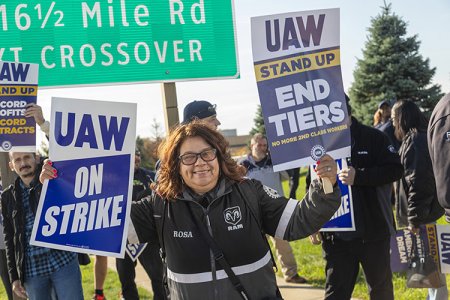
Lessons learned have been applied by teachers in Chicago and Los Angeles, and during the Red State Revolt of 2018. Organizing successes at Amazon and Starbucks, the defeat of longstanding bureaucracies in the UAW and Teamsters, the Stand Up strike in 2023 — all of these drew on the historical experience of the fights that preceded them.
We’ve also seen a shift in the way working-class politics are discussed and practiced on the left. In the wake of A Day Without Immigrants in 2006, May Day celebrations have become more common, as have discussions of general strikes (whether they’re called general strikes, social strikes, mass strikes, economic blackouts, or something else is of secondary importance). This was boosted further by UAW President Shawn Fain’s call for unions to align contract expiration dates for May 1, 2028.
Activists in Minneapolis, building off the discussions of general strikes, as well as their own experiences of coordination among unions, and the mass protests following the murder of George Floyd, have recently shown how to combine the fight to defend immigrants with the tools of mass mobilization and economic disruption.
They have repurposed roving pickets for ICE Watch, put mass picketing back on the agenda and found work-arounds for no-strike clauses. Teachers’ unions, who sought to protect their students from ICE, and the SEIU which responded to the demand of its members who were under threat, were particularly involved. This was followed by a significant presence by Minnesota unions and their members on No Kings Day at the end of March.
A layer of young socialist activists is following in the footsteps, but modifying the path, of those who committed to organizing from the bottom up in the workplaces of the 1970s and ’80s. And whether or not you think Teamsters for a Democratic Union (TDU) is right to endorse union president Sean O’Brien, many of us have learned valuable lessons from it and can all agree it’s good that TDU has survived and grown to the point that its endorsement matters both inside and outside the IBT.
Big Limitations
It’s important to acknowledge, though, that whatever advances have been made have not produced a broad shift in class relations. There have been no organizing wins at Amazon since the first one on Staten Island four years ago; unionized workers at Amazon and Starbucks are still without a contract (the NLRB recently ordered Amazon to recognize and bargain with the union at its Staten Island warehouse).
The UAW’s win in its Stand Up strike was followed by a successful unionization drive at Volkswagen in Chattanooga, but did not trigger a wave of unionization in the South; and the Federal Unionists Network notwithstanding, organized labor’s response to the job cuts and loss of the very right to a union was just as effective for federal workers in 2025 as it was for air traffic controllers in 1981 — that is, not at all.
And despite the broad opposition in the working class to Trump’s bombing of Iran, as this is being written, only two big AFL-CIO national unions — SEIU and National Nurses United – have issued statements opposing the war. Locals and other bodies are opposing the war, as is the non-AFL-CIO United Electrical Workers. Regarding internationalism and war, there is clearly still much to be learned.
The need for a true working-class party in the United States is one of the clearest examples of, “the task being sharply posed and the absence of any preconditions to resolve it” that we face. The success of candidates running as open socialists, whether inside or outside the Democratic Party, has changed the way the left discusses how to use electoral politics.
The number of successful candidates remains small, however, and neither the advocates of an immediate break from the Democrats nor those who envision a longer period of trying to build up strength from within the DP have presented a clear strategy for how a mass working-class party can be created. An absolutely necessary precondition is to figure out how best to respond to and challenge support for white supremacist and other forms of authoritarian politics in the working-class.
Moving Forward
While union activists, officers and members need to intensify their related efforts to fight against management on the job and for greater democracy inside their unions, responding to the wide-ranging attack against workers requires a multi-faceted vision of the role of unions. This will include but not be limited to these points:
• Adopting demands and practices to respond to climate-related disasters and crises. A number of unions, especially in the building trades and education, are already doing this and, in the process, making the case for a just transition to a green economy.
• This leads easily to arguing that unions should not just be fighting to do the work, but also about what work gets done. While some of the building trades unions are pushing for more solar and wind power, others are supporting the building of energy and water-sucking Artificial Intelligence (AI) data centers. While all provide construction jobs, it matters which gets built.
• Likewise in the auto industry; should the UAW tie its future to the production of personal vehicles or trams, buses and subway cars? The labor movement should be taking up the fight to ensure that socially beneficial goods are produced — by union labor.
• Centering the need to resist the rise of authoritarianism in the United States and its related wars. We’re seeing unions stepping up to confront ICE. More need to speak out against the war in Iran.
• Challenging billionaires’ control of AI. The spread of AI is the latest manifestation of capitalists’ drive to automate; to replace workers with computers, robots and algorithms. It has the potential to cost millions of blue and white collar workers their jobs. But it also has the potential to raise productivity in ways that could benefit millions of blue and white collar workers. A shorter workweek or fewer total jobs? Who will decide which it will be? To offer just one example, the TWU and ATU are already deeply engaged in fighting autonomous buses, to defend both their members’ jobs and service to their communities.
As parts of the left embrace “left economic populism” to guide its electoral work, there’s a risk that raising issues of race or gender will be seen as “dividing the working-class” so should be put off until some point in the future. This would be a mistake. Fighting for race and gender equality and justice is part of the process of uniting the working class.
Breaking Through Boundaries
There is an ongoing ideological battle around issues of equality and justice. There is also an economic battle over access to resources such as jobs, housing and education. Unions need to be more involved in the discussions about how they shape one another and what demands or policies flow from that.
It might seem odd to argue that we need to expand the boundaries of what unions fight for when they have not found the key to preserving what they once had. But maybe it’s precisely because they haven’t found that key that they need to expand the goals of the labor movement — and as they fight for a more expansive vision of what unions are for, hopefully regain the initiative at the workplace.
In her final article cited above, Luxemburg asks:
“The question of why each defeat occurred must be answered. Did it occur because the forward-storming combative energy of the masses collided with the barrier of unripe historical conditions, or was it that indecision, vacillation, and internal frailty crippled the revolutionary impulse itself?”
Substitute “working-class movement” for “revolutionary impulse” and the question is as valid for us as it was for the German working class during a revolutionary crisis. It’s a useful one to ask ourselves, from time to time, following defeats, setbacks and partial victories.
Source: May-June 2026, ATC 242.