International Viewpoint, the monthly English-language magazine of the Fourth International, is a window to radical alternatives world-wide, carrying reports, analysis and debates from all corners of the globe. Correspondents in over 50 countries report on popular struggles, and the debates that are shaping the left of tomorrow.
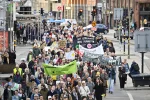
The policies pursued since 2022 have been among the most reactionary, racist, and repressive in modern Swedish history. Examples include restrictions on the right to asylum, attempts to retroactively revoke residence permits, significantly stricter requirements for obtaining Swedish citizenship, stop-and-search zones in working-class suburbs, repressive legislation that allows 14-year-olds to be imprisoned, deportations of young people separated from their families, legislative changes that threaten democracy, and welfare reforms that severely worsen conditions for the poorest and for those without citizenship.
read article...
The Partido Socialismo e Liberdade (PSOL) and the anti-capitalist left have two gigantic challenges to face simultaneously in the coming Brazilian elections: to contribute to the broader struggle against the main Brazilian expression of global neo-fascism, and to build a radical and independent left pole.
read article...
On Wednesday, 23 September, the police evicted Maricarmen in Madrid. Maricarmen is an 87-year-old woman whose rent was gradually increased by a vulture fund, until the fund decided it wanted the flat for new business ventures. In that sense, her case is not so unusual: in Spain, there are thousands of evictions every year. The housing movement fights against them every day, often in the face of a media blackout that looks the other way when it comes to a tragedy that is part of everyday life in working-class neighbourhoods.
read article...
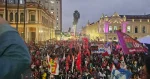
Hundreds marched in three separate demonstrations to protest the mass murderers—President Donald Trump, Israeli Prime Minister Benjamin Netanyahu, and Iranian President Masoud Pezeshkian—speaking at the United Nations General Assembly held in New York last week. The event became a kind of macabre circus with these monsters in the big ring as some delegates walked out while others protested outside.
read article...
IN AUSTIN, TEXAS an ICE agent shoots a food delivery driver after he was rammed and pulled over by an unmarked van. Wilber Rafael Garces Perez, from Venezuela, entered the United States legally and is seeking asylum. He is now in ICE detention with his serious gunshot wounds inadequately treated.
read article...When I first started writing this series of remarks in Italian (“Riflessioni degeneri”), subsequently collected into a single piece for the English version Remarks on Gender, my aim was twofold. The first was to make a complex debate – one that has unfolded over the course of several decades – accessible to a public of activists and people interested in gender, race, and class politics. The second was to contribute toward reopening this crucial debate about how we should conceptualize the structural relationship between gender oppression and capitalism.
Feminist theorists today are increasingly returning to the insight that capitalism must constitute the critical frame for understanding contemporary forms of gender oppression. Investigating the relationship between feminism and capitalism raises a host of difficult questions, however, which Cinzia Arruzza faces head on in her lucid essay Remarks on Gender. She gives an illuminative roadmap of the terrain in which this issue was debated in the 1970s and 1980s by laying out three different theses on how capitalism and gender oppression are related: dual or triple systems theory, indifferent capitalism, and the unitary thesis. She begins by assessing carefully the problems of the first two positions and concludes by defending the third, the unitary thesis: in capitalist societies, a patriarchal system that would be autonomous and distinct from capitalism no longer exists. Instead of treating gender and sexual oppression as separate forms of domination, a unitary Marxist-feminist theory must incorporate them in the total framework of capitalist accumulation.
It is not an easy task to reconstruct succinctly the main problematics that have traversed Marxist feminism in the last 40 years, without risking simplifications or serious omissions, or without producing a mere summary that avoids critically engaging with the subjects that it raises. And yet, I believe Arruzza’s text “Remarks on Gender” accomplishes the task very well: her reconstruction of the key theses on the relationship between patriarchy and capitalism proposed by different currents within socialist and Marxist feminism from the 1970s onwards is not only lucid and informative, but also extremely clear and accessible. Furthermore, her partisan critique of the different positions on the table, alongside an indication of the most promising questions for debate, give us – as feminists who locate ourselves in the Marxist tradition(s) – a great opportunity to begin and/or deepen a much needed discussion and exchange. A new generation of Marxist feminists has emerged in the last years; it begins to question, re-articulate, expand and criticise the theorizations and disputes it has inherited from previous generations.
This text raises the question of a unified theory of social relations. Cinzia Arruzza’s essay “Remarks on Gender” reminds us of the debates, left dormant for decades, around creating a unified theory of capital. However, Arruzza’s path toward that unification is one that abdicates the possibility of locating gender and race as part of the abstract, logical, or “essential mechanisms” of capitalism, opting instead to incorporate these pervasive relations as aspects of capitalism’s historical and concrete unfolding.
Secondary school pupils are taking action; the government is cracking down. The situation in the national education system has been deteriorating for years. Successive governments and various ministers, led by Blanquer [Minister of Education 2017-2022], have accelerated the destruction. The lack of resources is becoming increasingly unbearable.
- read article...The parliamentary elections held in early 2026 in Slovenia resulted in a narrow majority for the right, thereby enabling the formation of a radical conservative government. This government wasted no time in taking steps to undermine the welfare state.
- read article...The Pakistani military establishment had launched an attack on the online Jeddojehad. Its editor, Farooq Suhleria’s, home was raided. He could not be arrested as he was not in the country. But it means he cannot return to his job. Another member of the Editorial Board was also raided. The website has been shut down.
- read article...“Ortega has abolished elections. Do not deny Nicaragua the right to choose freely—the same right that could make you president of Brazil for a fourth time.”
- read article...Once again, we face a summer plagued by fire. Tens of thousands of hectares, earlier than in any other year, have already burned, and a devastating season is expected in terms of forest loss, fertile soil destruction, and above all, loss of life.
- read article...International Viewpoint is published under the responsibility of the Bureau of the Fourth International. Signed articles do not necessarily reflect editorial policy. Articles can be reprinted with acknowledgement, and a live link if possible.
We need your help to get our message across! Send donations payable to International Viewpoint 10b Windsor Rd N7 6JG, Britain - or why not donate online:
Site Map
| Log in |
Contact |
RSS 2.0