International Viewpoint, the monthly English-language magazine of the Fourth International, is a window to radical alternatives world-wide, carrying reports, analysis and debates from all corners of the globe. Correspondents in over 50 countries report on popular struggles, and the debates that are shaping the left of tomorrow.

“It’s turning out to be a major general strike; the data we have from last night shows workers are determined to treat today as a major day of struggle,” said the CGTP’s General Secretary in the morning outside one of the striking schools in Lisbon.
read article...
In Bolivia, mobilizations against austerity and an agrarian reform favourable to the concentration of land have weakened the government of Rodrigo Paz and his neoliberal policies.
read article...
Is this the beginning of a shift in dynamics? To attempt to formulate an answer, our perspective cannot begin with the latest election results, but rather with an analysis of Andalusian political history. In this regard, we operate on a fundamental premise: there is no electoral victory without a prior social and political victory. In the south of the Spanish state, the right wing did not conquer the institutions by chance in 2018; it did so by first winning the battle for "common sense", displacing collective frames of reference and colonising the public agenda long before the ballot box validated its hegemony.
read article...
The clashes over the next 20 days on the streets, in workplaces and on social media in Colombia will determine not only the name of the country’s new president – between a neo-fascist and a progressive – but also, to a large extent, the balance of power in South America. The Colombian presidential elections, with a second round on 21 June, are a precursor to the Brazilian elections in November and are of central importance to the construction of Trump’s “shield” on the continent.
read article...
“May 11th will be etched in the collective memory of the Valencian people. The teachers, the grassroots and union movement, and the entire educational community will make history for the dignity, determination, and strength they demonstrated during weeks of mobilisation and organisation. The indefinite strike is already a moral and political victory against an arrogant, authoritarian government that is completely out of touch with the reality of educational institutions.”
read article...The fast-reviving South African left is urgently coming to grips with the most acute national crises of structure and agency the country has experienced since the historic freeing of Nelson Mandela in February 1990 and the shift of the entire body politic in favor of the African National Congress (ANC) and the South African Communist Party (SACP). At that time, the ANC soon took control of the country’s progressive forces, winning mass social hegemony, vanquishing other liberation tendencies (Pan-Africanism and Black Consciousness), and dissolving the anti-apartheid United Democratic Front (UDF) that civil society activists founded a decade earlier. It then negotiated the first democratic election, which it won handily in April 1994 under Nelson Mandela’s leadership. Afrikaner state managers and corporate titans, as well as multilateral agencies and other forces of imperialism, demanded from the ANC an elite transition that opened both the macro- and microeconomies. Property rights were granted maximum protection, even though whites had acquired the bulk of those through what is widely termed a crime against humanity: apartheid.
When I first started writing this series of remarks in Italian (“Riflessioni degeneri”), subsequently collected into a single piece for the English version Remarks on Gender, my aim was twofold. The first was to make a complex debate – one that has unfolded over the course of several decades – accessible to a public of activists and people interested in gender, race, and class politics. The second was to contribute toward reopening this crucial debate about how we should conceptualize the structural relationship between gender oppression and capitalism.
Feminist theorists today are increasingly returning to the insight that capitalism must constitute the critical frame for understanding contemporary forms of gender oppression. Investigating the relationship between feminism and capitalism raises a host of difficult questions, however, which Cinzia Arruzza faces head on in her lucid essay Remarks on Gender. She gives an illuminative roadmap of the terrain in which this issue was debated in the 1970s and 1980s by laying out three different theses on how capitalism and gender oppression are related: dual or triple systems theory, indifferent capitalism, and the unitary thesis. She begins by assessing carefully the problems of the first two positions and concludes by defending the third, the unitary thesis: in capitalist societies, a patriarchal system that would be autonomous and distinct from capitalism no longer exists. Instead of treating gender and sexual oppression as separate forms of domination, a unitary Marxist-feminist theory must incorporate them in the total framework of capitalist accumulation.
It is not an easy task to reconstruct succinctly the main problematics that have traversed Marxist feminism in the last 40 years, without risking simplifications or serious omissions, or without producing a mere summary that avoids critically engaging with the subjects that it raises. And yet, I believe Arruzza’s text “Remarks on Gender” accomplishes the task very well: her reconstruction of the key theses on the relationship between patriarchy and capitalism proposed by different currents within socialist and Marxist feminism from the 1970s onwards is not only lucid and informative, but also extremely clear and accessible. Furthermore, her partisan critique of the different positions on the table, alongside an indication of the most promising questions for debate, give us – as feminists who locate ourselves in the Marxist tradition(s) – a great opportunity to begin and/or deepen a much needed discussion and exchange. A new generation of Marxist feminists has emerged in the last years; it begins to question, re-articulate, expand and criticise the theorizations and disputes it has inherited from previous generations.
From 18 to 25 July 2026, the Movement for Socialism (BfS/MPS) of Switzerland, in collaboration with the Internationale Sozialistische Organisation (ISO) in Germany, is organising the 41st summer camp of the Fourth International.
- read article...The New Fascist International, by Ugo Palheta. We need £2,000 to finance the translation
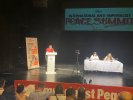
- read article...On 4 April 2026, on the occasion of the anniversary of the founding of NATO, the Global Anti-Militarist Webinar was held, organised by the “No to NATO” initiative, created following the appeal of the Workers’ Party of Turkey (TIP), in which members of the Fourth International are active. Bringing together speakers from several dozen countries and nearly 200 participants, this webinar called for the organization of an International Anti-Imperialist Peace Summit in June 2026, in response to the summit of this criminal organization planned in Turkey. We are releasing the final statement of the webinar.
- read article...Faced with the G7, which is meeting in Evian to organize the destruction of peoples, the exploitation of living things and the domination of bodies, let us organize our resistance against fascism and imperialism! Let’s meet from June 13 to 17, 2026 in Geneva to build the internationalist response!
- read article...Last night, the world once again witnessed Israel’s absolute impunity. The Israeli army carried out a raid in international waters, intercepting and rendering several vessels of the Global Sumud Flotilla (GSF) inoperable. This assault took place off the coast of Crete – nearly 1,000 km from Gaza!
- read article...International Viewpoint is published under the responsibility of the Bureau of the Fourth International. Signed articles do not necessarily reflect editorial policy. Articles can be reprinted with acknowledgement, and a live link if possible.
We need your help to get our message across! Send donations payable to International Viewpoint 10b Windsor Rd N7 6JG, Britain - or why not donate online:
Site Map
| Log in |
Contact |
RSS 2.0