
 Version imprimable
Some aspects of Legislative Powers
Legislative powers serve as the path for the Fujimori administration—not only to ensure the continuity of the economic model but also to deepen it. Among the points in the Fujimori administration’s governing plan is the elimination of maximum caps on interest rates for bank loans.
The Defensoría del Pueblo or Ombudsman’s Office itself, along with various advocacy groups, warns that removing interest rate caps would allow banks and microfinance institutions to charge very high interest rates to the most vulnerable sectors—those with the least bargaining power—thereby giving free rein to predatory banking practices and leading to over-indebtedness.
Furthermore, these powers are being used to revive large-scale private investment—specifically involving major mining companies and their notorious "legal contracts". These agreements grant investors—whether domestic or foreign—guarantees and legal, tax, and contractual protection. In effect, they provide a green light to plunder our natural resources while paying only meagre taxes and royalties. This process also leads to pollution and deforestation, causing distress and even deaths within local communities—such as the cases of children suffering from lead poisoning in the Cerro de Pasco region. Moreover, this dynamic puts family-based agriculture—the primary economic activity in these resource-extraction zones—at serious risk.
The government’s legislative agenda—pursued through delegated legislative powers—comprises 27 points. We have highlighted those most dangerous to workers and the general public, as they are fundamentally anti-people; however, one of the most contentious and concerning proposals involves changes to the labour regime. This is being justified as a measure to reduce high rates of informality within micro and small enterprises and various productive sectors. In reality, it represents an assault on workers, as it rolls back labour rights—for instance, by disregarding collective bargaining on wages for state employees—thereby contravening International Labour Organisation conventions.
In conclusion, the Fujimori-era labour reform modifies regulations that protect the fundamental rights of workers, under the pretext of promoting formalisation or competitiveness. The proposal would facilitate reforms and the introduction of greater flexibility regarding severance pay, bonuses, paid leave, working hours, overtime, profit-sharing, contributions to the social security system and the pension system, job security, and protection against arbitrary dismissal—while also allowing for the creation of labour regimes with fewer rights.
The mafia-like Fujimorist government’s primary argument is that it is necessary to obtain legislative powers to address the El Niño crisis afflicting our country and to combat crime. Both arguments are false— since these are national emergencies, the granting of such legislative powers is not required. For such situations, there exist "emergency decrees"—legal instruments with the status of law—which the Executive Branch (the President of the Republic, with the approval of the Council of Ministers and the countersignature of the Prime Minister) may issue in extraordinary and unforeseeable circumstances.
Insecurity is spreading at an alarming rate; between organised crime, contract killings, extortion, and criminal violence, there are 7 to 8 homicides every single day. The central government’s policy—deploying the armed forces to the streets and declaring states of siege—mirrors the approach taken by previous administrations. These measures have yielded no results during the first three months of the current government; in fact, the primary intent behind deploying the military to the streets serves a different purpose: to prepare for the suppression of popular protests that are bound to erupt once Keiko Fujimori begins to impose her governing agenda.
Ultimately, these legislative powers serve as a “Trojan horse” to repay favours to the allies of the Fujimori-era administration—namely, the nation’s major business elite and multinational corporations—with the goal of deepening the neoliberal economic model and continuing the accumulation of profits for a select few.
Fujimorism reveals its true face whilst disapproval grows
The deplorable role played by certain opposition political forces in the Chamber of Deputies—such as Buen Gobierno, Obras, and the social-democratic Ahora Nación (Now Nation) —dealt a severe blow to the working class and the general public by voting to grant special legislative powers to the executive. They justified their approval by claiming to have removed some provisions from the original text while adding others; however they did so fully aware that the Fujimorist faction holds a majority and control in the Senate. In the Senate, Ricardo Belmont’s party, Obras, played a disastrous and treacherous role by providing the quorum necessary for the ruling party not only to secure these legislative powers but also to incorporate additional measures—many of which had previously been rejected in the Chamber of Deputies. But this is not all: what was approved was also enacted into law—a move that is unconstitutional under Congressional regulations. By doing so, the bicameral system is effectively dismantled, turning the legislature into a de facto parliament. The ultraconservative bloc’s intention is either to abolish the Chamber of Deputies entirely or, alternatively, to keep it in place solely to project a false image of democracy.
The Fujimorist government has begun to reveal its true authoritarian face. At the same time, disapproval of Keiko Fujimori’s administration has risen—after only three months into her term (she took office on July 28, 2026)—driven by concerns regarding the economy and insecurity. Her approval rating fell to 28.3% (a drop of 14.5 percentage points from the previous month), while her disapproval rating climbed to 53.6%.
Prepare resistance against legislative powers
The winds of rebellion from Europe and other continents are blowing toward our continent: the victories in Serbia—ending the 14-year regime of Aleksandar Vučić—the massive mobilisations in Italy and Belgium, the ongoing unrest in France against austerity cuts, the defeat of Netanyahu in the Israeli parliament, and the impressive rallies at Hostages Square in Tel Aviv all signal a new wave of rebellion that is now reaching the Americas—arriving first in Argentina with the national student march against Milei’s reactionary agenda Lula’s victory in Brazil against the “Trump-like” figure of Jair Bolsonaro, who was defeated in the runoff by a margin of nearly 4 million votes is also part of this wave. What all these uprisings in various countries across the globe have in common is that youth are at the forefront of these struggles, acting as the vanguard.
In Peru, we are not immune to these developments in the international landscape. Keiko’s authoritarian government is not only aggressively enforcing an economic model with an iron fist, but has also joined the "Shield of the Americas"—a platform for Trump’s operatives and sycophants, whose goal is to exert control over the economy and politics of our region, and to seize our natural resources, just as was done in Venezuela, one of the world’s primary sources of oil.
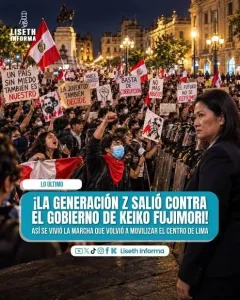
With the legislative powers now approved, the Fujimorist faction has 120 days of absolute power; all that remains is implementation. This is precisely where opposition will emerge through mobilisation in the streets. As a preview, this past weekend saw an initial demonstration of what is to come: Generation Z—the youth currently spearheading rebellions in many countries—mobilised against these legislative powers and Fujimorist authoritarianism. They are now calling for a broad-based meeting, bringing together various sectors to discuss how to resist and fight against the government’s agenda.
From our organisation, SÚMATE (Join us!)—an internal current within the left-wing Nuevo Perú por el Buen Vivir (New Peru for Good Living)—we call for the formation of a broad national front of resistance. We envision a movement in which the youth take a leading role, joined by leftist and progressive organisations, defense fronts, various social movements, the Confederación General de Trabajadores del Perú (General Confederation of Workers of Peru, the largest trade union), Sindicato Unitario de Trabajadores en la Educación del Perú (the Unified Union of Education Workers of Peru), women’s groups, neighbourhood associations, professional bodies, workers, and the Peruvian people as a whole. We must organise and deliberate on a plan of action to prevent the implementation of the neoliberal, anti-people agenda of the authoritarian, mafia-like Fujimorist regime.
There is no saviour who will rescue our people; today, the struggles and mobilisations of various peoples around the world show us the way. We alone can—and must—put the brakes on the measures that Fujimorism will impose once in power. At the same time, it is the duty of those who fight to build an internationalist, anti-fascist, and anti-imperialist coalition to counter the colonising agendas of Trump and the "Shield of the Americas."
31 October 2026
Translated and annotated by David Fagan for International Viewpoint.