
 Version imprimable
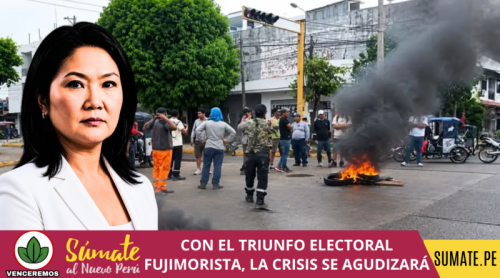
Despite the fact that the organisation Juntos por el Perú [1] won more than 9 million votes nationally and in most regions, mainly in the Andes and the Southern Andes, victory was given to Keiko Fujimori by the Jurado Nacional de Elecciones [2] and we entered another political period. This was an electoral victory riddled with irregularities, but one that does not end the political, economic, and social crisis that was forcefully expressed in the social uprising from December 2022 to March 2023, when the far right staged a coup against Pedro Castillo, and Fujimorism and its allies began to govern from parliament in an authoritarian manner, capturing almost all state institutions determined to continue the economic model that does not resolve the most pressing contradictions for Peruvians and only strives for the interests of powerful groups.
Since December 7, 2022, Keiko Fujimori and her mafia-like coalition have failed to defeat the social and citizen movement; they did not win the elections, and now they are preparing an authoritarian offensive against the majority of citizens, in favour of big business and international corporations, taking advantage of their control of the Public Prosecutor’s Office, the Constitutional Court, the National Board of Justice, the Armed Forces, and the National Police. Keiko Fujimori will implement a continuation of the policies of her puppet predecessors: Dina Boluarte, José Jerí, and José Balcázar are now seeking legislative powers from Congress to implement their reactionary and anti-popular government plan. In addition to democratic and labour setbacks, they intend to crush social mobilisation by empowering the Armed Forces to intervene with a bill that deprives citizens of their human rights. Now, law enforcement could commit abuses, even killings, and will be tried in military courts—meaning they will investigate themselves if any accusations arise. The so-called Mafia Pact, led by Keiko Fujimori for the past ten years, is leading the country into a crisis of decay; applying a neoliberal model in deep crisis and also establishing a corrupt regime, a State with its back to the country, a bicameral parliamentary regime with a Senate with all the power; assaulting the institutions of state power.
A presidential message of contionuity, a cabinet that expresses dictatorship, and the demand for legislative powers
Keiko Fujimori lacks the stature of a president or a great leader of the state; she is, in reality, an intermediary (lobbyist) for national and foreign private interests. That is why, in her inaugural address, she did not outline the major principles of a national project for the country, but rather continued measures favouring private capital projects, such as the anti-forestry law designed to repay favours to the Romero Group for logging and benefiting the palm oil industry. And so it is in every ministry, to such an extent that the bombastic increase in the minimum living wage to Peruvian Soles 1,300 [USD388] (a ridiculous Sol170 or less than USD51 increase) has been consigned to the freezer of the National Council for Labour and Employment Promotion. [3] The height of subservience is the appointment of an employee of the United States embassy as Foreign Minister, a person who has been a mouthpiece for the empire for 15 years, confirming that this government will be subservient to the interests of neo-fascist imperialism headed by Trump. In order to impose this reactionary government plan they are requesting legislative powers from Congress to enable rigid enforcement without hindrance.
Unity, organisation and the struggle to confront the corrupt government and imperialism
In this first phase of government, Keiko rearticulates, realigns and deploys her conservative and ultraconservative forces. Her defeat in the election for the Bureau of the Chamber of Deputies and her fraudulent victory in the election for the Bureau of the Senate show that she does not have the parliamentary correlation of previous congresses, so governance will be more complex and her offensive will need to use all the power of the state. This is evident in the opening of criminal cases against retired colonel of the Peruvian National Police Harvey Colchadowho has led investigations into corruption, investigative journalist Gustavo Gorriti, and anti-corruption prosecutors Rafael Vela and José Domingo Pérez. It is also seen in the manipulation of judges to apply pro-crime laws and laws favouring military and police jurisdiction in the prosecution of military and police personnel.
The current Parliamentary group (JP, Ahora Nación or Nation Now, Partido Cívico OBRAS or Civic Party OBRAS), as well as the one united with the Partido del Buen Gobierno (Good Government party), must be part of this accumulation of forces acting in coordination with social and citizen struggles; for this task, a space of broad unity called Frente Patriotico, Democratico y Popular (Patriotic, Democratic and Popular Front or FPDP) has been formed.
The FPDP formed on July 26th of this year, a space that brings together various social organisations and the left, emerged to agree on a Platform for Struggle with the demand for solutions to urgent and unavoidable demands such as the repeal of pro-crime laws, the increase of the legal minimum wage to Soles1,500 or USD448, the freedom of Pedro Castillo and those unjustly imprisoned for the social uprising; as well as the resolution of regional, provincial and territorial demands in each part of the country. At the same time, it must propose concrete measures of strategic scope, such as restoring the right to a referendum to hold a citizen consultation on whether or not they agree with a new Constitution, and others.
This Fujimori mafia government has not resolved the crisis; the existing polarisation is a reality that works against it. The main task is to strengthen the Patriotic Front at the national level so that it can resist and confront this reactionary and dangerous moment.
October elections for governors and mayors
In October, elections will be held for regional governors and mayors in provincial and district offices. Our Electoral Alliance Venceremos (We will Win) has registered 13 regional lists, 41 provincial lists, and more than one hundred district lists throughout the country. Another equally important task is to give priority support to the candidacy of our comrade Veronika Mendoza for governor in Cusco, and to obtain militant support in every region, province, and district for her. A victory in Cusco opens the opportunity for us to strengthen, from all over the southern Andes, the struggle against the Fujimori government and forcefully raise our most deeply felt demands, such as gas for all, the rights of indigenous peoples, a second agrarian reform for family farming, and to continue striving for a democratic solution to the existing crisis; for a Constituent Assembly and thus to bury the corrupt and subservient constitution of Fujimorism.
We make a united call to close ranks in this just citizen and popular struggle to defeat the anti-popular government plan of the Fujimori regime, but the task is more arduous than this. At the same time, it is crucial to advance in building a great Latin American unity to stop the neo-fascist project of imperialism led by Trump and his agents in our region. The only tool will be the broadest unity and winning the streets to our cause.
August 19, 2026
Translated and annotated by David Fagan International Viewpoint from Sumate.