
 Version imprimable
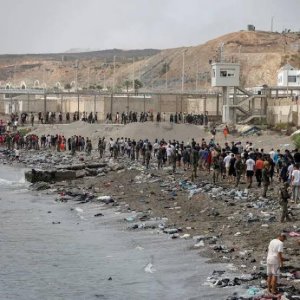
In fact, it is important to remember that mass arrivals by sea to the autonomous cities are far from new. In February 2014, some three hundred people attempted to swim across from Castillejos to Ceuta via Tarajal beach and were repelled by the Civil Guard, who used riot gear against those who were in the water, resulting in the deaths of at least fourteen people. But this massacre has by no means deterred attempts to migrate by swimming. Every year, dozens of people die anonymously on these border beaches, swelling the numbers that make the Mediterranean the world’s largest mass grave. This time, at least, we know that around one hundred people have died in just under forty-eight hours: people, not data or numbers, as they are often treated in institutional and journalistic accounts.
People fleeing poverty – we cannot forget that we are facing one of the most unequal borders in the world. No one risks their life if they don’t understand that they have no future in their own country. These deaths are directly linked to a border regime that criminalises the freedom of movement of impoverished people, turning Europe into a veritable fortress. This dynamic, as Tomasz Konicz points out, is inherent to the crisis-ridden imperialism of the 21st century, which is no longer merely a phenomenon of resource plunder, but also strives to hermetically seal off the centres of superfluous humanity that the system produces in its death throes. Thus, protecting the remaining islands of prosperity constitutes a central element of imperialist strategies, reinforcing security and control measures that fuel a rising authoritarianism.
In this sense, we must contextualise the bellicose rhetoric of “barbaric invasions” that has been adopted by everyone from the right to certain sectors of progressivism, presenting the arrival of thousands of people as an “attack on territorial integrity” or even as an invasion. They thus avoid, at all times, acknowledging the social crisis that the situation reflects and instead call for a military, rather than a humanitarian, response. This situation is by no means new. A few years ago, the EU-NATO European Centre of Excellence for Countering Hybrid Threats did not hesitate to classify the migration flow from Belarus to Poland as part of a so-called hybrid warfare. A debate even arose within the Atlantic Alliance about whether Article 5 of the NATO treaty, which stipulates mutual defense, could be invoked in the face of such hybrid acts.
It is certainly paradigmatic of this bellicose rhetoric that, instead of ensuring safe passage for thousands of victims fleeing war, poverty, or climate change, European institutions and governments are responding by strengthening security policies and externalising borders. Because the first question in the face of this week’s massive influx of people into Ceuta is clear: if there were safe and regular ways to enter Europe, would anyone risk their life swimming to Ceuta?
Since the first barbed wire fence was built in Ceuta in October 1995, following attempts by groups of migrants to enter, walls, fences and concertina wire have continued to be erected, condemning the autonomous city to become a kind of open-air prison for migrants who seem forced to remain stranded in transit – lost in transition – without a home to return to and with a destination that closes its doors to them. But we would be mistaken to think that the ultimate goal of all the mechanisms of Fortress Europe is to prevent the arrival of migrants. Because Europe needs migrants.
Fortress Europe is, in reality, a strategy of exclusion from full citizenship that seeks to weaken a group—migrants—in order to further fragment the population as a whole. This is an operation inherent to the war among the poor, the class struggle of the second-to-last against the last, where competition between natives and foreigners for access to increasingly scarce resources—jobs and social welfare benefits and services—is paramount. The militarisation of migration routes, surveillance devices, the externalisation of borders, immigration detention centres, and the increasing curtailment of migration rights do not seek to prevent migrants from arriving, but rather to ensure that only those needed by the European production system arrive, but also that they are already broken, frightened, stripped of rights, aware of the fragility of their stay and the risks of not assuming their role in the secondary niches of European capitalism.
In fact, the humanitarian crisis that has unfolded in Ceuta in recent days has been exploited by the right wing, both domestically and internationally, with Meloni and Trump at the forefront, talking about a "pull factor" resulting from the regularisation of migrants in our country in recent months. Italy has even gone so far as to temporarily suspend the Schengen Area agreement with Spain regarding the free movement of people. A measure that, in practice, since we don’t share a land border, will only be applied through additional checks on passengers arriving in Italy from Spain. Pure political propaganda from the far right to undermine policies expanding rights. Because Fortress Europe is not only built with razor wire, but also through a deliberate, calculated, and deliberately racist institutional policy that undermines the legal and social protections of migrants. This process results in migrants losing not only a specific set of rights, but their very right to have rights.
Thus, the regularisation of migrants – by granting them certain citizenship rights – clashes with the legal degradation policies of Fortress Europe, which favour downward competition in the labour market. A widespread concept of "there is not enough for everyone" fosters exclusionary mechanisms that, as Habermas wrote, are characteristic of a "welfare chauvinism" and concentrate the latent tension between citizenship status and national identity, which the far-right Vox party has been appealing to lately.
Whilst some on the right and in progressive circles have pointed to the Moroccan monarchy and ruling class as the real culprit behind the images seen in Ceuta these days, by controlling migratory flows according to their own whims and interests, acting as the gendarme of the southern European border, everyone remembers May 2021, when the Moroccan government withdrew its border controls and allowed some 8,000 people to enter the city of Ceuta in just two days. On that occasion, it appears that the medical care provided to Brahim Ghali, leader of the Polisario Front, at a hospital in Logroño, Spain was the pretext that sparked Morocco’s anger and subsequent retaliation. Tensions only eased after the Prime Minister modified Spain’s historical position on Western Sahara and met the following year with King Mohammed VI of Morocco.
This time, the excuse for the Moroccan dictatorship’s reprisals could range from Pedro Sánchez’s trip to Algeria a few days ago to the negotiation of the new EU trade agreement, the processing of the Sahrawi nationality law in Congress, which grants Spanish nationality to Sahrawis — whose territory is curently claimed by Morocco— born when the African territory was still a Spanish colony or even Morocco’s interest in annexing the autonomous cities of Ceuta and Melilla with the support of Trump’s United States. While I don’t think we’ll ever truly know the Moroccan government’s motivations for neglecting its duties as the European border police during this period, what is beyond doubt is the immense power that Spain and the EU have granted to dictatorships like Morocco’s by outsourcing border control.
Alongside the militarisation of the borders of Ceuta and, later, Melilla, the cooperation agreement on border control between the Spanish State and Morocco was signed in 1992, the first formal step in the externalisation of the borders of an EU member state. From that moment on, the Alawi dynastic dictatorship was hired to reduce by all means – the murder of fifty people at the Melilla fence in 2022 is the most palpable example – the number of people crossing the borders of Ceuta, Melilla and the Strait of Gibraltar.
But this externalisation of borders was far from free. Between 1995 and 2006, Morocco received €1.64 billion from the EU’s Mediterranean-Europe programme (MEDA) for cooperation with third countries on the Mediterranean coast. In January 2007, the MEDA programme was replaced by the European Neighbourhood and Partnership Instrument (ENPI), without any reduction in funding: €722 million between that year and 2010. In addition to European funds, there were also substantial Spanish public funds and incentives allocated to this externalisation of borders in Morocco, often using development cooperation as a pretext for implementing projects or to hide budget items that actually served this other purpose.
Since it was decided to externalise European borders, Morocco has used and continues to use the migration issue as a pressure valve, tightening or relaxing the control of its borders depending on the funds it receives or the political benefits it can obtain at any given time. It is certainly curious that the most frequent criticism from both progressives and the right is that Morocco is not fulfilling its part of the agreement that makes it the enforcer of our borders, or even that they are outraged that the Moroccan monarchy is using its role as manager of migration flows geopolitically. But no one questions the criminal policy of externalising borders, which not only represses people who decide to migrate, but also makes us complicit with the dictatorship and its policy of occupation.
It is still repugnant that, once again, with more than one hundred deaths on the back of our migration policy, the people who were crowded together in Ceuta continue to be treated as inconvenient problems that should be expelled or eliminated as soon as possible: subjects without rights. Therefore, it is essential to understand the current migration situation not only as a humanitarian crisis, but also, and above all, as a human rights crisis and, consequently, a political crisis. A crisis that questions who has the right to have rights in Europe and that challenges us all.
2 August 2026
Translated by David Fagan for International Viewpoint from Viento Sur.