
 Version imprimable
Netanyahu said Israel would now “focus on Hamas,” suggesting a new phase of high-intensity war against Gaza. An Israeli channel revealed that the general staff and the army were preparing to relaunch the offensive “as early as next month”, after Hamas and other Palestinian factions refused to lay down their arms.
Demanding disarmament without quid pro quo
In meetings held in April between representatives of the main Palestinian factions — Hamas, Fatah, PFLP, DFLP and Islamic Jihad — and Nickolay Mladenov, the “Senior Representative for Gaza” of Trump’s Board of Peace, all of these groups refused to discuss any disarmament as long as Israel failed to implement the commitments made in the first phase of the ceasefire several months ago, including gradual withdrawal from the Gaza Strip, the free entry of humanitarian aid and goods, and the start of reconstruction.
Post-war and reconstruction hampered
Earlier in April, representatives of Fatah and Hamas met in Cairo to discuss measures to move to a post-war phase, including reconstruction and disarmament. Both organizations welcomed the creation of the National Committee for the Administration of Gaza — known as the “technocratic committee” and composed of Palestinians, to administer the Gaza Strip — with the aim of initiating humanitarian reconstruction. However, this committee remains subordinate to the Board of Peace and separated from Palestinian political institutions, without being independent of Israeli institutions. However, the farce seems to have no limits: the committee has still not been authorized by Israel to enter the Gaza Strip.
Orange, yellow and green, the colours of Gaza’s colonisation
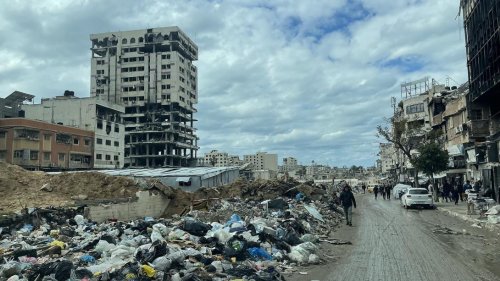
Even before a new offensive is launched, the situation in Gaza continues to worsen. Israeli forces have expanded the areas under their effective control inside the Gaza Strip, beyond the so-called “yellow line” established after the ceasefire agreement.
This yellow line was supposed to gradually recede over the course of the different phases. The opposite is true: the Israeli authorities have sent new maps to humanitarian organizations, defining a wider restricted access zone, dubbed the “orange line”, which alone represents about 11% of the territory of Gaza located beyond the initial “yellow line”. At the same time, the occupying forces continues to push this “yellow line” towards the sea through destruction. In fact, the territory under Israeli control has expanded by about 10 per cent in the Gaza Strip.
The occupation is still expanding
The “invisible” border of the yellow and orange lines is also a life-threatening zone for anyone who approaches it, even without knowing it. According to several testimonies, it is possible to fall asleep in one area and wake up in another, after the Israeli army has moved the lines. In practice, Gazans are now reduced to living on only 40% of their original territory.
In the part of the Gaza Strip under Israeli military control — the so-called “Green Zone” — Israel organizes and finances several armed militias operating there, while targeting and murdering police personnel in Gaza under the pretext that they are Hamas fighters. This systematic destruction of Gaza’s civilian structures, often administered by Hamas, is also a strategy of disorganization preventing any return to normal life. These assassinations also allow armed gangs to play the role of a police force directly under Israel’s orders.
The resumption of the war on Gaza, in the continuity of the de facto annexation of the West Bank and southern Lebanon, as well as the expulsions in Gaza, put the intensification of the Nakba in context. Even if a total annexation of the West Bank remains unfeasible, Israel seems to want to accelerate its large-scale offensives before a possible challenge to its international impunity emerges. Even if, in practice, this impunity has so far met with very few limits.
From Sumud to liberation
However, Palestinians do not remain passive. Gaza’s factions and groups remain operational despite almost three years of genocide. Despite the complicity of the Palestinian Authority, groups are being organized in the refugee camps in the West Bank, but also in the villages of Area C, especially in the face of the upsurge in settler violence. Self-organized groups try to protect residents, animals and homes.
The Palestinian “Sumud” remains present despite occupation, colonization and genocide. [2] But the situation is complicated by the persistent fracture and paralysis of Palestinian political life. According to Khaled Odetallah, a Palestinian intellectual and founder of the Suleiman Halabi Institute for Colonial Studies and Ideological Liberation:
The crisis is that of a society that is currently unable to clearly define its goal of liberation, after its social structures have been destroyed by the Israeli occupation. The violence of the occupation has devastated social structures such as trade unions, student movements and associations, killing many people and imprisoning thousands more. It has also partitioned Palestinians into distinct geographic realities. The separation between Gaza and the West Bank, for example, has been built over the years, and different realities have been created between the north and south of the West Bank, not to mention Jerusalem and Palestinians holding Israeli citizenship, and there are many social groups with divergent interests in each of these regions. Political representation usually arises from the interaction and struggle between social groups, which builds the representation of a society from the bottom up. This process has been systematically prevented by Israeli segregation and repression, resulting in the absence of a unified leadership.
We have long explained that the possibility of a united Palestinian political response also depends on the space that international solidarity is able to create by putting pressure on Israel. The Nakba commemoration marches are there to remind us of the existence of the Palestinian people, and of their resistance.
14 May 2026
Translated by International Viewpoint from l’Anticapitaliste and l’Anticapitaliste.