
 Version imprimable
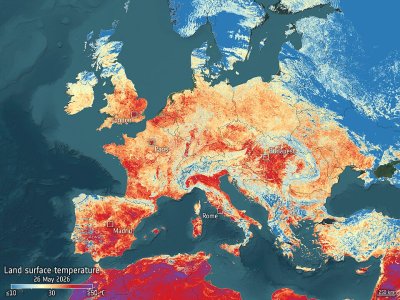
It’s hot. For some, it’s just a matter of temperature. For the working class, however, it’s already a matter of health and finances: less income, higher prices, greater vulnerability. “The severe heat wave sweeping across Europe threatens people’s health, their livelihoods, and their ability to work,” Jessie Ruth Schleypen, a climate economist at Climate Analytics, told Bloomberg.
What appears to be a current emergency is actually a trend that has been underway for years now. A study published last Wednesday in the international journal Global Environmental Change shows that between 2004 and 2022, droughts and heat waves have already eroded nearly 3% of the average annual income of European households and pushed another 5.6 million citizens into poverty. And looking ahead, if the 1.5 °C limit set by the Paris Agreement is not met, household income could plummet by more than 21 percentage points by the end of the century.
Most at risk
The group most at risk is the poorest 20% of the population. Construction and logistics workers, farmhands, and manual laborers who bear the brunt of the climate’s impact. It’s a matter of class. Those in air-conditioned offices are protected, to some extent; those who work outdoors are not. Madrid is a prime example: according to the study, the Spanish capital has seen an income decline of nearly 10% in recent years, solely due to the effect of heat on productivity.
There are major problems for agriculture and livestock farming. In France and Spain, crops are paying the price for record-breaking temperatures, water shortages, and rising production costs. The situation in France is the most critical: 72 departments are on red alert, and hundreds of thousands of farm animals—especially poultry—have died due to the extreme conditions. In Spain and the United Kingdom as well, the heat is reducing productivity in livestock farming and fruit and vegetable production, putting pressure on entire supply chains. Among the hardest-hit crops is corn, which is suffering from reduced water resources and uncertainty about yields. The consequences are already visible in the markets: according to Euronext, corn futures have risen by 9% since mid-month, fueling fears of greater instability in global agricultural prices. Speculators could have a field day.
Meanwhile, demand for electricity is skyrocketing in cities. On Tuesday, June 23, European energy prices hit record highs: air conditioners running everywhere, the grid under strain, and insufficient supply. In Belgium, prices reached a staggering peak of 1,038 euros per megawatt-hour.
Food and energy
Food and energy becoming more expensive means higher inflation. And for low-income households—which allocate the largest share of their household budget to food and utility bills, with no ability to cut back on other expenses—rising prices have an immediate and disproportionate impact. According to economists, climate change could add between 0.3 and 1.2% per year to global inflation starting in 2035.
“We’re starting to see a situation where a new shock occurs every year,” argues Maximilian Kotz, a researcher at the Barcelona Supercomputing Center. And these shocks no longer affect only specific products: they impact entire supply chains, from energy to transportation, including insurance, water, and food.
But that’s not all. The climate crisis has also become a new source of financial instability. For some sectors of the economy, extreme events are taking on a significance comparable to that of geopolitical crises. Some market participants are already developing financial instruments to speculate on the frequency and intensity of phenomena linked to El Niño and climate anomalies. Les Finemore, chief investment officer at Moreton Capital Partners, has announced, in this vein, a new fund dedicated to trading on climate risks: “We’ve been focused on the war in Iran. The next event will be El Niño.”
A clear paradox: while extreme heat reduces workers’ incomes, increases the cost of living, and makes those with fewer resources more vulnerable, a segment of the financial sector is turning the very same phenomenon into an opportunity for profit.
And in Italy?
And in Italy? Things aren’t any better. According to a stress scenario developed by Allianz, between 2026 and 2030 the country risks a cumulative loss of nearly 150 billion euros in GDP. The hardest hit would be investment, which could plummet by 12.8% due to shrinking corporate profit margins. This combination opens the door to a stagflationary spiral: rising prices, falling productivity, and rising unemployment. The fiscal deficit is estimated to worsen by another 1.9 percentage points of GDP.
In this way, the climate crisis also functions as a social tax. But it is not a progressive tax. It hits those who have the least, with steep utility bills, more expensive food and mortgages, lost workdays, and growing health risks. The bottom line: temperatures are rising for everyone, but the cost of the heat continues to be distributed in a deeply unequal manner.
27 June 2026
Translated by International Viewpoint from Il Manifesto.