
 Version imprimable
The issue of Western Sahara has just been discussed again at the UN, regarding the renewal of MINURSO’s mandate, which ended on 31 October. A renewal demanded by the Polisario Front, which, after fighting against the Spanish occupation, has been fighting since 1975 against Morocco’s annexation of Sahrawi territory. A territory listed as a United Nations non-self-governing territory, yet to be decolonized.
MINURSO was created in 1991 to monitor the ceasefire concluded at that time and to contribute to organizing the self-determination referendum provided for by the settlement plan approved at that time by the UN Security Council, as well as by the Polisario and Morocco. But Rabat did everything to prevent this referendum from taking place: diplomatic manoeuvres, the “Moroccanization” of Western Sahara, expulsions and brutal repression of the Sahrawi people, a large part of whom (more than 170,000 people) had to find refuge in camps in Algeria.
Diplomatic impotence and imperialist complicity
Due to lack of consensus in the Security Council, MINURSO was not extended this year. The renewal resolution proposed by the United States — supported notably by France — removed any mention of the referendum and transformed the UN mission into an instrument for implementing Morocco’s so-called autonomy plan for Western Sahara: an “autonomy” under Moroccan sovereignty! A veto from Russia, which proposed an alternative solution to renew MINURSO, was met with a US veto.
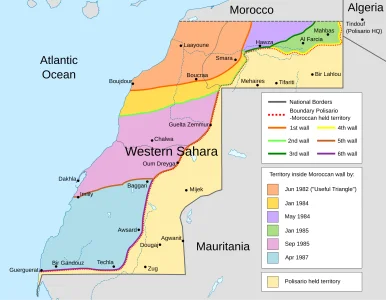
Although the resolution favourable to it could not be adopted, Rabat, backed by Western imperialisms, intends to use the departure of UN observers and military personnel to its advantage. The royal cabinet immediately reacted by declaring that “the UN process [... ] no longer has any reason to be” and that MINURSO, “inherited from an anachronistic and reconstructed context,” must leave as soon as possible. With the barely concealed intention of taking its place and continuing and consolidating its colonization. In its 5 November article, Jeune Afrique, which recalls that the Royal Armed Forces (FAR) have never ceased operations in the 20% of Western Sahara controlled by the Polisario, no longer rules out — citing sources close to the FAR — “a sustainable redeployment [of the Moroccan army], with new military positions beyond the wall” that divides Western Sahara in two.
International solidarity, a matter of life or death
The Polisario, given the military balance of power, is now betting on the diplomatic front. But even on this front the balance of power is unfavourable to it. After the United States, it was the Spanish state and then France, in 2024, that supported the Moroccan so-called autonomy plan, even advocating it on the Security Council, which last year adopted it, without any votes against, as a basis for resolving the conflict.
The Sahrawi people nevertheless resist, tirelessly. But their resistance needs a powerful mobilization of international solidarity, which they sorely lack today, to wrest their right to exist.
13 November 2026
Translated by International Viewpoint from l’Anticapitaliste.