
 Version imprimable
The Islamic Republic’s security situation has never been so critical. The country is in the grip of a crisis of exceptional gravity. The threat now reaches the highest levels of power and its principal institutions. Even during the darkest hours of the eight-year war against Iraq, the regime had never confronted a crisis of this magnitude.
After the massacres of January 2026, [1] at a time when the United States and its allies were intensifying their military presence around Iran, a familiar assertion resurfaced in the official media: had the Islamic Republic possessed nuclear weapons, it would not now be facing an “existential threat.” This idea is circulated not only by certain regime supporters, but also by circles close to the Islamic Revolutionary Guard Corps (IRGC), [2] by commentators aligned with the official discourse, and even by sections of the left claiming allegiance to the “Axis of Resistance.” Some go so far as to urge the leadership to complete the manufacture of a nuclear weapon without delay.
Yet this narrative belongs less to strategic analysis than to fantasy. It ignores the real history of nuclear proliferation and misunderstands the Islamic Republic’s actual position in the global order. The central question remains: could a nuclear bomb have guaranteed the regime’s security at any point?
This hypothesis may appear self-evident, but it is wrong. A nuclear weapon cannot enable a state to compensate for its strategic weaknesses through technological power alone. The history of nuclear proliferation, and the theory of international relations, demonstrate that security is never an automatic consequence of possessing the bomb. Proliferation might stabilise certain international relationships --- but only where states are integrated into structures of mutual recognition and institutional balance. Iran is far from that position.
The genuine question, then, is whether nuclear weapons could have guaranteed the Islamic Republic’s security.
Secondary nuclear powers: comparative limits
To address this, the cases of the so-called secondary nuclear powers --- India, Pakistan, and North Korea --- deserve examination. Contrary to the simplistic narratives propagated by certain political commentators, each of these states acquired nuclear weapons under exceptional circumstances. Their weapons programmes developed within the interstices of a specific geopolitical configuration, and within the “containment logic” applied by the great powers.
India, Pakistan, and North Korea are frequently presented as success stories of nuclear proliferation. However, each acquired the bomb within a specific geopolitical context, and with the tolerance or implicit support of major powers:
– India counterbalanced Chinese nuclear power, enjoying strategic latitude tolerated by the Soviet Union;
– Pakistan developed its programme in response to India, with the tacit tolerance of the United States and China, as part of a shared interest in regional balance;
– North Korea was indirectly supported by China as a buffer zone against the United States.
In each of these cases, possession of the bomb forms part of a broader security architecture. It is never an isolated instrument of sovereignty.
The Iranian “third way”: deterrence without a great power protector
The Islamic Republic attempted a different strategy: to obtain the benefits of deterrence without possessing a nuclear patron among the great powers. This “third way” consisted of creating a “nuclear ambiguity” that would allow Tehran to hold itself at the threshold of confrontation without enjoying the guarantees of a protecting power.
Once the Iran—Iraq War had ended, the Iranian regime seriously considered nuclear deterrence as a strategic lever for its survival through the 1990s. However, the post-Cold War global context offered it no patron: Russia was redefining itself, China was integrating into global markets, and no great power had any interest in backing Iran at the price of direct confrontation with the United States.
In 2010, UN Security Council Resolution 1929 confirmed this reality: Beijing and Moscow would no longer assume the role of protector for a militarised Iranian nuclear programme. [3] That vote sent a clear message: neither Beijing nor Moscow would underwrite the Islamic Republic’s militarised nuclear programme. The era in which great powers could use containment logic to manage proliferation was over. And even had that logic returned, Iran did not --- and does not --- occupy a geopolitical position that would allow such a model to apply. To take a more telling example: even the Shah’s government, though it was a US security partner in the Middle East and the Soviet Union’s southern neighbour, was never subject to a containment policy employing nuclear weapons.
Yet even this warning was ignored.
From that point on, the Islamic Republic persisted in a course that neither the United States, nor Europe, nor even Russia or China, was prepared to tolerate: a programme incompatible with non-proliferation policy and with any logic of great-power equilibrium.
Iran today is a regional power of limited means and restricted opportunities. Were it to attempt to use the bomb --- or even to cultivate “nuclear ambiguity” --- to play a role analogous to that of the United States, it would be attempting to implement a “third way” without precedent in history.
It would not be the United States alone resisting such a policy. Russia and China would oppose it too. Their refusal would not be motivated by ethical considerations or international law, but by their own security interests. A secondary power that acquires the bomb and seeks to impose a confrontational dynamic with a first-rank power would destabilise the international order for everyone --- including Beijing and Moscow.
The fantasy of a saving alliance
Over the years, the Islamic Republic has repeatedly sought to place itself under the protection of Russia and China through long-term contracts and military and political cooperation. But these efforts have never produced a genuine strategic security partnership. The reason is simple: neither Russia nor China regards Iran as an actor that would justify a nuclear risk.
This does not mean Iran holds no interest for them. Its presence in their sphere of influence can offer a security advantage. The problem lies elsewhere: the Islamic Republic seeks to associate itself with them in order to play the role of counterweight to the United States and to assert greater influence in the Middle East. This is precisely what leads Moscow and Beijing to conclude that a strategic alliance with Tehran offers them nothing.
China and Russia have many disagreements with Washington, but all three capitals agree on the “special privileges” attached to their status as global powers. None of them wishes to see a secondary actor attempting to challenge that hierarchy. In their eyes, such a situation would be absolutely unacceptable, whatever their rivalries with one another.
Some attribute the failure of Iran’s nuclear strategy to “reformist” Iranian governments --- those of Mohammad Khatami, Hassan Rouhani, and now Masoud Pezeshkian --- supposing them to have been “too accommodating” towards the West. This reflects a fundamental misreading of others’ intentions: Iranian presidents have never had the power to alter the strategic calculations of Moscow or Beijing, nor to secure nuclear protection. Moreover, within Iran’s political system, presidents --- “reformist” or otherwise --- have never exercised decisive control over foreign policy.
Beijing and Moscow regard Iran as useful, but insufficient to justify confrontation with the United States. Even in periods of rivalry, the great powers share an implicit consensus: the global hierarchy must be preserved, and a secondary state such as Iran cannot overturn it by acquiring nuclear weapons.
The structural failure of Iran’s nuclear strategy
No one can know with certainty the state of Supreme Leader Khamenei’s thinking. Perhaps he concluded that a nuclear bomb would have brought the Islamic Republic no security --- neither today, nor ten or twenty years ago. Even under the scenario most favourable to the regime, the bomb would only have marginally delayed a direct confrontation.
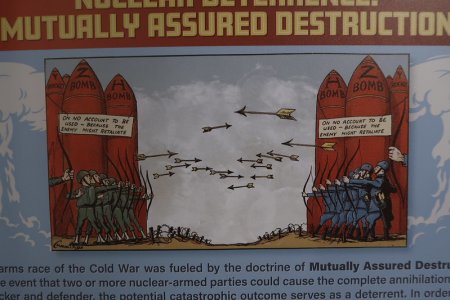
Nuclear deterrence functions only when it is credible, recognised, and integrated into a strategic equilibrium. It requires a “diplomacy of credible threat”: possession of a nuclear weapon has value only when accompanied by mechanisms of verification, legitimacy, and international recognition.
Iran possesses none of these elements: no international support, no credible security architecture, no stable internal legitimacy. On the contrary, the programme has reinforced Iran’s isolation, deepened sanctions, and intensified external threats. Even in the best-case scenario, the bomb would have delayed a direct confrontation only marginally. [4]
Conclusion
Iran’s nuclear programme illustrates the structural limits of autonomous deterrence for a secondary state. Proliferation produces stability only when it is embedded in a recognised equilibrium and backed by the great powers. Without this, it is liable to increase the risks of conflict and escalation.
For the Islamic Republic, nuclear weapons were never a protective shield. They proved to be a countdown to crisis --- a colossal investment that weakened the country and increased its vulnerability. The classical theories of deterrence and proliferation confirm that security cannot be decreed: it is built within a system of balances and protections that the clerical regime never managed to achieve.
Translated by International Viewpoint from l’Anticapitaliste.