
 Version imprimable
Since Pierre Leroux coined the term “socialism”" in 1833, Pierre-Joseph Proudhon established the word “anarchism” in 1840, and Étienne Cabet introduced “communism” into the modern political vocabulary that same year, these new notions and others associated with them have sparked heated debates and served as a programme for small, semi-clandestine groups of artisans and teachers, first in Europe and then in other parts of the world. How could these avant-garde ideas, which were in the minority in the 1830s and 1840s, be transformed into the great workers’ ideologies to which millions of workers around the world adhered in the first decades of the twentieth century?
The founders of these doctrines initially waged a colossal battle of ideas against the dominant ideas of their time, but their action went far beyond mere ideas. They created modern means of dissemination, translated the world of their dreams into powerful and captivating images, forged lasting symbols, conquered the hearts of their cities to erect tribunes, marched through their streets to make their demands heard, hammered new slogans and sang in chorus, established rituals and ceremonies.
As social doctrines spread throughout the world, the old doctrinaires, armed with their pen and paper, took on multiple roles: they were not only writers, but also orators, typographers, journalists, printers, publishers, translators, publicists, graphic designers, musicians, street vendors, and booksellers. Their range of action went beyond the borders of their nations, for they were also cosmopolitan migrants, enthusiastic emissaries of the new faith, refugees, clandestine passengers, political exiles, revolutionary agents with false passports, and delegates to workers’ congresses held in distant lands. This anarchist, socialist, and communist labour culture thus gave rise to new militant subjectivities: the man and woman of the left, a model of life that defied the customs and routines of their time.
Today, when these symbols, ceremonies and practices have lost the magnetism and fascination of the past in the eyes of the broad masses, it is worth attempting a long-term historical retrospective of this militant working class culture. We will not emphasize the programmatic dimension of these great workers’ ideologies or their differences and quarrels, which were certainly not negligible. What interests us here are the ways in which these ideologies have historically been embodied and the means they have used, to the point of constituting a militant political culture on a global scale.
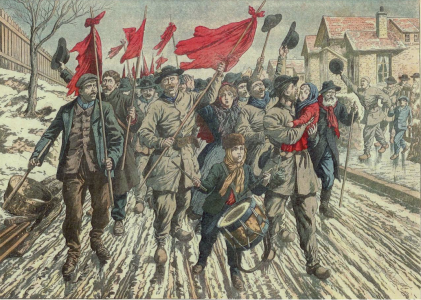
These movements were able to recover and update forms of communication that preceded them and to create totally innovative modalities, which gave rise to a militant culture that remained alive for a century and a half, characterized by the practice of factory strikes and general strikes, street rallies and demonstrations, where the slogans of the combative press were chanted, red flags were fluttered, fists were raised, and the revolutionary repertoire was sung. Among all these modalities of militant culture, we will dwell on four of them: the birth of the workers’ press, the left-wing political poster, the “invention” of the red flag and the role of collective singing.
The literate dimension of working-class culture
When one studies the workers’ press of the second half of the nineteenth century and that of the beginning of the twentieth century, one cannot help but be surprised by the capacity of anarchism and socialism (and later communism) to create, with limited financial means, mass media at the forefront of their time, capable of competing in the press market with the “bourgeois press” of a commercial and professional character. As Regis Debray has aptly pointed out, socialism originated in the nineteenth century within the printing press, and it is no coincidence that its current decline coincides with the eclipse of print journalism, that of paper and ink.
The French author reminded us, a few years ago, that a large part of the workers’ leaders of this classical period were typographers: Pierre Leroux, the “inventor” of socialism, Proudhon, the “father” of anarchism, as well as Pablo Iglesias and José Mesa, the founders of Spanish socialism. To this could be added William Morris, the precursor of British socialism, who, among other professions, was a printer and typeface designer. The herald of labour and socialist journalism in Mexico, Juan de Mata Rivera, was a printer. The founder of socialism and then communism in Chile, Luis Emilio Recabarren, was a typographer. Astrojildo Pereira, the anarcho-syndicalist who would later found the Brazilian Communist Party, had been a linotypist and typographer in his youth. Alfredo López, the first secretary of the Workers’ Federation of Havana, was an anarchist typographer. This is not a succession of coincidences. As Debray has perceptively remarked, “Socialism was born with a printers’ docket around its neck.” [1]
A large part of the workers’ leaders of the late nineteenth and early twentieth centuries, whether anarchists, socialists or trade unionists, were also prominent journalists and editorialists. The workers’ press had to compete in the written press market with the professional press of the bourgeoisie, so that organs such as Wilhelm Liebknecht’s Der Volksstaat (Leipzig), the precursor of Vorwärts (Berlin), Pablo Iglesias’ El Socialista (Madrid), Jean Grave’s Les Temps nouveaux (Paris), Juan de Mata Rivera’s El Socialista (Mexico), Lenin and Plekhanov’s Iskra (Leipzig), Jean Jaurès’ L’Humanité (Paris), Juan B. Justo’s La Vanguardia (Buenos Aires), Federico Urales’ Tierra y Libertad (Madrid-Barcelona) and Antonio Gramsci’s L’Unità (Rome), to name just a few of the most enduring publications, strove to recruit subscribers, promote sales in the street, at rallies and demonstrations, attract the best writers of their time, and incorporate visual innovations as the graphic arts advanced.
The workers’ press not only reported on national events from a class perspective, but also reported on the situation of the workers’ movement in the four corners of the world. It alternated doctrinaire articles with information useful to workers looking for work, announced rallies and demonstrations, as well as invitations to Sunday evenings where a speaker’s speech was accompanied by the performance of a “philodramatic play” performed by amateur actors sand an orchestra that sang “Hijos del Pueblo” or "The Internationale”, before finally giving way to popular dance.
The workers’ press aimed to create a community of active readers, who were also invited to send letters and to collaborate in propaganda, distribution and militant sales. When the press was underground, the risks incurred by the collaborators were greater. Those who were most active in these tasks eventually became party militants, so much so that Lenin came to affirm that the very life of the party revolved around the writing and distribution of the press: “The newspaper,” he wrote in the early years of Iskra, “is a collective organizer.” [2]
There is no anarchist group without a press, nor a socialist or communist party without a newspaper. Thus, the aspiration of all the initiators of a new movement was to obtain the necessary equipment to print independently, without depending on commercial printing presses. All that was needed was an old Minerva machine, a typographer and an assistant equipped with ink, paper and a set of movable type for the miracle of transposing ideas onto printed paper to take place. From this rudimentary printing press, initially mechanical, would emerge not only the classic newspaper, but a whole series of printed matter — the leaflet, the political weekly, the monthly magazine, the annual almanac, the pamphlet and the book — which constitute a veritable “press system”.
Of course, the typographers of the nineteenth century formed a literate elite from this craft that was in the process of being transformed into the modern working class. Their dual status as manual workers and scholars placed them in a singular position: forced by their own work to read the latest issues of a newspaper or a book on a daily basis, they often played a vanguard role within their class, while being able to maintain a dialogue on an equal footing with the literate elites of the bourgeoisie. The great masses from the countryside and in the process of proletarianization were illiterate or semi-illiterate, but the workers’ press reached them thanks to the collective reading that a literate worker often offered in a trade union office, a party room or a Maison du Peuple.
But even for literate people, books remained, at the end of the nineteenth century and the beginning of the twentieth century, an expensive product. In addition, bookshops in urban centres were spaces designed for the elite, veritable secular sanctuaries where rituals of sociability were practiced that were foreign to the habitus of the simple worker. This is how the working classes discovered books thanks to the press. Indeed, nineteenth-century newspapers offered in each issue what was called a “feuilleton”, the lower third of a page that was cut off: at the end of the series, these pages could be folded and bound in a traditional way to form a book. Thanks to this system, not only did authors such as Honoré de Balzac, Victor Hugo, Fyodor Dostoevsky, Leo Tolstoy, Robert Louis Stevenson, Emilio Salgari and Benito Pérez Galdós become popular, but working-class families also began to build up their own libraries. The workers’ press also turned to the feuilleton, alternating doctrinal works with social literature.
Similarly, emerging political currents resorted to the creation of popular libraries in working-class neighbourhoods, while setting up libraries offering home loans in union and partisan premises, where reading aloud sessions were also organised. Workers went there to read outside their working hours, during what Jacques Rancière called “the night of the proletarians”. [3]
Anarchists and socialists set up their own publishing houses, initially using pamphlets as a cheaper medium than books: they were shorter and their stapling system avoided the high costs of binding. By the end of the nineteenth century, pamphlets and small books were offered in numbered series, which encouraged workers to collect them. Books, which were announced by the workers’ press, were offered for sale at rallies, demonstrations, and conferences. Anarchists and socialists also took up the old method of street vending that Europeans, at least since the sixteenth century, called peddling. Bibles or religious books were no longer offered at your doorstep, but August Bebel’s La Femme or Jean Jaurès’ History of the French Revolution, as well as other classics of social thought, payable in instalments. Communist publishing houses still used peddlers, these door-to-door salesmen, in the middle of the twentieth century.
The graphic on the left
Illustrators of the workers’ press, magazine and book covers, as well as posters announcing a rally or demonstration, have shaped, over the decades, a left-wing graphic design that is perfectly recognizable through images of intertwined hands, raised fists, workers breaking their chains, workers on the march or proletarian Madonnas.
For example, as early as the nineteenth century, trade unions and workers’ federations used the traditional image of the handshake as a symbol of union and fraternity in their graphic design—frontispieces of their seats, posters, newspaper covers, membership books—as a symbol of union and fraternity. For its part, the raised fist made its appearance in political iconography from the militant practices themselves. It first appears in an oil on canvas by Honoré Daumier (“The Uprising”) depicting the popular mobilizations of 1848 in France. From there, it was taken up in the magazines of the Wobblies (the nickname given to American revolutionary syndicalists who identified with the Industrial Workers of the World - IWW) and also became one of the emblems of the Communist International. In 1936, it became the greeting exchanged by Spanish militiamen during the Civil War, and then it was taken up by the student movement of 1968, the feminist movement (the symbol of Venus contains a clenched fist) and Black Power in the form of a black fist.
Successive workers’ internationals have been able to disseminate powerful images of human emancipation. Their graphic designers have been able to adapt the themes of workers’ fraternity, great demonstrations, days of struggle and revolutionary uprisings to the successive styles that have dominated illustration, from romantic art, symbolism and Art Nouveau to pop art, expressionism, constructivism and socialist realism. On the front pages of the newspapers and magazines of May 1, allegories of Work, Dawn, Light, as well as images of the valiant body of the worker in the forge, resting with hammer in hand or learning by candlelight, predominated. In the background, factories with tall chimneys can be seen spewing smoke that invades and darkens the sky of the city. Another unavoidable motif: the proletarian Madonna, a child in her arms. We also inevitably find the bells that ring the tocsin and arouse torpor, the chains finally broken thanks to the strength of the worker, the workers marching with their banners towards a radiant destiny usually represented by a dawn, leaving behind them the vestiges of the old world: a bible, a code of laws and a set of weapons, so many symbols of ecclesiastical, legal and military power.
The beginning of the First World War tore the left away from these sweet Art Deco and Art Nouveau reveries and imposed an anti-war imagery. Three years later, in this historic month of October 1917, the great upheaval occurred: the Revolution broke out in Russia, threatening to spread to Western Europe, even to China. The Dawn towards which the proletariat was marching now had a name: it was called the Soviet Union. Two images sum up these years of messianic hope: Dimitri Moor’s Red Army soldier, who calls out to the viewer with his index finger and demands his active participation in the civil war, and the naked worker by the Hungarian Mihály Biro, painted in intense red, who is about to deliver the fatal blow of his mass to the bourgeois world.
And, of course, that powerful emblem which, since then and for more than a century, would go around the world: the hammer and sickle, symbol of unity between peasants and workers, designed in 1918 by the Russian artist Yevgeny Ivanovich Kamzolkin and approved at the Fifth All-Russian Congress of Soviets. In 1923, it was integrated into the Soviet red flag, which thus took up the symbol par excellence of workers’ and socialist struggles.
In 1919, the Communist International popularized, on the cover of its official magazine, the image of the muscular worker breaking the chains that enslaved the planet with a blow of a sledgehammer, drawn by the Russian artist Boris Kustodiev.
In the left-wing graphic art of the 1920s and 1930s, engraving imposed itself as the dominant medium, as if black and white contrasts were more effective in representing a historical cycle marked by great social cleavages: bourgeois and proletarian, city and countryside, rich and poor neighbourhoods, communism and Nazism. Newspapers, magazines, and posters around the world endlessly reproduced the famous drawings of the German George Grosz depicting the rich and decadent elites, as well as the expressionist engravings of the German Käthe Kollwitz and the Belgian Frans Masereel, as they appeared, for example, on the covers of Monde, the famous magazine founded by Henri Barbusse.
The miserabilist representations of the worker gave way, in the aesthetics of socialist realism, to the colossal images of workers in the big factories, of soldiers resisting the Nazi invaders, of the founding fathers of the Soviet fatherland: Lenin and Stalin.
The most aggressive communist iconography of the early 1930s took a “frontlist” turn after1935: the fist raised in the name of class war and the place of the two clenching hands, a symbol of the workers’ and people’s fraternity of the Popular Fronts. During the years of the Spanish Civil War and the Second World War, anti-war and anti-fascist motives became definitively established. The proletarians march in column like soldiers; the proletarian mothers protect their children in their arms against air raids; the bourgeois Grim Reaper hides his hideous grin behind the mask of peace.
The outbreak of the Cuban Revolution in January 1959 marked the beginning of the New Left, as well as a new graphic quest. This specifically Latin American revolution would generate its own graphic universe, notably through its powerful screen-printed posters and photographs of its bearded leaders. One image that would go around the world was that of the photogenic Ernesto “Che” Guevara. His face, with his beret and his star, immortalized by Alberto Korda, became the dominant icon of the 1960s and 1970s, graphically reinterpreted in a thousand and one ways over the years. The Argentinian Roberto Jacoby, a leading figure in conceptual art linked to the left, reproduced it with this inscription: “A guerillero does not die just to hang on the wall”.
The star then became the graphic symbol that gave the new armed organizations of Latin America their identity. The red star is a very old sign, which was used by both Christian culture (the Star of Bethlehem) and Muslim culture. The Russians adopted it after the October Revolution of 1917 as a symbol of their flag and coat of arms (and from there it spread after the Second World War to several People’s Republics). From then on, the soldiers of the Red Army wore the red star as an emblem on their caps and jackets. For the Communist International, the five branches symbolized the five continents where the revolution was to begin. But in the 1960s, the red stars, often surrounded by a circle in street graffiti, were taken up by various armed movements in Latin America, from the People’s Revolutionary Army in Argentina to the Zapatista Army of National Liberation in Mexico.
Many of the graphic motifs of the popular mobilization, reinvented by the young people of the Atelier populaire de Paris at the frantic pace of the May 1968 days, were now in line with pop art. The students of the École des Beaux-Arts had succeeded, during these six weeks, in merging the cultured and the popular, an elite culture from the United States and a mass revolutionary practice.
Similarly, the May graffiti marked a departure from the old styles on street walls, to which the students had added a hitherto unknown dose of political humour and situationist-inspired political imagination. In the 1920s and 1930s, Mexican muralists had introduced the visual arts to government and educational buildings, but Banksy and other urban artists simply brought them to the streets. In the 1980s, with the rise of the spray can, a new generation of visual artists, often anonymous, invented street art, offering their social, political and environmental messages to ordinary urban walkers and subway users without the need to go to a museum. [4]
The "invention" of the red flag
As new doctrines were embodied in the streets, new symbols and visual representations emerged spontaneously. The emergence of the red flag, perhaps the most characteristic emblem of the left, is eloquent in this regard. The modern use of red flags predates their adoption by communism: it dates back to the time of the French Revolution.
Although it has taken on various meanings over the centuries, by the eighteenth century it had acquired a martial connotation, universally accepted: raising the red flag announced a fight. Although earlier uses have been identified by workers in struggle—it was hoisted in 1768 by London dockers during a strike and reappeared in November 1816 during popular riots in London’s former Spa Fields Park—its modern use by the left originated in France.
In 1791, during the French Revolution, the mayor of Paris raised the red flag as a warning when a group of citizens gathered to demand the removal of the king, who had just been arrested, and the National Guard opened fire on the crowd. A revolutionary newspaper, La Mère Duchêne, published an article calling for “turning the little red flag against those who used it.” As Enzo Traverso points out, the popular masses appropriated it from then on by operating a kind of “symbolic reversal”.
Both the anarchist and socialist left spread these new ideas by taking up old formats, such as popular almanacs, whose tradition dates back to the seventeenth century.
Originally, these were small, illustrated books published in December, on the eve of the new year, which offered a popular audience an annual agricultural calendar indicating, for each week, the corresponding moon phase and, for each day, the names of the saints, followed by a mixture of poems, songs, excerpts from classical texts, thoughts, stories, essays, and information about the political events of the past year. Republicans, democrats, free-thinking Freemasons, socialists, and anarchists adapted them to their own doctrines, replacing the names of saints in the calendar with those of their heroes and martyrs, such as Giordano Bruno, Voltaire, Robespierre, Louise Michel, and Auguste Blanqui. As late as the 1930s, the Italians published the Almanacco Socialista and the Almanacco Antifascista, the French Communists the Almanach Ouvrier et Paysan and the Argentine Socialists the Almanaque del Trabajo.
Thus, in Paris, the red flag briefly flew during the popular insurrection of 1832. Victor Hugo put it in the hands of Father Mabeuf, an endearing character in Les Misérables who fell, dejected, from the top of the barricade. The red flag flew again during the popular uprising in Lyon in 1834. It reappeared during the February Revolution of 1848, proposed by the socialist proletarians as the emblem of the new Republic. In a famous speech, the brand new minister Alphonse de Lamartine welcomed them from the staircase of the Hôtel de Ville, the city hall of Paris, asking them to lower this flag of war, “drenched in the blood of the people”, and to raise the glorious tricolour flag again. During the June Days of that same year, when the Parisian proletariat mobilised for the first time independently in the face of the imminent closure of the National Workshops which gave work to the unemployed, red flags flew in defiance on the barricades.
The Paris Commune of 1871 adopted it as its flag on 28 March of that year, barely ten days after its proclamation. Some sections of the International Working Men’s Association, such as the British section, adopted it as the flag of the world proletariat, and the Second International, founded in Paris in 1889, completed its establishment on a world scale. When, on 1 May 1890, simultaneous demonstrations in favour of the eight-hour day took place in cities as far apart as Paris, Marseilles, Lyons, London, Vienna, Prague, Warsaw, Hamburg, Rome, Turin, Barcelona, Madrid, Chicago, Havana, Mexico City, Buenos Aires, and Rosario, the red flag flew over the workers’ tribunes of the world.
With the Russian Revolution of 1917, it became the flag of the USSR, an example followed by the People’s Republics of China, Vietnam and North Korea. Despite this appropriation, social democracy kept the tradition of the red flag, but, instead of superimposing the communist hammer and sickle, it added the emblem of the fist and the rose, created by the graphic designer Marc Bonnet in 1971. As the French historian Maurice Dommanget, a pioneer in these studies, has pointed out, writing the history of the red flag was tantamount to writing the history of the proletariat, socialism and communism. [5]
Collections of revolutionary songs
If visual symbols had an undeniable weight in the formation of militant culture, the same is true for revolutionary anthems and political songs. Speakers, journalists, or political leaders were only one of thousands. They addressed a listening audience or a community of readers. Choral singing, on the other hand, is collective, by definition. The intonation of the professional singer is lost in that of the crowd. Rooted in the Catholic and Lutheran liturgy, it is the moment when the voice of the priest gives way to the collective voice of the congregation, which intervenes by intoning simple melodies. The social movements of the nineteenth century secularized a whole series of rituals and ceremonies specific to the religious world, transforming them into civic rituals. [6] The processions turned into marches on foot through the city, during which the modern proletariat burst onto the public scene of many cities in Europe and America, waving their red flags and singing their songs of human solidarity while marching through the streets of the city centre. All the chronicles devoted to the celebration of May Day from 1890 onwards agree in pointing out, in the most diverse cities, the presence of brass bands accompanying the collective singing of proletarian anthems. [7]
Collective singing was a fundamental element in the process of forming the modern workers’ movement, as well as revolutionary political communities. The workers’ movement itself inherited it from the national republican movements of the nineteenth century, in which choral societies and collective singing had already played a significant role in the creation of “imagined communities”. [8] From the end of the nineteenth century, political anthems and songs were essential moments at political marches and demonstrations, rallies and demonstrations, civic funerals, as well as political and trade union congresses. The brass band was a must during the Sunday evenings that took place in the workers’ premises, where hymns and songs alternated with short plays and speeches by social leaders. Among the most popular songs at the rallies and demonstrations were “En marche vers la liberté” or “La Marseillaise prolétarienne”, the “Hymn to the proletariat” by the German Johann Most and the “Workers’ March” by William Morris. [9]
Collections of revolutionary songs from the nineteenth and twentieth centuries open with “La Marseillaise”, even though they are often adapted versions, such as the “Marseillaises des travailleurs”. In the version of the Russian populist Pyotr Lavrov, the refrain was repeated: “Be there, come on, working people/Be there against the enemy, brother-hunger/Come on, let’s go/Sower of vengeance of the popular cry”. In Latin America, there are anarchist, socialist and even Aprist versions of this proletarian anthem. [10] For example, in the Chilean city of Concepción, the lyrics were adapted into the “Socialist Marseillaise”, which repeated: “Socialists, to the struggle/determined to win,/fervour, action/until our revolution triumphs”. In 1936, the Chilean Socialist Party adopted it as the party’s anthem at its Third Congress. It was still sung under the Popular Unity government led by Salvador Allende.
But the most emblematic piece of the world’s revolutionary repertoire is undoubtedly “L’Internationale”, which also postdates the Paris Commune, but is intrinsically linked to it. Its lyrics are nothing more than a poem written in secret by Eugène Pottier, a craftsman and fabric designer, after the repression of the Commune, in which he had participated as a member of the popular militia known as the National Guard. The poem was not published until 1887. Pottier, who died that same year, could not even have imagined the posthumous fame of his poem.
It was not until a year later that Pierre Degeyter, a Belgian-born worker and amateur musician and member of the musical and choral society of the French Workers’ Party’s, Lira, composed the melody that in a few years would make it the proletarian anthem par excellence. The Socialist International, created in 1889, adopted it as its anthem, and by the end of the nineteenth century it had been translated into all the languages of the world. At the congress held in Copenhagen in 1910, it was performed by 500 musicians and choristers. In 1919, the Communist International adopted it and it became the national anthem of the USSR, until in 1943, when Stalin decided to replace it with another anthem, the lyrics of which he entrusted to Sergey Mikhalkov. [11]
In the first decades of the twentieth century, the anonymously written Italian song Bandiera rossa [Red Flag], which has a melody of Lombard origin and whose author is unknown, was disseminated by the socialists, but from the beginning of the 1920s it became one of the flagship pieces of the Communist repertoire. Its worldwide influence was surpassed only by “Bella ciao”, the anonymous song sung by Italian partisans during the Second World War. The Spanish Civil War (1936-1939) in turn gave birth to its own powerful repertoire, or if you will, to a double repertoire: popular culture forged new songs, but above all adapted old texts and melodies to its time and space, such as “¡Ay, Carmela!” and “Si me quieres escribir”, which were sung by the troops of the Spanish army at the time of the French invasion of 1808.
The context of social and political radicalization in the 1960s and 1970s not only gave rise to its own singer-songwriters, but also contributed to the rediscovery and revitalization of old repertoires on a global scale. In the United States, Joan Baez sang the “Ballad of Sacco and Vanzetti”, while in Spain, Chicho Sánchez Ferlosio reinvented the repertoire of the Civil War with such popular titles as “Gallo rojo, gallo negro”, “Quinta Brigada” and “A la huelga”.
Violeta Parra, Rolando Alarcón, Víctor Jara and Quilapayún made the songs of the Spanish Civil War resonate in the Chile of Popular Unity, just as Los Olimareños and Daniel Viglietti did in Uruguay, when the Frente Amplio was born. For their part, Léo Ferré, Yves Montand, Georges Moustaki and Jean Ferrat revived the French revolutionary repertoire. The era of proletarian lyres and workers’ choirs is over; that of professional musicians has taken over. Their songs are no longer heard only at demonstrations or in popular songbooks printed for a few cents, but thanks to the record industry and the radio.
Like their religious predecessors, political choirs fostered a sense of belonging to the same community, whose verses were sometimes addressed to the people, the proletariat, the producers, the disinherited, the wretched of the earth, the peasants, the young or the armed fighters. While denouncing an oppressor (whether monarchy, capitalism, fascism or dictatorship) or an invader (colonialism), they were performatively forging the cohesion of a community in struggle.
Collective singing had a huge advantage over printed texts when unity was urgent: it could reach an illiterate crowd immediately. It helped fighters endure extreme situations, such as isolation, hunger, disease, or death of their comrades. But it was not only indispensable in combat contexts: the lyrics of hymns and songs had educational value by expressing doctrinal principles in one or two simple verses, or by condensing complex ideas into a metaphor. For example, all the lyrics of the “Internationale" revolve around the notion of the human self-emancipation of the exploited: they invite us not to place our hopes in third parties (“neither God, nor Caesar, nor tribune”), but in the action of self-transformation (“Producers, let’s save ourselves”).
Like much popular composition, the revolutionary repertoire appealed to humour. Not only choral singing, but also shared laughter, created a sense of community when it came to using mockery to desecrate ancestral authorities (such as the monarchy, big landowners or the Church) or to ridicule the enemy in battle. And the songs have never ceased to resort to the carnivalesque reversal of roles between rich and poor to undermine the authority of the big landowners and nourish messianic hope: “When will the god of heaven want/that the situation is reversed,/that the rich eat bread/and that the rich go to hell”.
12 September 2026
Translated by International Viewpoint from marx21.ch. Original publication: 5 September 2026 on the website Nueva Sociedad — 323, August 2026 under the title ‘Imaginarios de redención social. Formación, auge y declive de una cultura militante’. Translated from Spanish by Marx21.ch with added further illustrations and the final section omitted.