
 Version imprimable
With less than a month to go before the presidential elections on 4 October, Brazil finds itself plunged into a crisis that, for the first time, has divided the Federal Supreme Court (STF) and is already considered the greatest crisis of the bourgeois-democratic regime established by the 1988 Constitution.
In January 2023, the country was on the brink of collapse in the face of a coup d’état that would have kept Jair Bolsonaro in power, even after he had been defeated at the polls. It was largely the STF, through its investigations and almost unanimous rulings, that made it possible to defeat the coup plot. Thus, instead of being reinstated in power as a far-right dictator, Bolsonaro is currently serving a prison sentence of 27 years and three months; and, for the first time in the country’s history, there are generals who have been tried, convicted and are serving prison sentences.
Four years on, we are in the midst of the election campaign for the 2026 presidential elections. Lula is standing for a fourth term, with his main opponent being Flávio Bolsonaro, the former president’s son. The outcome of the elections is uncertain. Polls predict a victory for Lula in the first round, but a dead heat between Lula and Flávio Bolsonaro in the second. In these circumstances, any minor or unexpected event could sway undecided voters and cause them to lean one way or the other.
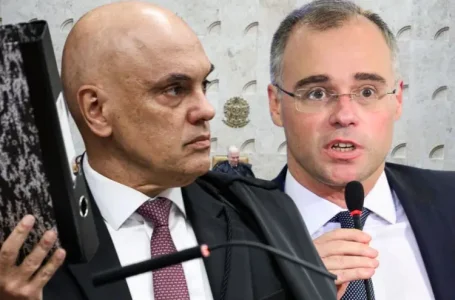
It was at this very moment that a Supreme Court judge, André Mendonça, chose to launch a scathing attack on his colleague Alexandre de Moraes. The latter responded in kind, and the affair threatens to throw the final stretch of the election into disarray.
The arsenal of ammunition on both sides is fuelled by the Banco Master scandal – the bank went bankrupt on 18 November last year – and the dangerous links between politicians and judges and the bank’s owner, Daniel Vorcaro, who has been in custody since that date.
Banco Master / Daniel Vorcaro Scandal
Before exploring the theme of the ‘duel between Supreme Court judges’, it is worth briefly summarising the Banco Master case and its owner, Daniel Vorcaro.
The 42-year-old banker Vorcaro managed to vastly increase his wealth by setting up a classic pyramid scheme at Banco Master, issuing investment securities with no real backing, which were to be paid for by newly recruited clients. To give the impression of a financial strength it did not possess and assets that did not exist, the bank set up a veritable factory of forged documents that transformed worthless pieces of paper into securities worth millions. Another department of the bank specialised in threatening commercial competitors, adversaries and critics who posed any possibility of scrutiny or attempts to enforce legal rules and regulations.
At the same time, Vorcaro sought to win over figures from the political and legal spheres with favours, trips on his private jets and stays in luxury hotels. Depending on the importance of the person he wished to court, he might even arrange consultancy engagements without any clear provision of services. This gave him access to these circles and reinforced the impression of the bank’s prosperity.
In statements given after his arrest, Vorcaro said he sought to build these close relationships to obtain institutional protection against inspections and pressures in the financial market.
The out-of-court liquidation of Master, ordered by the Central Bank on 18 November last year, affected more than 1.6 million customers and may force the Credit Guarantee Fund (FGC) to pay them more than 47 billion reais (7.9 billion euros). It is already considered the biggest financial fraud in Brazil’s history.
And the losses have not yet been fully accounted for. Far from it.
“Terribly evangelical”
The first shot in the duel between the Supreme Court judges was fired by André Mendonça on 1 September this year. The pastor was appointed to the Supreme Court by Jair Bolsonaro for being “terribly evangelical”, a requirement put forward by devotees of this faith to maintain their support for Bolsonaro. He had previously served as Attorney General and Minister of Justice in the Bolsonaro government. His confirmation in the Senate was the closest ever, with 47 votes in favour and 32 against.
The trigger for André Mendonça’s dismissal was the lifting of confidentiality on the Federal Police (PF) report concerning messages found on banker Daniel Vorcaro’s mobile phone, which were reportedly intended for Judge Alexandre de Moraes. The messages suggest that meetings took place between Moraes and Vorcaro. The PF also discovered that the latest version of the contract between Banco Master and the law firm run by Moraes’s wife, worth 129 million reais, had been drafted by the judge himself. The report further reveals that Vorcaro, when he felt the net closing in on him, asked Moraes whether he should leave Brazil – two days before being arrested by the PF as he was preparing to board a flight to Malta.
Moraes escalates the dispute
Alexandre de Moraes’s response to Mendonça’s barrage of criticism marked an escalation in the conflict on Thursday 3 September. The judge accused Mendonça, who is leading the investigation into the Master scandal, of having breached “judicial impartiality” and favoured “certain political groups” by ordering an investigation into himself, Moraes, claiming that the Federal Police report on the exchange of messages between Moraes and Vorcaro was in itself an investigation which, to be valid, would have had to be authorised by the Supreme Court’s plenary session.
A brief aside to better understand what is implied when speaking of favouring “certain political groups”: André Mendonça was appointed to the post of Supreme Court judge by the then President Jair Bolsonaro, as we have seen. Alexandre de Moraes was nominated by Michel Temer, Dilma Rousseff’s vice-president, who assumed the presidency on 31 August 2016 after Dilma had been removed from office following the impeachment approved by Congress. Finally, Edson Fachin, the current president of the Supreme Court, was nominated by Dilma Rousseff.
To support the argument that Mendonça was targeting certain individuals to the detriment of others, Moraes also lifted the confidentiality of other Federal Police reports which detail conduct by Mendonça deemed to be irregular, acting against Moraes himself and other colleagues on the court and usurping “the direction of investigations by the police authorities”, by “directing investigations towards specific targets (Justice Alexandre de Moraes and Senator Davi Alcolumbre) for personal and political reasons (...)”.
Added to this is the fact that Mendonça himself was forced to acknowledge that he had met with Vorcaro, after an investigation by Intercept Brasil had published text and audio messages regarding the arrangements for that meeting.
Attorney General sides with Moraes
On the same day, the Attorney General, Paulo Gonet, sought to have the decision annulled that led the Federal Police to produce the report on Vorcaro’s messages to Moraes.
Mendonça’s response, last Tuesday, 8 September, was to provisionally suspend the Director of the Federal Police, Andrei Rodrigues, from his post, arguing that he had acted unlawfully in producing reports requested by Moraes and used to incriminate him.
And then, on Wednesday, 9 September, a third figure burst onto the scene: Flávio Dino, also a Supreme Court judge, who decided to reinstate the Federal Police director whom Mendonça had suspended.
Supreme Court President decides to intervene
Finally, the President of the Supreme Court, Edson Fachin, decided to intervene just as the confusion seemed to be reaching a head, convening a plenary session of the court for next Tuesday, 15 September, in an attempt to restore order.
The plenary session of ten judges will consider the request by the Attorney General (PGR) to annul the report on Judge Moraes’ alleged involvement with the banker Vorcaro, which was commissioned by Mendonça. In the Attorney General’s view, Mendonça lacked the authority to commission a Federal Police investigation at the pre-trial stage. Depending on this decision, the question of whether or not to open an investigation into Moraes’s links with Vorcaro will then be discussed.
In addition to convening the court’s plenary session and determining the matters to be debated, Fachin also decided to suspend Mendonça’s decision to remove the Director-General of the Federal Police, whilst also overturning Flávio Dino’s decision to reinstate him.
In other words, everything has remained as it was before. The President of the Supreme Court also stripped Moraes of his role in leading the Fake News inquiry, which he had been overseeing for seven years, with Fachin himself now taking over as rapporteur
By now, any reader who has followed me this far and who is interested in Brazilian politics will surely have put two and two together and concluded that this crisis in the Supreme Court is entirely linked to the October elections. The Bolsonaro supporter and “fervently evangelical” André Mendonça wanted to catch Moraes off guard and decisively alter the election result. After all, what better way than to make public reports that cast Moraes under suspicion of corruption, thereby whipping up sentiment amongst Bolsonaro’s hard-core supporters.
On 7 September, they managed to gather 30,000 people on Avenida Paulista – fewer than the 40,000 who turned out at the same location in 2025 to demand amnesty for the coup plotters, but still a significant number that could have a growing impact. The most frequently heard chant was the demand for ‘Xandão’ (the nickname Bolsonarists give to Moraes) to be removed from the STF.
Let us recall that it was Alexandre de Moraes who was responsible for investigating the 2022–2023 attempted coup d’état, which concluded with the conviction of Jair Bolsonaro and seven other defendants: four generals, a lieutenant-colonel, two former police chiefs and politicians.
But the toxic centre of these elections is called Banco Master / Daniel Vorcaro. Anyone caught red-handed having close ties with the banker is immediately suspected of corruption.
This was also the case with Flávio Bolsonaro. In May this year, conversations between Vorcaro and Flávio were made public, in which the latter pressed the former to transfer a sum of money towards the production of a film, Dark Horse, which tells the story of Jair Bolsonaro.
“Bro, I’m with you and always will be; there’s no beating about the bush between us. I just need you to give me a hand! Abs!” wrote Flávio in one of the messages published by Intercept Brasil, which highlights the close relationship between the two. The revelation caught Flávio Bolsonaro red-handed, as he had previously claimed not to know Vorcaro.
Candidate Flávio Bolsonaro’s involvement with the imprisoned banker and the lies he told have dealt a blow to his credibility, causing a drop of around ten points in the polls and bringing relief to Lula’s campaign. The situation was reversed, however, with the revelation of Judge Alexandre de Moraes’s possible involvement with Vorcaro. Although Moraes has no links to Lula’s campaign, his uncompromising stance against the coup plotters and in favour of their punishment leads to him being identified with the current president. Lula distanced himself, stating that anyone who breaks the law must be punished; but the lead he had previously held in the polls has melted away, and Flávio Bolsonaro is once again neck and neck with Lula in the second round.
Meanwhile, the Federal Police have launched a new operation to investigate the link between the funds used to produce the film Dark Horse and the infamous parliamentary amendments, which make up the so-called ‘secret budget’.
Between now and 4 October, if the current pace continues, a great deal will still happen.
The stakes are high.
A victory for the Bolsonaro clan in Brazil would be tragic for the left and for the people of Brazil, Latin America and the world. The Latin American political landscape would be tinted with the colours of the Trumpist far right, with unpredictable consequences. To give just one example: the next President of the Republic of Brazil is expected to appoint five judges to the Federal Supreme Court, replacing those who are due to retire. Now imagine the STF with six Andrés Mendonças. Will democracy – even in its most tenuous form – manage to survive?
14 September 2026
Translated by International Viewpoint from Esquerda.net.