
 Version imprimable
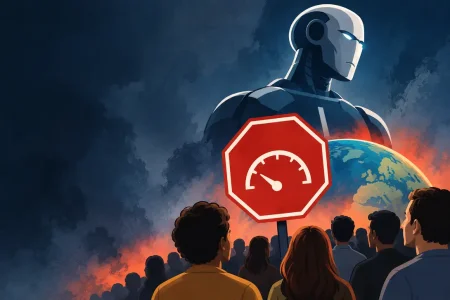
The CEO of Anthropic recently launched an appeal: AI is becoming a threat to humanity, the time has come to slow down its development.
If somebody who invests billions in AI says so, should we really be worried? Of course, but the fact that the warning comes, as in the past, from those who profit from AI should at least make us suspicious. Every time the US tech giants warn of future disasters, it is precisely the investments in AI that increase.
We must be wary of utopian and dystopian narratives alike. Whether AI saves humanity or leads it to extinction, the message remains the same: technological development is natural and unstoppable. A critical point of view should, on the contrary, start from the opposite premise: technology is neither neutral nor indisputable.
It is therefore necessary, above all, to demystify certain myths, unveil deceptions and relativize the hyperbolic exaggeration of the possibilities of AI.
AI is neither prodigious nor magical, but a system of power based on new technologies, in the hands of a handful of masters of the world, who colonize every aspect of our lives, with the sole purpose of reducing them to digital data and extracting value from them. In 2025, they were in the front row at Trump’s inauguration: Zuckerberg, Bezos, Musk, the CEOs of TikTok, Google, Apple and OpenAI. Not to mention Peter Thiel, a true black soul of Silicon Valley, owner of Palantir and guru of JD Vance. They are the richest men on the planet; they hold colossal economic power and can influence the public life of entire countries, with consequences for democracy and fundamental rights. The problem is not only that they can control us, but they can manipulate us.
The idea that AI works without moving a gram of matter is also false. AI is polluting and energy-intensive. The “cloud” is not an immaterial cloud, but an extractive and heavy technology, all along the value chain: from the minerals used for batteries and microchips to its infrastructure, data centres. Huge factories running constantly, which employ very little manpower, but have a considerable polluting impact on the land where they are located, excessive energy and water consumption to prevent them from overheating, as well as rapid obsolescence, which renders them practically useless in the space of a few years.
And it’s also not true that AI trains itself. Without the hyper-alienating and exploited work of millions of “data workers” who label and moderate data for pennies per click, a Tesla would never learn to recognize when a traffic light is red.
Not to mention the data theft that is the basis of AI learning. The more systems develop, the more they need more and more accurate data. Much of this data is taken from web archives, i.e. extracted from pre-existing works: articles, stories, songs, illustrations, films. Any work that comes from a person’s creative work can become training material for AI, easily circumventing copyright, i.e. without acknowledging any copyright to those who created this content and, sometimes, to those who hold the archives. The case of the New York Times is emblematic: it sued OpenAI for stealing millions of its articles in order to train ChatGPT to provide information in competition with the newspaper itself.
And since AI feeds on existing data that integrates inequalities and discrimination related to gender and ethnic origin, by reproducing them, it reinforces them, in an even more pernicious way, because they appear neutral.
AI is therefore a system that reinforces current forms of domination, from capitalism to colonialism to patriarchy, while fuelling the climate crisis and creating new forms of labour exploitation. Every imaginary dystopian future seems to warn us of this danger, but in reality, it distracts us from the real and imminent risks of AI, including its criminal use in wartime.
What is to be done, then? What is needed is to invest in an intersectional way in all forms of collective anti-capitalist, trade union, ecosocialist, decolonial and feminist struggle. In modern history, the benefits and wealth generated by technology have never been redistributed to the community in a natural way, but as a result of the balance of forces that have been determined within a dynamic of class struggle.
If we recognize this, it is not difficult to understand why the alert issued by the CEO of Anthropic cannot be the solution, but is part of the problem.
18 September 2026
Translated by International Viewpoint from Inprecor. Originally published by Libertà e Giustizia.