
 Version imprimable
IN THE FIRST decade of the 21st century, Hugo Chávez’s Venezuela had the most radical government and most developed social movements of the Latin American Pink Tide.
To many global justice activists, Venezuela seemed a model for asserting national sovereignty, reducing poverty, and expanding popular power. It inspired millions worldwide.
Twenty years later, Venezuela was far less attractive: its economy was ruined, its social movements were shells, and the government of Nicolás Maduro, Chávez’s successor, was repressive.
On January 3, 2026, the U.S. military raided Venezuela and captured Maduro and his wife Cilia Flores. The Trump administration alleged that they were involved in drug trafficking. The Venezuelan government, now led by Maduro’s vice president Delcy Rodríguez, briefly protested the kidnapping and then made a deal to return to the imperialist fold in exchange for lifting U.S. sanctions.
On June 24, 2026, a pair of large earthquakes struck Venezuela, the most severe since 1900. In what could be taken as a metaphor, the quakes collapsed structures built during the Chávez years, as well as before and after.
Chávez’s Venezuela could have organized earthquake relief, as Cuba has repeatedly organized hurricane relief. Rodríguez’s Venezuela left earthquake survivors largely to manage on their own. What happened?
Chronicle of the Process
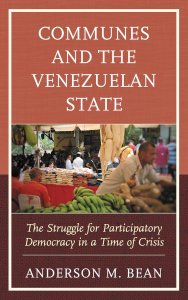
Anderson Bean’s Communes and the Venezuelan State: The Struggle for Participatory Democracy in a Time of Crisis (2022) and Venezuela in Crisis: Socialist Perspectives (2026) tell the story of the advance, retreat, and collapse of the Bolivarian process, named by Chávez after Simón Bolívar, who led the Venezuela-to-Bolivia sector of Latin America’s war of independence from Spain in the early 19th century.
Bean, a sociology lecturer at North Carolina Agricultural and Technical State University in Greensboro, travels to Venezuela frequently for professional and personal reasons and is well-connected with activists and organizations there.
Against the Current readers will find elements of Bean’s analysis familiar, as ATC has had many articles on Venezuela over the years. Bean’s books cover the arc of chavismo with the breadth and depth the topic deserves.
This review will summarize the two books and reflect on what seems to me their central lesson: Hugo Chávez tried to follow a path between capitalism and socialism, a path he called 21st century socialism. The attempt improved the lives of the Venezuelan people for a time, but in the end the intermediate path proved to be an illusion.
If Chávez had lived, Venezuela might have avoided the Maduro disaster. But socialism requires a different path: a Latin American revolution that throws off capitalism and imperialist domination and puts the working class in power — not just participatory democracy at the local level, but workers’ power from top to bottom and bottom to top.
Communes and the Venezuelan State
Communes and the Venezuelan State is a doctoral dissertation turned into a book and updated for subsequent events. For the dissertation, Bean did seven months of fieldwork in 2015 and 2016. For the update, he conducted follow-up interviews in 2020.
The introduction sets the tone for the book with an account of a visit to a commune and then proceeds to history: While the roots of the Bolivarian process go back to the Caracazo of 1989 and Chávez’s failed coup of 1992, the process formally began with Chávez’s election as president in 1999.
The Bolivarian process had three main components: 1) rewriting of the Venezuelan Constitution to include civil, political, economic, and social rights far beyond those in the U.S. Constitution; 2) redistribution of oil profits through social programs (missions) for education, food, healthcare, housing, and land; and 3) popular assemblies, including communes.
The introduction summarizes the book’s main argument:
“The construction of networks of communes and communal councils in Venezuela has achieved three important things. First, it has restructured how power is distributed and decisions are made for many Venezuelans. Second, it presents an alternative form of development to the neoliberal model. And lastly, it has enabled workers and peasants in the country to exercise a significant degree of agency in the face of neoliberal globalization.”
The introduction ends on the somber note of Venezuela’s developing crisis: “The future of the communes is very much connected to the future of the Bolivarian process. If the Bolivarian process fails, the communal movement will likely also fail.”
The four chapters from 2015-2016 describe the rise of the communes, the aspirations of the communal movement, and the alternative development model the communes represent. They discuss the challenges and limitations of the communes, struggling to survive and thrive in a capitalist state and economy.
The fifth chapter, from 2020, describes the deep economic crisis Venezuela had fallen into: unemployment, inflation, diminishing access to healthcare, food, and other basic consumer goods, poverty, malnutrition, lack of clean water and electricity, displacement, and out-migration. The communes tried to help, but the economic crisis and tension with the Maduro government limited what they could do.
The chapter identifies four interrelated causes for the crisis: 1) economic war waged by Venezuela’s rightwing opposition, 2) economic and political mismanagement by the Maduro administration, 3) U.S. sanctions against Venezuela, and 4) the larger international context, including the end of the commodities boom, the drop in oil prices, and the ebb of the Pink Tide. Venezuela in Crisis takes up these themes in a sharper fashion.
Venezuela in Crisis: Socialist Perspectives
Venezuela in Crisis consists of an introduction and afterword by Bean and 11 essays by Venezuelan socialists on the Bolivarian process and crisis. The limited space for this review and the limits of my competence lead me to focus on Bean’s contributions.
Bean’s introduction again identifies the main gains of the Bolivarian process. It reiterates that Venezuela wasn’t socialist, even under Chávez. Rather, the commodities boom of the early 2000s greatly increased the government’s revenue and “enabled Chávez to increase social spending, create various distribution programs, and improve the standard of living of the majority of Venezuelans. But this increased revenue also meant Chávez was able to increase social spending without having to confront the capitalist class in any serious way.
There was no real meaningful transformation of social property relations, no transformation of the international division of labor, and no challenge to the prerogatives of transnational capital. Importantly, there was also no break with extractivism… In fact, Venezuela’s dependence on oil exports increased during the Chávez and Maduro era, leaving the country more beholden to global financial and oil markets.
The Great Recession of 2007-2009 and the slowing of China’s economic growth burst the bubble. The prices of oil and other commodities collapsed. Chávez fell ill with cancer in 2012 and died in March 2013. As the crisis hit, Maduro was left to deal with the consequences.
Bean describes Maduro’s choice: “In a situation of newly austere state revenues, the question stood as to who would pay for the crisis: workers or capital. Almost without exception, Maduro chose the working class… Despite maintaining the socialist and anti-imperialist rhetoric of Chávez, Maduro carried out a regression and reversal.”
Bean refers to “the many ways that Maduro has contributed to the crisis through anti-worker, neoliberal programs and increasingly authoritarian measures” and describes eight of them.
Having laid this foundation, Bean introduces the Venezuelan writers whose contributions make up most of the rest of the book. As anti-capitalists, anti-imperialists, and socialists, they agree on opposing both U.S. sanctions and Maduro’s corrupt and repressive capitalist government. They differ over how to characterize the Chávez government and what shaped Maduro’s neoliberal, anti-worker policies.
As Bean puts it,
In the debate about continuity or rupture, those who emphasize the continuities (Milan, Rodríguez, Vázquez, and Márquez) tend to stress Chávez’s and Maduro’s failure to depart from a rentier model of capital accumulation and their failure to alter the inherent exploitation of capitalist social relations…
Others (García, Viloria, López, Carcione, and Gómez), while recognizing the continuation of the rentier model and capitalist relations of production, place their emphasis on the drastic ruptures, or breaks, that Chávez made with the previous governments and that Maduro made from Chavismo.
Orientation correlates with organizational affiliation. All but one of the writers is affiliated to one or more of three groups: Marea Socialista (Socialist Tide, the Venezuelan section of the International Socialist League), the Partido Socialismo y Libertad (PSL, the Venezuelan section of the International Workers Unity, unrelated to the PSL-US), and the Citizen Platform for the Defense of the Constitution (PCDC, a grouping in the milieu of the leftwing news website Aporrea.org, to which both Marea and the PSL supporters contribute).
Maria supporters are generally of the rupture persuasion, PSL supporters are generally of the continuity persuasion, and PCDC supporters are divided on the question.
Marea Socialista and the PSL were and are the most important revolutionary socialist organizations in Venezuela. As Bean relates, they came from the same previous political organization, the Party of Revolution and Socialism (PRS). Together, they built the Class Struggle, Revolutionary, and Autonomous Union Current (C-CURA), the most important rank-and-file caucus in the National Workers’ Union of Venezuela (UNT).
They parted ways over whether to join the United Socialist Party of Venezuela (PSUV), created by Chávez in 2007 to unify the left in a new governing party.
Reflections
The Venezuelan socialists who contributed to Venezuela in Crisis develop a shared position. The gains of the Bolivarian process — the political, economic and social democracy embodied in the 1999 Constitution, the redistribution of oil profits through the missions, and popular assemblies, including communes — were important and well worth defending.
The Bolivarian process was not socialist. It did not fundamentally challenge capitalist property relations or the imperialist international order. It did not break with extractivism or diversify the Venezuelan economy.
The Bolivarian process depended on high oil prices. When the 2007-2009 Great Recession and the slowing of China’s economic growth caused commodity prices to tumble, the Bolivarian process tumbled with them.
Had Chávez lived, he might have led a popular movement to make further inroads on capitalist property and defend the gains. But Chávez died in March 2013, just as the crisis broke, and Maduro chose to defend crony capitalism and corruption with repression.
The Venezuelan government turned to China and Russia to counter the pressure of U.S. imperialism, but in the end it succumbed and made a deal to maintain the degenerated post-Chávez regime without Maduro. Socialists should oppose both U.S. imperialist domination of Venezuela and the country’s corrupt and repressive capitalist government.
This consensus leaves many questions to be explored further. Here are some that particularly interest me:
1. Could Venezuela have followed a socialist path, instead of the intermediate path of the Bolivarian process? Could the workers have taken power? Could they have overthrown capitalist property and imperialist domination?
2. What councils, parties, and other class organizations would this have required? How much of an obstacle was the PSUV on this path?
3. Could an anti-capitalist, anti-imperialist revolution in Venezuela have succeeded without an anti-capitalist, anti-imperialist revolution in Latin America? Could the former have ignited the latter?
4. How do Marea Socialista and the PSL now see their parting of ways in 2007? What balance sheet do they draw of their respective experiences? Did Marea Socialista’s eight-year membership in the PSUV give it the access to Chavista militants it sought? Did the PSL’s independence give it the clarity of message it sought?
5. With the Bolivarian process having run its course, Marea Socialista and the PSL now take quite similar positions. Could they, should they, reunite?
6. What tactical orientation should revolutionary socialists adopt in post-Maduro Venezuela? What are the opportunities in the unions, the communes, and other organizations?
I look forward to discussions among Venezuelan revolutionaries and to Anderson Bean’s next book.
Source: September-October 2026, ATC 244.