
 Version imprimable
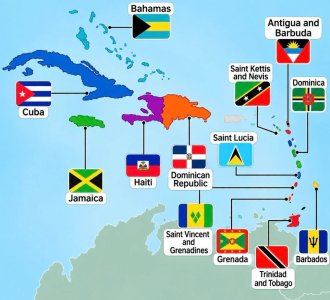
The Caribbean and American Imperialism
Since the birth of the United States as an independent, merchant-capitalist and slaveholding state in North America, the Caribbean region has been a constant target of its interventions beyond its own borders. This was the case before the Civil War (1861–65), during the period of its consolidation as an industrial power in the second half of the 19th century and once the imperialist era began in the early 20th century. Suffice it to recall the observation made in 1823 by the future president John Quincy Adams—that Cuba would eventually fall into the hands of the American Union like a piece of “fruit” dislodged by a storm; the instructions issued in 1825 by Secretary of State Henry Clay—that as long as Puerto Rico and Cuba were not ready to pass into the hands of the United States, it was preferable for them to remain under Spanish control; the attempt to annex the Dominican Republic between 1868 and 1870; and the statements made in 1891 by Secretary of State James G. Blaine—that Cuba and Puerto Rico were two territories worth “taking.”
Among other events, the imperialist era—as Lenin noted in the opening sentence of his 1916 study—was heralded by the Spanish-American War, through which the United States occupied Cuba and Puerto Rico in the Caribbean (as well as the Philippines and Guam in the Pacific). Shortly thereafter, a republic under tutelage was established in Cuba (the Guantánamo base remains under occupation to this day). Puerto Rico has been retained as a direct colony to the present day. Other interventions have followed continuously. An incomplete list includes: sponsoring the separation of Panama from Colombia (1903), further interventions in Cuba (1906, 1912, and 1917), the occupation of Haiti (1915–34), the occupation of the Dominican Republic (1916–24), the purchase of the “Danish” Virgin Islands (1917), and armed intervention in Nicaragua (1926–33). The interventions in Nicaragua and the Dominican Republic led to the establishment of new “national guards,” from which would emerge the brutal and long-lasting dictatorships of the Somoza dynasty (1937–79) and of Trujillo (1930–61).
The pattern persisted after the Second World War: the overthrow of the government of Jacobo Árbenz in Guatemala in 1954; military intervention in the Dominican Republic in 1965 to prevent the victory of constitutionalist forces (in both cases, progressive movements and governments accused of “communism”); the embargo and aggression against the Cuban Revolution from 1960 onwards; the invasion and occupation of Grenada in 1983; aggression against the Nicaraguan Revolution from 1980 to 1990; and the invasion of Panama in 1989. In short, the recent imperialist offensive in the Caribbean is a new link in an already very long chain of interventions.
The counterpart to these military aggressions is a constant and enduring economic penetration. From the 19th century and throughout the 20th century, a large portion of the region’s economies were oriented toward exporting to the United States market—often under the direct control of major North American agricultural (sugar, banana), and later, industrial and hospitality, corporations. There is nothing new in Trump referring to Venezuela’s oil as “our oil.”
Trump’s security strategy and the Caribbean
The national security strategy formulated by the Trump administration criticises its predecessors’ ambition to intervene in—and devote equal attention to—all the world’s regions, conflicts, and problems. The document argues that, in the past, there was an overestimation of the capacity to simultaneously fund the welfare state, the military apparatus, and foreign aid. Consequently, a more selective use of resources and of the capacity for imperialist intervention is required. According to this doctrine, it must be acknowledged that, in certain regions, other powers will hold predominant influence. [1]
Yet, within this perspective, the Western Hemisphere—and, by extension the Caribbean—remains the indispensable base for American imperialism. A central tenet of the Trump doctrine is the restoration of “American preeminence in the Western Hemisphere,” which entails securing control over and access to “strategically vital resources” and pushing back against “non-hemispheric competitors” (a reference to China) that have gained a foothold in recent years. One can thus discern the imperialist thread connecting the insistence on acquiring Greenland, the threats to retake the Panama Canal along with warnings against Chinese involvement in its administration, the intensification of the blockade aimed at stifling Cuba’s challenge to imperialism, and the military offensive in the Caribbean ostensibly launched to combat drug trafficking—an offensive that culminated in an operation to abduct the president of Venezuela, Nicolás Maduro, and his wife, the legislator Cilia Flores.
Military Offensive
The military offensive that would culminate in the abduction of the president of Venezuela began under the banner of combating drug trafficking. Between January and July 2025, the Trump administration designated various groups associated with drug trafficking as Foreign Terrorist Organisations or Specially Designated Global Terrorists. In July, he signed the order authorising military action against those organisations. In August, the military presence began to increase with the deployment to the Caribbean of the amphibious assault ship Iwo Jima and its accompanying vessels, including an expeditionary force of 2,200 Marines. By the end of September, there were nine warships and a nuclear-powered submarine in the area.
Attacks on boats belonging to alleged drug traffickers began on September 2 in an operation that left 11 people dead. There is no evidence that those targeted were actually drug traffickers—and even if they were, these incidents constitute extrajudicial executions. The attacks continued over the following weeks: September 15 (3 dead), September 19 (3), October 3 (4), October 14 (6), October 16 (2), October 17 (3), October 24 (6), November 2 (3), November 6 (3), November 10 (4)…and so on, until the death toll reached 210 by June 2026. In short: a true massacre on the high seas.
Throughout this entire operation, the Trump administration insisted on linking Maduro to drug cartels, suggesting that the military deployment—rather than being aimed at combating drug trafficking—was intended to bring about “regime change” in Caracas. Consequently, in mid-October, Trump announced that he had ordered preparations for attacks and operations within Venezuelan territory. A few days later, the military deployment intensified dramatically when orders were issued for the strike group led by the aircraft carrier Gerald R. Ford—the world’s largest warship, carrying over 75 aircraft of various types—to move into the area. By this point, only the most naive could have believed that the ongoing operation was merely an attempt to intercept small boats.
Meanwhile, other preparations were underway. Since November, the United States Navy has begun rebuilding parts of the facilities at the former Roosevelt Roads naval base in Puerto Rico, where equipment necessary for the planned operations is being moved. Troops sent to the region are also being quartered in Puerto Rico.
During December, the move toward an attack on Venezuela accelerates. In late November, Trump declares Venezuelan airspace closed and warns that attacks against its territory will soon begin. In mid-December, forces launched from the Gerald R. Ford seize a tanker carrying Venezuelan oil—an act of blatant piracy that clearly has nothing to do with combating drug trafficking. At the end of the month, the first bombardment of coastal installations in Venezuela takes place. On January 3, 2026, United States forces abduct the president of Venezuela, Nicolás Maduro, and his wife, congresswoman Cilia Flores.
Suffocating Cuba
Ever since the triumph of the Cuban Revolution and its transformation into a socialist revolution, destroying and dismantling it has been a constant objective of American imperialism: this example of independence—and the determination to create a society at odds with the rules of capitalism in its own Caribbean “backyard”—was, and remains, particularly humiliating for the great power to the north. Just as toppling or subduing the government of Venezuela was and is among its objectives, dealing a definitive blow to the Cuban Revolution is an equally important goal. The weapon adopted is an act of overt material aggression: an attempt to paralyse Cuban society by depriving it of access to fuel—without which no modern society can function. It is not merely a matter of prohibiting the sale of oil to Cuba by the United States or American companies; rather, it is about preventing any other country—or any company from another country—from doing so.
The first step in this strangulation strategy was to cut off the supply of Venezuelan oil—a measure to which the administration of acting president Delcy Rodríguez acceded without protest (the first in what has become a series of instances of compliance with the Trump agenda). Trump then intensified pressure on the government of Mexico, another major oil supplier to the Caribbean island. In late January, President Claudia Sheinbaum announced the “temporary” suspension of oil shipments to Cuba—an act of submission to Trump that she attempted to frame as a “sovereign decision.” The last shipment of Mexican oil arrived on January 9. In late January, shortly after Sheinbaum’s announcement, Trump signed an executive order authorising the imposition of additional tariffs on imports from countries that supply oil to Cuba.
At the same time, the Washington administration increased pressure on various countries to expel Cuban medical missions—which, in some instances, serve as a source of foreign currency for Cuba. In February, the governments of Guatemala and Honduras announced the closure of these Cuban missions, and other nations have signalled a reduction in their reliance on Cuban personnel. Meanwhile, the governments of Costa Rica, Ecuador, and the new administration in Colombia have severed diplomatic ties with Cuba, partly with the aim of currying favour with Trump.
Needless to say, a lack of electricity affects every aspect of life in a country. In Cuba, increasingly prolonged power outages have impacted the operation of water-pumping systems, the functioning of hospitals and other healthcare services (such as dialysis), the harvesting of crops, the distribution and preservation (refrigeration) of food, transportation, waste collection, conditions in schools and educational institutions, and the services offered by hotels and other lodging establishments. Foreign airlines have suspended their flights, hotels have closed, and the flow of tourism—another major source of foreign currency—has been cut by more than half. The objective is clear: to drive Cuban society into a state of paralysis and desperation that forces its government to bow to the demands of a “transition” designed in Washington (we might call this the “Delcy Rodríguez option”), or to trigger an explosion of protests that would allow for that transition to be imposed by other means.
Anti-imperialist agenda
How should this imperialist offensive be confronted? First and foremost, simplifications and false equivalencies must be avoided. The situations in Cuba and Venezuela, for instance, are not the same—nor is the nature of their respective governments—and there is no reason to adopt an identical stance toward both. Unlike Venezuela—even during the Chávez era—Cuba underwent a socialist revolution that expropriated the bourgeoisie and established a planned economy, which must be defended.
Secondly, imperialist intervention must be rejected, regardless of our stance toward the governments of the countries being attacked. The only consequence of imperialist intervention is the deepening of the exploitation of the majority, of the violence required to impose it, of subordination to imperialism, and of environmental depredation and destruction. Of course, rejecting imperialist aggression does not preclude criticising governments, including the Cuban government. Rejecting imperialist aggression entails denouncing the abduction of—and demanding the release of—Maduro and Flores, regardless, once again, of our stance toward their government.
Thirdly, the current situation has once again demonstrated that the Caribbean propertied classes lack any anti-imperialist will. Therefore, anti-imperialist resistance must be built upon the struggles of the working classes and all oppressed sectors, with complete independence from the bourgeoisie and its institutions. This independence must also extend to so-called progressive governments. Today, we see the progressive government of Mexico—and, further afield in the Caribbean, the government of Brazil—hesitating to support Cuba. They are waiting for Trump’s permission to send oil. They fail to see that what imperialism is doing to Cuba today, it will do to them tomorrow. They do not realise that by allowing Cuba’s independence to be nullified, they are paving the way for the nullification of whatever may remain of their own independence.
Fourthly, an international and internationalist response is required. If Washington coordinates with its puppet regimes in the region, then popular movements in the region must, in turn, coordinate their own efforts. If imperialism has a vision for a Caribbean defined by large corporations that exploit labor and plunder nature, it must be countered with a programme for an ecological Caribbean—a Caribbean of the people. We recently expressed some of these ideas at the International Anti-Fascist and Anti-Imperialist Conference held in Porto Alegre, which brought together nearly 5,000 participants from more than 40 countries. [2] A call was made there to organise similar conferences in various regions. Trump’s offensive adds urgency to this call. We need a major anti-imperialist and anti-fascist conference somewhere in the Caribbean, Mexico, or Central America—with the participation of movements and forces from the United States as well—that would help bring together and strengthen the ties between the various struggles in the region. As the great Puerto Rican revolutionary Ramón Emeterio Betances said in 1868: only an “agreement” among the peoples in defense of their independence would allow them to save themselves from the “American Minotaur.”
8 November 2026
Translated by David Fagan for International Viewpoint.