
 Version imprimable
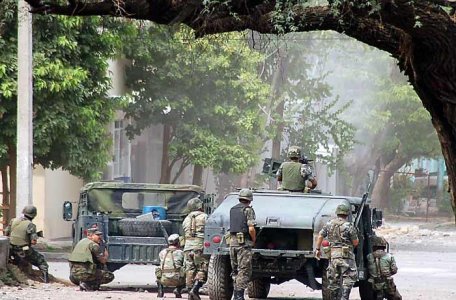
The drug lord’s death sparked a wave of violence in more than half of the country’s states, with CJNG members blocking roads and burning businesses, vehicles and gas stations, leading to the suspension of work and school activities and a lockdown of the population as in the time of the Covid-19 pandemic.
The “Narco war”
The situation of violence we are experiencing in Mexico cannot be understood without taking into account the context created by the so-called “war on drugs” launched in 2007. In December 2006, Felipe Calderón, of the Partido Acción Nacional (PAN, “National Action Party”, conservative right), became president following electoral fraud against Andrés Manuel López Obrador, a representative of progressivism. Millions of people took to the streets to denounce the fraudulent elections and demand a recount of the votes. To establish his legitimacy, Calderón announced a “war on drug trafficking” just weeks after taking office, in which he brought the military out of their barracks to confront the cartels. The message to Mexican society was clear: you have to choose your side, either you are with the government, or you are with the criminals.
Calderón’s term in office ended with a 148 percent increase in homicides, more than 17,000 people missing and 230,000 people displaced due to violence, as well as human rights violations and a security strategy based on militarization. pursued by subsequent presidents. Moreover, it has been shown that this so-called “war” was nothing more than the use of state forces to favour certain cartels to the detriment of others, since Calderón’s Minister of Public Security, Genaro García Luna, was arrested and convicted in 2024 in the United States for drug trafficking, as his links to the Sinaloa cartel were established.
Those of us who live in Mexico know that the fall of a drug lord does not mean the end of violence. The “Narco war” has taught us that after the decapitation of a cartel, power struggles ensue between interim cadres for succession, as well as acts of revenge against the Mexican state and attacks on rival cartels that will take advantage of this moment of weakness to gain influence. And this is because, even though El Mencho has fallen, the transnational structures that produce, feed and exploit these drug lords are still in place.
Capitalism and Narco, a structural problem
The major drug consumption centres and arms companies in Mexico need illegal organizations that produce the substances they consume and that are loyal buyers of their war products. Even if Washington is outraged by drug trafficking and violence, the facts show that the cartels’ weapons were sold by US companies taking advantage of that country’s permissive legislation.
Between 2012 and 2025, Mexican authorities seized 137,000 rounds of ammunition from the state-owned Lake City Army Ammunition Plant, located in Missouri, not from commercial gun shops. In addition, Mexican president Claudia Sheinbaum said that 85 percent of the weapons seized during the El Mencho operation came from the United States.
Drug trafficking is an economic activity governed by the capitalist laws of competition and the pursuit of maximum profit. Cartels are companies that, by operating illegally, push these economic dynamics to their ultimate consequences, thus highlighting the most violent form of a system that reduces human beings to mere disposable labour.
There is a strong international trade network that ensures the distribution and marketing of drugs. In addition, the cartels have diversified their activities to extend to other economic sectors, both illegal (human trafficking, arms trafficking, organ sales and racketeering) and legal (avocado agribusiness as well as the restaurant and leisure sectors).
In many areas controlled by organized crime, there are mining megaprojects, such as mines and dams, and this organized crime is involved in assaults on unionized workers, journalists, and environmental activists. A few days ago, the T-MEC group of experts revealed that the Canadian mining company Camino Rojo, which operates in the northern state of Zacatecas, had used drug traffickers to threaten workers of the National Miners’ Union after their victory in the union elections.
The socio-political power of the cartels stems from their immense economic power and the acts of violence they commit to secure their profits, such as intimidation, assassinations, enforced disappearances, money laundering, illicit enrichment through capital injections, corruption and complicity with the state security forces.
Decades of neoliberal policies have increased precariousness, migration and undeclared work, as well as rural exodus and lack of opportunities. These difficult living conditions, combined with the individualistic, meritocratic and ruthless competitive ideas promoted by neoliberalism, have led many people, especially young people, to work for organized crime in the hope of a better life.
The deregulation of international trade under NAFTA and then CUSMA (United States-Canada-Mexico Free Trade Agreements), as well as Mexico’s subordination to the great power of the north, allowed the entry of large-calibre weapons into our country and led us to become suppliers to the drug market in the United States.
Only one way out: a break with the system
It is clear that violence linked to organized crime is not an easy problem to solve. As this is a systemic phenomenon, analysing it in all its complexity is a first step and we can only remedy it through systemic changes.
On the Mexican revolutionary left, we are convinced that, while working to destroy this deadly capitalist system that engenders drug trafficking, we must always side with the victims of violence and support the initiatives that emanate from the popular classes. This is why we are in contact with the associations of mothers of missing persons and support them in their demands and mobilizations; We have also participated in demonstrations for peace and against militarization and American intervention. We believe that our priorities are as follows:
– To strengthen community ties to protect ourselves collectively from violence.
– To denounce the hypocrisy and responsibility of imperial powers such as the United States, which take advantage of the insecurity on this side of the border, both politically and economically.
– To denounce the dangers of security strategies based on the use of armed forces, because of the human rights violations they entail and the gradual transfer of political power to military power.
– To study other security strategies set up by the communities, such as the community police in the mountainous and coastal regions of the state of Guerrero (southern Mexico) or the Zapatista “caracoles”.
– To reject discourses that criminalize and stigmatize the working classes by presenting them as traffickers. Attempts by the right to link the security crisis to the so-called “loss of family values” that it attributes to advances in women’s and LGBTIQ+ rights.
– To show solidarity with the victims and their relatives, to accompany them in the actions they decide to take, to contribute to strengthening political awareness and self-confidence, and to encourage left-wing organisational processes based on demands for peace and security.
– To approach the problem from a class perspective and to help to understand it, in the absence of sufficiently in-depth analyses.
February 2026
Translated by International Viewpoint from Revue l’Anticapitaliste.