
 Version imprimable
Carnage for the people
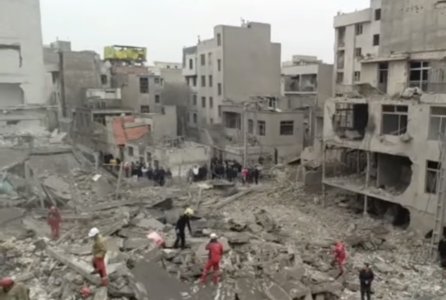
The United States and Israel are striking not only at the regime’s military and security apparatus, but also at civilian infrastructure such as seawater desalination plants and residential areas. Bombings of oil sites, refineries and oil reserves, including Tehran, are also environmental disasters. The civilian population is the first victim: there have already been more than 1,700 deaths.
In the affected cities, residents are facing shortages and soaring prices, in a context where the recent uprising bloodily crushed by the regime began over hyperinflation. Security forces impose martial order in urban areas, increasing checkpoints.
Political strengthening of regime
On the political level, the war has strengthened the position of the leadership of the Revolutionary Guards, who, despite heavy losses, has just imposed Mojtaba Khamenei as Supreme Guide to replace his father. Elected by the Assembly of Experts, Mojtaba Khamenei has long been an influential figure in the regime. Remaining in the shadow of his father Ali Khamenei, he maintains close links with the leadership of the Revolutionary Guards and is well acquainted with the internal mechanisms of power. He has played an important role in the repression of the numerous uprisings since 2009.
At the religious level, his legitimacy remains weak. Before his appointment, he was only a hojatoleslam, a relatively modest rank in the hierarchy of the Shia clergy, although he will probably be elevated to the rank of ayatollah. He has never made a public political speech and draws his influence mainly from his networks within the state apparatus as well as from his economic power. He is also known for corruption and embezzlement charges amounting to tens of billions of dollars. His appointment is above all intended to show the continuity of the regime. It remains to be seen how long he can survive and maintain this position, which will depend in part on the evolution of the war and the decisions of Washington and Tel Aviv.
Response capabilities despite losses
Militarily, the regime has suffered heavy losses, and its air defence system is largely neutralized. The Islamic Republic has never invested in the protection of civilian populations: neither shelters nor an effective warning system exists. On the other hand, significant resources have been devoted to the construction of bunkers for dignitaries of the regime and for nuclear and ballistic installations.
Despite its military weaknesses, Iran retains the capacity to retaliate and cause harm. The Revolutionary Guards have scattered missile and drone launch pads throughout the country. US bases in the region as well as Israeli cities are regularly targeted.
The Iranian regime’s strategy is to increase the economic cost of the war in order to generate pressure from Western public opinion against this intervention. Tensions around the Strait of Hormuz and attacks on Gulf oil monarchies have caused a significant rise in the price of gas and oil. The effects are already being felt in Europe and the United States with the increase in fuel prices.
The alignment of the Western powers
This situation is strongly destabilizing the region and worrying the Gulf states, which are already opposed to the Israeli-American intervention. China and Russia, despite being allies of Tehran and permanent members of the UN Security Council, remain diplomatically reserved and have not even asked for an emergency meeting of the United Nations.
European states, with the notable exception of Spain, have once again sided with Trump and Netanyahu. Macron’s decision to open French bases to US aviation, including Istres, and to “secure” navigation in the Strait of Hormuz, through which 20% of the world’s oil passes, is fraught with danger because such an action would be seen as an entry into war by Iran.
Solidarity with the peoples of the Middle East
Trump is still seeking to negotiate with some factions of the Iranian regime, but strong security pressure inside the country is preventing any dissenting expression within the government for the time being. As for Netanyahu, who is also waging a criminal war against Lebanon, his strategy is to weaken the region’s strong states and fragment them, if necessary, so that the state of Israel is the sole regional power.
In the face of this disastrous situation for the peoples of the Middle East, the forces of the social and political left must build a movement against the war and for an end to the criminal Israeli intervention in Lebanon. The struggle against imperialism is inseparable from the struggle of the peoples against dictatorships and against reactionary states.
Support for the peoples of the Middle East in the face of imperialist war and against the colonial and genocidal state of Israel is accompanied by our solidarity with the struggles against dictatorship, for the right to self-determination, social justice, equality and freedom throughout the region.
Dangerous instrumentalisation of some Kurdish forces
Six Kurdish bourgeois nationalist organizations backed by Washington and Tel Aviv have decided to join forces. This policy, if it led to an armed confrontation against the Islamic Republic of Iran, would result in brutal repression against the civilian population in Iranian Kurdistan and in violent retaliation by the Tehran regime against Iraqi Kurdistan.
In this context, the Communist Party of Kurdistan (Iran) and its Kurdish branch, the Komala, have warned against these dangerous policies that would turn the Kurds into auxiliaries of imperialism, foot soldiers of Trump and Netanyahu. This policy of collaboration with US imperialism would lead to new tragedies and betrayals of the Kurdish national movement and the legitimate aspirations of the Kurdish people.